
Why Are Governments Telling People to Prepare? The Complete 3–10 Day Emergency Survival Guide
Imagine waking up tomorrow morning to discover that the electricity has gone out. At first, you might not think much of it. You make your way to the kitchen, reach for your phone, and discover that your internet connection is down, too. Then you turn on the tap and nothing comes out. By lunchtime, the grocery store down the road has closed, debit machines have stopped working, and nobody seems entirely certain when normal services will return.
For the first few hours, this might feel like an inconvenience. After 24 hours, however, the situation begins to look very different, especially for households with children, elderly relatives, medical needs, or limited food supplies. Refrigerated food starts becoming questionable, batteries run low, and suddenly the ordinary comforts of modern life don’t seem quite so permanent. The unsettling part isn’t necessarily the idea of a catastrophic disaster. It’s realizing just how many everyday necessities depend on a surprisingly small collection of interconnected systems.
That question has become particularly relevant in late October and early November 2026, as governments across Europe renew their calls for households to prepare for disruptions lasting several days. The European Commission issued new crisis-preparedness guidance on November 3, 2026, while the United Kingdom and Netherlands launched updated public preparedness campaigns in October. Some countries recommend three days of supplies, while others encourage households to prepare for a full week or even ten days. So why are governments suddenly talking so much about emergency readiness, what exactly are they preparing for, and how much food, water, and equipment should an ordinary family actually keep at home?
The reassuring answer is that becoming better prepared doesn’t require a remote cabin, a basement full of expensive survival equipment, or a lifetime spent learning wilderness survival techniques. A sensible emergency reserve can be assembled gradually using ordinary groceries, affordable containers, basic tools, and supplies you may already have. This guide will walk through the process in detail, from calculating how many cans of food your family needs to choosing safe water containers, organizing storage space, and preparing for life without electricity or running water. By the end, you’ll have a realistic plan for keeping your household supplied for three, seven, or ten days.
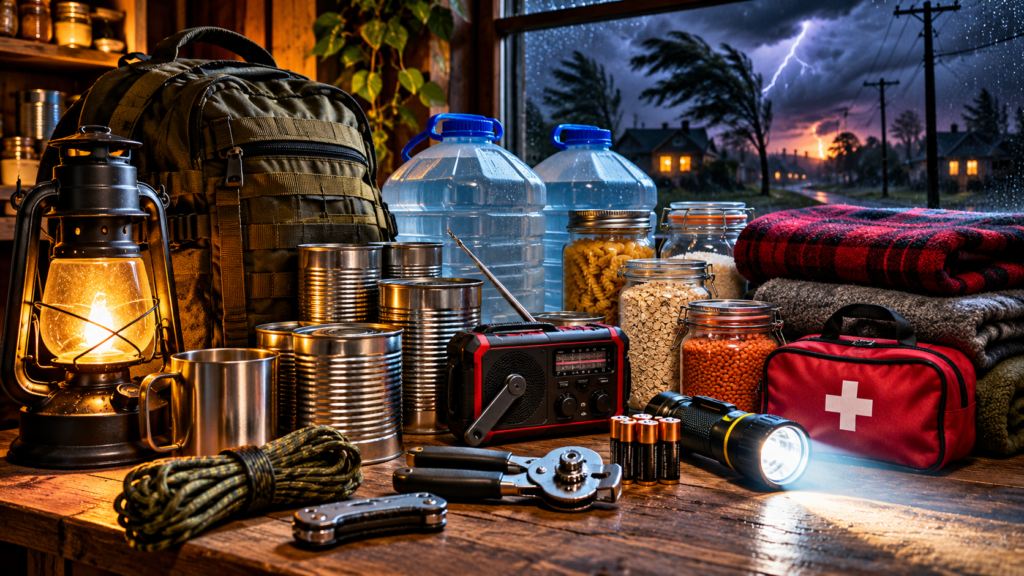
Why Are Governments Encouraging Emergency Preparedness in November 2026?
On November 3, 2026, the European Commission announced new guidelines intended to help European residents and communities prepare for emergencies, including becoming more self-sufficient during the first 72 hours of a crisis. The announcement was part of the European Union’s broader preparedness strategy, which seeks to strengthen responses to natural disasters, infrastructure problems, and other serious disruptions. It also emphasized public education, accessible emergency planning, and helping vulnerable people prepare. The official announcement can be read through the European Commission’s crisis-preparedness guidance.
Just twelve days earlier, on October 22, the United Kingdom launched its updated Be Ready campaign, encouraging households to maintain three days of food and water while taking practical steps to protect themselves during temporary disruptions. The Netherlands had launched another phase of its Denk Vooruit, or Think Ahead, preparedness campaign on October 12, emphasizing the importance of being able to manage without normal electricity, water, and internet services for 72 hours. These campaigns address different national circumstances, but the underlying message is remarkably consistent: families should not assume that normal services will always be immediately available.
Interestingly, some European countries already recommend substantially longer periods of self-sufficiency. Sweden and Norway encourage households to prepare for at least one week without essential services, while Germany’s Federal Office of Civil Protection and Disaster Assistance recommends building food and water reserves for ten days. Canada generally recommends a minimum of 72 hours, with additional supplies encouraged wherever possible. These aren’t identical standards, but together they illustrate a growing recognition that household resilience matters, particularly when emergency workers must concentrate on people who cannot safely manage on their own.
What Are Governments Actually Warning About?
It’s tempting to interpret several governments issuing preparedness reminders within a few weeks as evidence that authorities know something the public doesn’t. Add geopolitical tensions, cyberattacks, military conflicts, and extreme weather to the picture, and the imagination can quickly wander toward dramatic scenarios. Yet these recommendations are not, by themselves, evidence that a particular disaster is imminent. Emergency planning has existed for decades, and many of today’s campaigns are updates to longstanding guidance rather than entirely new warnings.
There are nevertheless good reasons why preparedness is receiving renewed attention. Severe weather can damage electrical networks, floods can contaminate drinking-water systems, cyber incidents can disrupt digital services, and major infrastructure failures can affect entire regions. Modern society is extraordinarily efficient, but that efficiency often depends on electricity, communications, transportation, and payment systems working together. A problem in one area can create unexpected difficulties elsewhere.
The practical takeaway is neither panic nor complacency. You don’t have to believe that society is on the verge of collapse to recognize the value of keeping emergency supplies at home. The same preparedness kit that helps during a major winter storm could prove useful during a prolonged power outage, evacuation, water-main failure, or temporary interruption to grocery deliveries. Preparation is most valuable when it addresses several realistic problems rather than betting everything on one imagined catastrophe.
What Does a Proper Emergency Preparedness Setup Look Like?
A good emergency setup has three distinct parts: a supply of food and water for remaining at home, a collection of essential equipment for managing without normal services, and a portable bag that can be grabbed quickly if evacuation becomes necessary. Keeping everything in one enormous storage bin might seem convenient, but it creates problems when the container becomes too heavy to move or essential supplies are buried beneath other equipment. A better approach combines a small, accessible grab-and-go kit with clearly organized household reserves.
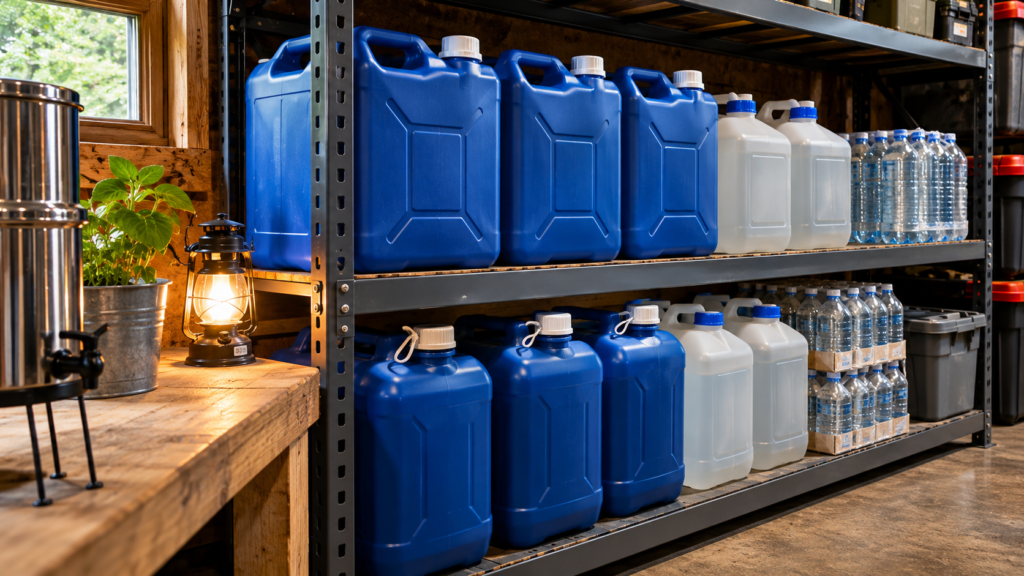
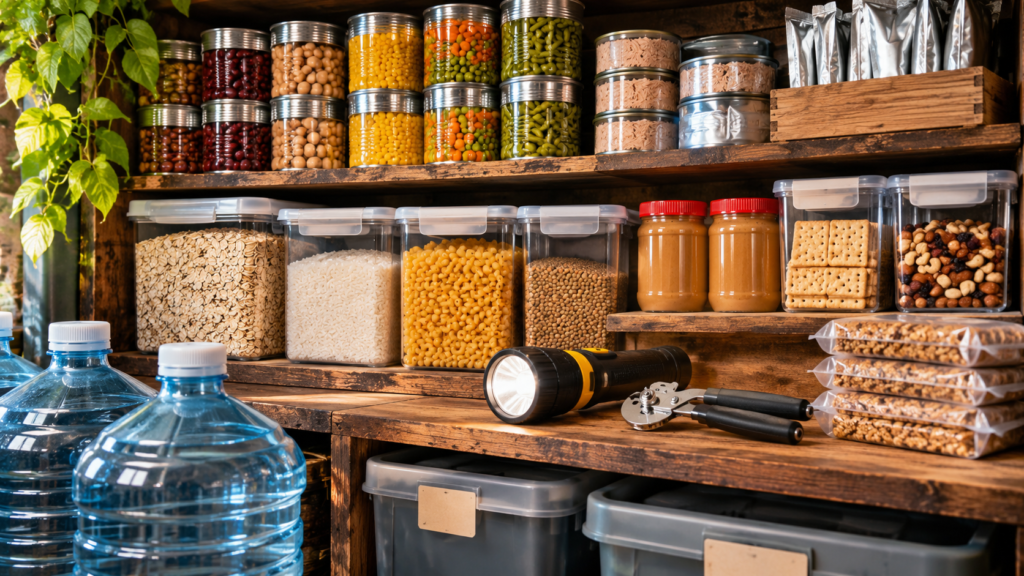
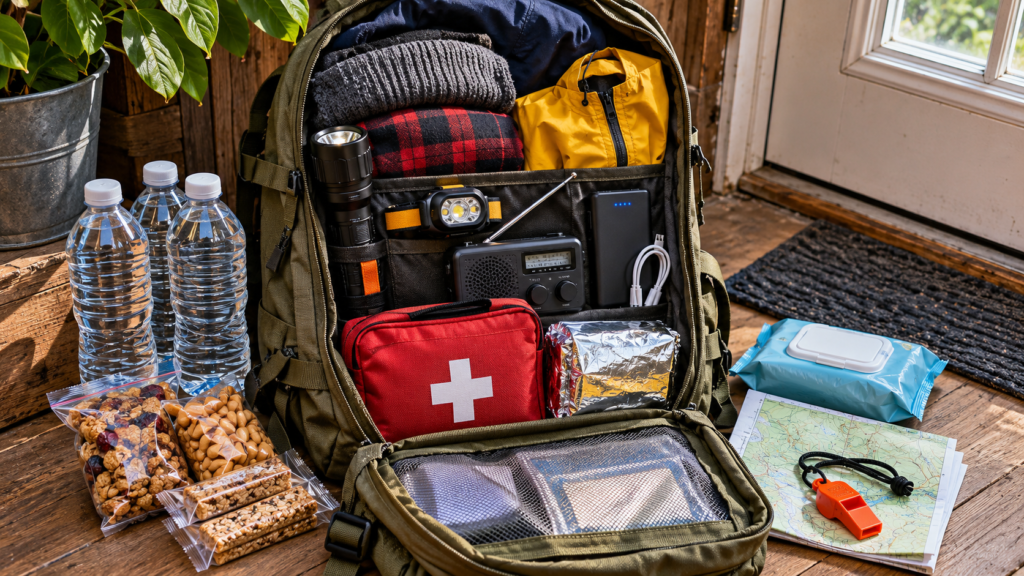
The following examples illustrate three useful elements of that system: dedicated water storage, a rotating emergency pantry, and a portable evacuation backpack. Notice that none requires expensive specialized survival equipment; the emphasis is on safe storage, useful supplies, and keeping everything accessible.
How Many Days Should Your Family Prepare For?
The first decision is how long you want your emergency supplies to last. Three days is a useful minimum and a reasonable starting point for households building their first emergency kit. Seven days provides a larger margin for disruptions that take longer to resolve, while ten days offers additional flexibility and is consistent with Germany’s household stockpiling recommendation. None of these periods guarantees that emergency services will arrive by a particular deadline, but they provide practical planning targets.
For most households, seven days is an excellent goal. It is long enough to be meaningful without requiring an entire room devoted to stockpiling, and the supplies can be built up gradually rather than purchased in one expensive shopping trip. Once you’ve assembled a seven-day reserve, expanding it to ten days is largely a matter of adding extra food, water, medication, and consumables. The important thing is to begin with a realistic target instead of becoming overwhelmed by everything you might eventually want.
How Much Water Does Your Family Need?
Water is arguably the most important component of any household emergency supply. A person might be able to stretch their food reserves by eating smaller portions for a short period, but drinking water is far less negotiable. You also need water for preparing certain foods, brushing teeth, basic hygiene, and some medical requirements. If a disaster damages your water system or causes officials to issue a drinking-water advisory, the water coming from your taps may no longer be suitable for normal use.
Ontario recommends planning for approximately four litres of water per person per day in an emergency kit, a useful figure for household calculations. That amount covers drinking and limited other essential uses, not ordinary showers, laundry, or unrestricted household consumption. People who are pregnant, nursing, unwell, physically active, or exposed to high temperatures may require additional drinking water. Pets, infants, and some medical equipment also need to be accounted for separately.
Emergency Water Requirements by Household Size
| People | 3 days | 7 days | 10 days |
|---|---|---|---|
| 1 | 12 L | 28 L | 40 L |
| 2 | 24 L | 56 L | 80 L |
| 3 | 36 L | 84 L | 120 L |
| 4 | 48 L | 112 L | 160 L |
| 5 | 60 L | 140 L | 200 L |
| 6 | 72 L | 168 L | 240 L |
A family of four preparing for seven days should therefore aim for at least 112 litres of stored water under this planning method. That might initially sound excessive, but the quantity becomes more manageable when divided among several containers. Six properly filled 20-litre containers would provide 120 litres, slightly exceeding the target, although each full container would weigh approximately 20 kilograms before accounting for the container itself. Twelve 10-litre containers would be easier to lift individually, and a combination of larger jugs and small bottles could offer the best balance of storage efficiency and portability.
It’s also worth remembering that different governments use different water-planning assumptions. Norway, for example, recommends storing approximately 20 litres per person for one week as a minimum household drinking-water reserve, while Ontario’s four-litre daily recommendation results in 28 litres over the same period. These figures aren’t necessarily contradictory; they reflect different assumptions about minimum requirements and other uses. For this guide, the four-litre calculation offers a practical starting point, but households should always increase their reserve when individual circumstances demand it.
Where Can You Buy Emergency Water Containers?
You don’t need to purchase an expensive commercial survival-water system to store a useful reserve. Camping stores, outdoor-equipment retailers, hardware stores, farm-supply outlets, and some big-box retailers commonly sell containers designed for transporting and storing drinking water. Search for terms such as food-grade water jerry can, 10-litre drinking-water container, 20-litre potable-water storage container, or food-grade HDPE water container. Many people find that several 10- or 20-litre jugs are easier to manage than a single large barrel, particularly when storage space is limited.
Whatever you purchase, confirm that the container is specifically intended for potable water or food contact. Look for clear manufacturer information about the material, intended use, lid, and cleaning requirements rather than relying solely on its colour or appearance. Containers with secure caps and manageable handles are particularly convenient, while a tap or spigot can make dispensing easier if the design can be cleaned properly. Never reuse containers that previously held fuel, pesticides, cleaning chemicals, or other potentially hazardous materials, even if they appear clean.
Should You Filter Tap Water Before Storing It?
This is one area where preparedness advice can become unnecessarily complicated. If your municipal tap water is already safe to drink, you generally don’t need to run it through a wilderness filter before putting it into properly cleaned, food-grade storage containers. In fact, a filtration device does not automatically improve the safety of already potable water, and it may introduce contamination if the equipment is poorly maintained. The essential requirements are a safe initial water source, a properly prepared container, a secure lid, and suitable storage conditions.
Begin by cleaning and sanitizing reusable containers according to the manufacturer’s instructions and recognized public-health guidance. Fill them with cold, potable tap water, close them securely, and label each container with the filling date. Store them in a cool, dark location away from gasoline, pesticides, cleaning supplies, direct sunlight, and freezing temperatures. The U.S. Centers for Disease Control and Prevention recommends replacing home-filled emergency water every six months, while commercially bottled water should be rotated according to its label and applicable guidance.
What About Rainwater, Rivers, and Natural Water Sources?
This is where bushcraft knowledge becomes useful, but it is important to distinguish between storing known-safe water and treating an uncertain natural source. Rainwater collected from a roof, water from a pond, or water taken from a nearby river may contain microorganisms, chemicals, animal waste, or other contaminants. A camping filter can be useful for certain biological hazards, but different filters remove different substances, and an ordinary outdoor filter should never be assumed to remove viruses, dissolved chemicals, fuel, or industrial contamination. The actual treatment required depends on what is wrong with the water.
If officials issue a boil-water advisory, follow the specific instructions from your local water authority. For microbiologically unsafe water where boiling is appropriate, public-health guidance generally recommends bringing clear water to a rolling boil for one minute, with longer boiling required at high elevations. However, boiling does not make chemically contaminated or radioactive water safe, and neither does adding an ordinary water-purification tablet. The best emergency strategy is to store safe drinking water first, keep appropriate treatment supplies as a backup, and use natural sources only when their risks can be properly evaluated.
Exactly How Much Emergency Food Should You Store?
Food is where many emergency preparedness guides become frustratingly vague. It’s easy to tell someone to keep seven days of non-perishable groceries, but that doesn’t explain how many cans to purchase, whether a couple of boxes of crackers are enough, or what to do if the stove stops working. For a useful emergency plan, you need to think in terms of calories, familiar foods, preparation requirements, and how easily everything can be stored. A cupboard containing 50 cans of low-calorie vegetables might look impressive, but it wouldn’t necessarily provide enough energy to sustain a household for very long.
As a starting point, consider approximately 2,000 calories per day for an illustrative adult food plan, adjusting for age, body size, activity, and medical needs. This is not a universal nutritional requirement, and some adults will need substantially more while others need less. For seven days, the illustrative target becomes 14,000 calories per adult, ideally with some extra food available for unexpected delays or increased activity. The easiest approach is to combine shelf-stable staples with canned proteins, fruits, vegetables, and foods that can be eaten without cooking.
A Practical 3-, 7-, and 10-Day Food Supply for One Adult
The following is an example shopping template, not a prescribed diet. It assumes ordinary retail-sized cans, ready-to-eat foods, and a mix of high-calorie staples. Calorie counts can differ dramatically among brands and package sizes, so shoppers should verify the actual total using nutrition labels.
| Food item | 3 days | 7 days | 10 days |
|---|---|---|---|
| Canned beans or chickpeas | 3 cans | 7 cans | 10 cans |
| Canned fish or chicken | 3 cans | 7 cans | 10 cans |
| Canned vegetables | 3 cans | 7 cans | 10 cans |
| Canned fruit | 3 cans | 7 cans | 10 cans |
| Rolled oats | 300 g | 700 g | 1 kg |
| Peanut butter or suitable alternative | 250 g | 500 g | 700 g |
| Crackers or crispbread | 250 g | 500 g | 750 g |
| Energy or granola bars | 6 | 14 | 20 |
| Nuts or trail mix | 200 g | 400 g | 600 g |
| Total cans | 12 | 28 | 40 |
Using representative calorie values, the seven-day column provides roughly 16,000–17,000 calories, leaving some flexibility above the illustrative 14,000-calorie target. That makes it a fairly substantial emergency food reserve without requiring hundreds of cans for a single person. However, the result depends on what you actually buy: a small can of tuna and a large can of beans are not interchangeable sources of energy. Ready-to-eat meals, soup, shelf-stable milk, dried fruit, additional nuts, and other familiar foods can be substituted when their nutrition and preparation requirements are taken into account.
There’s also no rule requiring every household to stockpile fish, peanut butter, or any particular product. Someone with a peanut allergy should obviously choose another safe high-energy food, while a vegetarian household could use additional beans, lentils, ready-to-eat grain products, or other shelf-stable protein sources. Parents should account for children’s usual diets, and anyone with diabetes, kidney disease, swallowing difficulties, food allergies, or other medical requirements should tailor their supplies accordingly. The purpose of this table is to make planning tangible, not to suggest that everyone’s nutritional needs are identical.
How Much Food Does That Mean for an Entire Family?
The easiest conservative calculation is to multiply the seven-day adult example by the number of adult-equivalent food portions you need. If your household consists entirely of adults, this multiplication provides a straightforward shopping target. Children will often need different quantities, and families can refine their list using the food each household member normally consumes. Even so, planning enough adult-sized portions for everyone is a simple starting method when you want some extra capacity.
| Adult-equivalent portions | Cans for 7 days | Energy bars | Water for 7 days |
|---|---|---|---|
| 1 | 28 | 14 | 28 L |
| 2 | 56 | 28 | 56 L |
| 4 | 112 | 56 | 112 L |
| 5 | 140 | 70 | 140 L |
| 6 | 168 | 84 | 168 L |
For example, a household planning four full adult-equivalent food portions for one week would store approximately 112 assorted cans, 2.8 kilograms of oats, 2 kilograms of peanut butter, 2 kilograms of crackers, 56 energy bars, and 1.6 kilograms of nuts or trail mix. Alongside that food, the household would aim for approximately 112 litres of emergency water. This is a significant amount of inventory, but it is also a clear target that can be spread across several grocery trips. Because family members have different needs, the final shopping list should always be checked against real menus, food preferences, and the calorie information printed on the packages.
What Would You Actually Eat During Those Seven Days?
A sensible emergency pantry should contain food that people recognize and are willing to eat. Breakfast might consist of rolled oats prepared with safe water, peanut butter, and some canned fruit. Lunch could include crackers with canned fish or beans, followed by a snack bar or handful of trail mix. Dinner might involve chickpeas, vegetables, and shelf-stable bread or another convenient ready-to-eat meal, with extra nuts or crackers helping meet daily energy needs.
The key is selecting foods that do not depend on a functioning refrigerator, freezer, electric stove, or lengthy cooking process. Canned beans, fish, fruits, and vegetables are generally ready to eat once opened, provided the packaging is intact and the food has been stored safely. Rolled oats can be softened with safe cold water, while crackers, nut butter, and energy bars require no preparation. If you have a safe and permitted outdoor cooking arrangement, your menu can become more varied, but the core emergency food reserve should remain usable without one.
Where Should You Store All These Supplies?
Once you’ve purchased enough supplies, organization becomes almost as important as quantity. There’s little value in owning 100 cans of food if half are scattered through different cupboards and nobody remembers what was purchased or when. A practical solution is to designate one area of the home for emergency supplies while allowing regularly used pantry items to remain in normal rotation. A basement storage room, interior closet, pantry, or other cool, dry location can work well, provided it is protected from flooding, pests, temperature extremes, and chemical contamination.
For most homes, a set of sturdy shelves works better for food than placing everything in a single massive plastic bin. Cans are heavy, and shelves make it easier to see labels, inspect packaging, and rotate older stock toward the front. Food-grade airtight containers can protect dry foods from insects and moisture, although products should retain their original packaging information or have the contents and dates clearly recorded. Heavy water containers should sit low, ideally on a stable surface that can support their weight without risk of tipping or damaging the structure.
The Two-Bin Emergency Organization System
One inexpensive approach is to use two medium-sized, clearly labelled plastic storage bins in addition to your regular pantry shelves and separate water reserve. The first bin contains equipment and consumables you aren’t likely to use every day, such as flashlights, spare batteries, a battery-powered radio, sanitation bags, disposable gloves, emergency blankets, and a small first-aid kit. The second holds portable supplies and backup necessities that can be collected quickly, including a manual can opener, packaged food, spare charging cables, personal hygiene products, and practical household tools. Any urgently needed medication or personal medical equipment should remain accessible according to its storage requirements, rather than being buried in a sealed container.
The advantage of separating equipment from food storage is that you can inventory each category without dismantling your entire setup. Every six months, inspect your supplies, check dates, test batteries, verify that flashlights and radios work, and replace anything damaged or no longer suitable. Use older groceries during normal meals and replace them with newly purchased items placed toward the back of the shelf. This method turns emergency preparedness into a manageable household routine instead of a collection of forgotten supplies gathering dust.
Essential Equipment Beyond Food and Water
A household can have plenty of canned food and still be poorly prepared for an emergency. Imagine having seven days of meals but no manual can opener, no way to see after dark, and no reliable means of receiving official updates. The best emergency equipment addresses specific practical needs rather than simply looking impressive in a survival kit. Many of the most useful items are inexpensive and already common around the home.
A well-equipped emergency setup should include:
- Lighting: LED flashlights, headlamps, spare batteries, and a battery-powered lantern.
- Communication: A battery-powered or hand-crank radio, charged power banks, compatible charging cables, and a paper list of important telephone numbers.
- Medical supplies: A properly stocked first-aid kit, needed prescription medications, personal medical equipment, and spare essential consumables where available.
- Food preparation: A manual can opener, utensils, a small cutting tool for ordinary household tasks, and safe containers for preparing or serving meals.
- Sanitation: Toilet paper, soap, hand sanitizer, wet wipes, garbage bags, menstrual products, and disposable gloves.
- Warmth and shelter: Blankets, warm clothing, sleeping bags, rain protection, and appropriate footwear.
- Documents and money: Copies of identification, insurance information, prescriptions, emergency contacts, and some cash in small denominations.
- Household safety: Working smoke and carbon monoxide alarms, an appropriate fire extinguisher, and knowledge of how to shut off utilities when directed.
A practical emergency kit also needs to account for people whose needs are not covered by a generic checklist. Babies may require diapers, formula, feeding supplies, and extra clothing, while older adults may depend on medications, mobility equipment, or assistance with everyday activities. Pet owners should store appropriate food, water, leashes, carriers, and medications for their animals. Anyone who uses electrically powered medical equipment should establish an individualized backup-power and relocation plan with their healthcare provider rather than assuming a small consumer battery bank will be sufficient.
How Do You Survive a Prolonged Power Outage?
Electricity affects far more than lighting. In many homes it supports heating, water pumps, refrigeration, internet connections, cooking equipment, and even certain methods of communication. When the power goes out, the immediate priority is to determine whether the outage is local or widespread, check for official warnings, and protect anything that could create an additional safety hazard. Keep refrigerators and freezers closed as much as possible, preserve phone batteries, and use LED lighting rather than relying on open flames.
Food safety becomes a particular concern during lengthy outages. Health Canada advises that an unopened refrigerator generally keeps food cold for about four hours, while a full unopened freezer may maintain frozen food for approximately 48 hours and a half-full freezer for roughly 24 hours. These times are guidelines, not guarantees, because room temperature, appliance condition, and the food’s actual temperature all matter. A refrigerator or freezer thermometer can help you judge conditions, and perishable foods that have remained too warm for too long should be discarded rather than tasted to determine whether they are safe.
Cold-weather emergencies introduce another problem: maintaining a safe indoor temperature. Insulating windows, closing unnecessary rooms, wearing layered clothing, and using blankets can help conserve warmth, but these measures have limits. Families in cold climates should identify a reliable alternative place to stay if their home becomes dangerously cold, especially when children, older adults, or medically vulnerable people are involved. A properly installed and maintained heating system designed for indoor use may provide backup heat, but improvised heating methods are often far more dangerous than people realize.
Never operate a portable gasoline generator, charcoal barbecue, camping stove, or other outdoor fuel-burning equipment inside a home, garage, shed, or enclosed space. Carbon monoxide is invisible, has no smell, and can become fatal without obvious warning. Canadian federal guidance recommends keeping portable fuel-burning generators at least six metres, or approximately 20 feet, away from buildings, directing exhaust away from openings, and never connecting a generator to household wiring without an approved transfer system installed by a qualified electrician. Using a gas stove or barbecue to heat a room is not a safe substitute for proper indoor heating.
What Happens If the Water Stops Running and Toilets Cannot Be Flushed?
This is one of the least glamorous aspects of emergency planning, which is probably why it gets overlooked so frequently. People naturally concentrate on food, flashlights, and survival tools, but an extended water or sewer interruption can turn sanitation into a serious problem within a day or two. Drinking water needs to be protected from contamination, hands still need to be cleaned, and human waste must be handled without introducing additional health risks. A few inexpensive household supplies can make these situations substantially easier to manage.
Start by keeping soap, hand sanitizer, disposable gloves, toilet paper, wet wipes, and heavy-duty waste bags in your emergency supplies. If the local sewer system is damaged or authorities instruct residents not to flush, don’t assume pouring stored water into the toilet is safe. A sturdy portable camping toilet or suitable bucket with a secure lid and disposable liners can provide a temporary option, but waste containment and disposal should follow local public-health instructions. Keep waste away from food and drinking-water supplies, and prioritize proper hand hygiene after every use.
For many households, sanitation is a more realistic reason to expand beyond a bare-minimum three-day reserve than any dramatic survival scenario. A few extra waste bags, cleaning materials, and hygiene supplies take up relatively little storage space. They also reduce the temptation to use precious drinking water for purposes that could be handled another way. If stored water becomes scarce, protecting it from contamination is just as important as rationing it sensibly.
Shelter at Home or Evacuate? Why You Need Two Different Plans
Not every disaster is something you should remain at home and endure. During certain severe storms, staying indoors may be the safest choice, while a wildfire, flood, structural emergency, or official evacuation order can require leaving immediately. That distinction is important because a seven-day household supply is not the same thing as a portable evacuation kit. Nobody wants to discover that their carefully prepared emergency supplies are too heavy to carry when they need to leave.
Your primary household reserve should be designed for sheltering safely at home, with water containers, pantry supplies, and equipment stored in accessible places. Separately, every household should have at least one lightweight evacuation bag containing the most important items for travelling to a safer location. A backpack near an exit is usually much more practical than a large plastic storage bin. It should be checked periodically, especially when seasons change or medications, contact information, and clothing sizes need updating.
A useful grab-and-go bag includes identification, emergency contact details, essential medications, a small first-aid kit, appropriate clothing, water, compact food, a flashlight, a power bank, basic hygiene supplies, and any necessary child or pet equipment. The contents should reflect how the family expects to travel, because carrying several days of water and food on foot may be unrealistic. Keep a separate supply of emergency items in your vehicle if practical, including seasonal equipment and a means of staying warm while waiting for assistance. Never allow the existence of a home emergency kit to delay evacuation when local authorities instruct residents to leave.
Make a Family Emergency Communication Plan
Supplies are useful, but they cannot replace a plan for finding and communicating with the people who matter most. Consider what happens if an emergency occurs while one parent is working, another is travelling, and children are at school. Decide in advance who is responsible for collecting children, where household members should meet if they cannot return home, and which trusted contact everyone should attempt to reach if local communications fail. Write down important information because mobile phones and online accounts may not be accessible when you need them.
Families should also understand local emergency alerts, evacuation routes, and hazards particular to their region. Someone living near a river may need a flood evacuation plan, while someone in a forested area may need to pay closer attention to wildfire warnings. Residents in areas with severe winter weather should consider the possibility of blocked roads, heating failures, and delayed deliveries. Good preparedness is fundamentally local, even when international news is what first motivates someone to begin.
How Much Does It Cost to Build a Seven-Day Emergency Kit?
A complete household reserve can look expensive when all the supplies are listed together, but the cost depends heavily on what you already own. Most people have some non-perishable food, spare blankets, kitchen utensils, batteries, medications, and storage containers available. Rather than purchasing a heavily marketed emergency survival package, begin by taking inventory of your existing supplies. You may discover that the biggest gaps are water storage, a reliable radio, a power bank, and a modest collection of additional groceries.
The smartest shopping strategy is to purchase familiar products when they’re discounted and build the reserve in stages. Canned beans, vegetables, fruit, oats, crackers, and other shelf-stable groceries frequently appear in ordinary supermarket promotions. Food-grade water containers may be available at hardware or camping stores, while storage bins and shelving can often be found second-hand. There is little reason to pay premium prices for supplies that serve exactly the same function as affordable, everyday alternatives.
A sensible four-stage approach would be:
- Stage 1: Assemble the essentials for 72 hours, starting with drinking water, ready-to-eat food, essential medication, lighting, and a manual can opener.
- Stage 2: Increase supplies to seven days, filling in food categories, water containers, hygiene supplies, and charging equipment.
- Stage 3: Improve organization and safety with sturdy shelving, labelled storage, a reliable radio, a first-aid kit, and a family emergency plan.
- Stage 4: Expand toward ten days if desired, accounting for additional water, consumables, seasonal conditions, and personal circumstances.
An advantage of this gradual approach is that nothing needs to sit untouched indefinitely. Your emergency pantry can overlap with ordinary household groceries, provided you maintain enough food to meet your preparedness target. Replacing a can of beans after using it for dinner is easier than discarding an entire prepackaged emergency food kit when its shelf life expires. Preparedness becomes more affordable when supplies are part of the household’s normal food rotation rather than a separate collection that nobody ever uses.
What About Long-Term Survival, Bushcraft, and Off-Grid Living?
There is a fascinating overlap between emergency preparedness, homesteading, and traditional bushcraft skills. Someone who knows how to maintain a wood-burning stove safely, repair ordinary household equipment, preserve food, grow vegetables, or navigate without a smartphone already possesses useful forms of self-reliance. A household with experience collecting rainwater for gardening, maintaining hand tools, and managing food storage may find it easier to adapt when normal services are temporarily unavailable. These skills don’t eliminate the need for a properly prepared emergency kit, but they can make people more resourceful.
The distinction is that short-term emergency preparedness should focus on the needs most likely to arise in the first few days. Learning to forage, build a shelter from natural materials, or collect food from the wilderness may be interesting recreational pursuits, but none is a reliable substitute for stored drinking water and ready-to-eat groceries during a winter blackout. Wild foods are seasonal, harvesting may be restricted by law, and mistakes involving plant identification or untreated water can make an emergency considerably worse. For the ordinary household, a dependable pantry beats a complicated wilderness survival plan.
Longer-term resilience can still be a worthwhile goal once the essentials are covered. Gardening, preserving food safely, improving insulation, maintaining practical tools, and developing neighbourly relationships all create benefits during ordinary life. A rainwater collection system might reduce dependence on municipal water for gardening, while a properly designed backup-power arrangement could support essential electrical loads during an outage. These projects should be approached with the same attention to safety and maintenance as any other household system.
Are Governments Overreacting, or Is Emergency Preparedness Becoming Essential?
There is a reasonable skeptical argument that emergency preparedness campaigns can sometimes sound more alarming than their actual recommendations justify. Governments have encouraged citizens to maintain basic supplies for many years, and a renewed publicity campaign does not necessarily indicate that officials believe a major disaster is approaching. Dramatic headlines can blur the distinction between preparing for a familiar winter storm and preparing for a geopolitical catastrophe. People should be cautious about sensational claims suggesting that routine preparedness advice proves some hidden event is about to occur.
On the other hand, the benefits of basic preparedness are difficult to dispute. Severe storms, extended power failures, floods, major wildfires, contaminated water supplies, and other disruptions have affected communities across the world. Emergency workers cannot necessarily restore every service or deliver supplies to every household immediately, particularly when a large area is affected. Having the means to manage for several days provides both practical security and breathing room while authorities deal with the larger situation.
Perhaps the most important point is that preparedness doesn’t have to become an obsession. You don’t need to spend every weekend researching the latest survival gadgets or imagining increasingly improbable disasters. A sensible seven-day reserve, kept clean and properly maintained, will address many short-term scenarios without occupying your entire home or budget. The goal is to reduce dependence on services during a temporary disruption, not to attempt complete independence from modern society.
The Final Emergency Preparedness Checklist
Before considering your household ready, review the following essentials and make sure the supplies are accessible, appropriate for your family, and in usable condition.
- Enough safe drinking water for every household member, calculated at approximately four litres per person per day.
- At least three days of suitable food, ideally expanded to a seven-day reserve.
- A verified food inventory with enough calories, ready-to-eat options, and a manual can opener.
- Clean, food-grade water containers stored away from heat, light, chemicals, and freezing conditions.
- Flashlights, spare batteries, a portable radio, and working phone power banks.
- Essential medications, first-aid supplies, and appropriate medical backup arrangements.
- Toilet paper, soap, hand sanitizer, waste bags, and a sanitation plan.
- Blankets, seasonal clothing, and a safe plan for dealing with extreme indoor temperatures.
- A portable emergency backpack for evacuation.
- Printed emergency contacts, copies of important documents, and some cash.
- Adequate supplies for pets, infants, or anyone with additional support needs.
- A family communication plan, local evacuation information, and a schedule for checking and rotating supplies.
Final Verdict: You Don’t Need to Expect Disaster to Be Ready for One
The recent wave of emergency preparedness announcements is certainly worth paying attention to. In October and November 2026, governments in several countries have renewed their emphasis on household readiness, while others continue encouraging families to maintain supplies lasting a week or longer. That doesn’t mean an extraordinary catastrophe is necessarily around the corner, and it certainly isn’t a reason to panic-buy everything from the nearest supermarket. It does, however, offer a useful reminder that even highly developed societies remain vulnerable to disruptions in services we normally take for granted.
For an ordinary household, a practical goal is simple: start with 72 hours of essential supplies, gradually extend that reserve to seven days, and consider ten days if your circumstances and storage space allow. Calculate your water requirements based on household size, choose familiar foods that provide enough calories, keep essential equipment accessible, and establish a clear plan for emergencies that require evacuation. Store everything properly, rotate your supplies, and make sure the people living in your home know where to find what they need. The best emergency preparedness system is not necessarily the biggest or most expensive one, but the one that is organized, maintained, and ready to use.
Perhaps that’s the real lesson behind the headlines. Preparedness isn’t about assuming the worst will happen tomorrow; it’s about recognizing that life can change unexpectedly and taking reasonable steps to protect the people who depend on you. A few containers of clean water, a well-stocked pantry, an accessible emergency bag, and a thoughtful family plan may not seem particularly dramatic. But when normal services disappear, even temporarily, those ordinary preparations can make an extraordinary difference.