
5 Outdoor Skills Every Man Should Learn Before Modern Life Makes Them Obsolete
Modern life has created a strange contradiction. Humanity has access to more technology than ever before, yet many people have never felt more disconnected from basic competence. A dead phone battery can ruin an entire day. GPS fails and people panic. A power outage suddenly makes modern homes feel fragile. Even simple outdoor discomfort — cold rain, darkness, being wet for too long — can overwhelm people who otherwise function perfectly well in climate-controlled environments.
That is one reason outdoor skills continue to fascinate people. Beneath all the gadgets, conveniences, and endless digital noise, there is still something deeply satisfying about knowing how to handle yourself outdoors. Bushcraft and survival skills are not only about emergencies. They are about confidence. They are about reducing dependence. They reconnect people with older forms of competence that human beings relied on for thousands of years before modern infrastructure existed.
The internet sometimes turns these skills into fantasy entertainment. You see thumbnails of people “surviving alone forever” in forests with tactical gear that costs more than a used car. That kind of content can be entertaining, but it often misses the deeper point. Real outdoor competence is usually quieter, simpler, and far more practical. It is understanding how to stay warm, how to stay dry, how to stay calm, and how to think clearly when conditions stop being comfortable.
The interesting part is that many experienced outdoorsmen say these skills affect the mind as much as the body. Learning how to make a fire in bad conditions changes the way a person reacts to stress. Learning how to navigate without blindly trusting technology changes awareness. Learning how to create shelter or process wood efficiently creates a kind of grounded confidence that modern life rarely teaches.
These are not skills reserved for hardcore survivalists. They are useful for hikers, campers, hunters, homesteaders, travelers, and ordinary people who simply want to feel more capable. In a world increasingly built around convenience, competence itself becomes valuable.
Why Outdoor Skills Still Matter
There is a tendency to assume modern systems will always function perfectly. Grocery stores will always be stocked. GPS will always work. The power grid will always stay online. Roads will always remain accessible. Most of the time, those assumptions are reasonable. But history repeatedly shows that systems fail more often than people expect.
Storms knock out power. Wildfires force evacuations. People get lost on ordinary hikes. Vehicles break down in remote areas. Phones lose signal. Floods isolate communities. None of these situations require Hollywood-style apocalypse scenarios. They are normal disruptions that happen every year.
Outdoor skills matter because they reduce fragility. A person who knows how to stay warm, purify water, orient themselves, and remain calm outdoors has options that others do not. That does not mean they are invincible. It means they are harder to overwhelm.
There is also a psychological component people rarely discuss honestly. Many modern environments disconnect people from direct problem-solving. Work often becomes abstract. Entertainment becomes passive. Daily life becomes heavily mediated through screens. Outdoor skills restore direct feedback between action and consequence. Either the fire starts or it does not. Either the shelter blocks wind or it does not. Either you prepared correctly or you suffer for it.
That kind of feedback sharpens people.
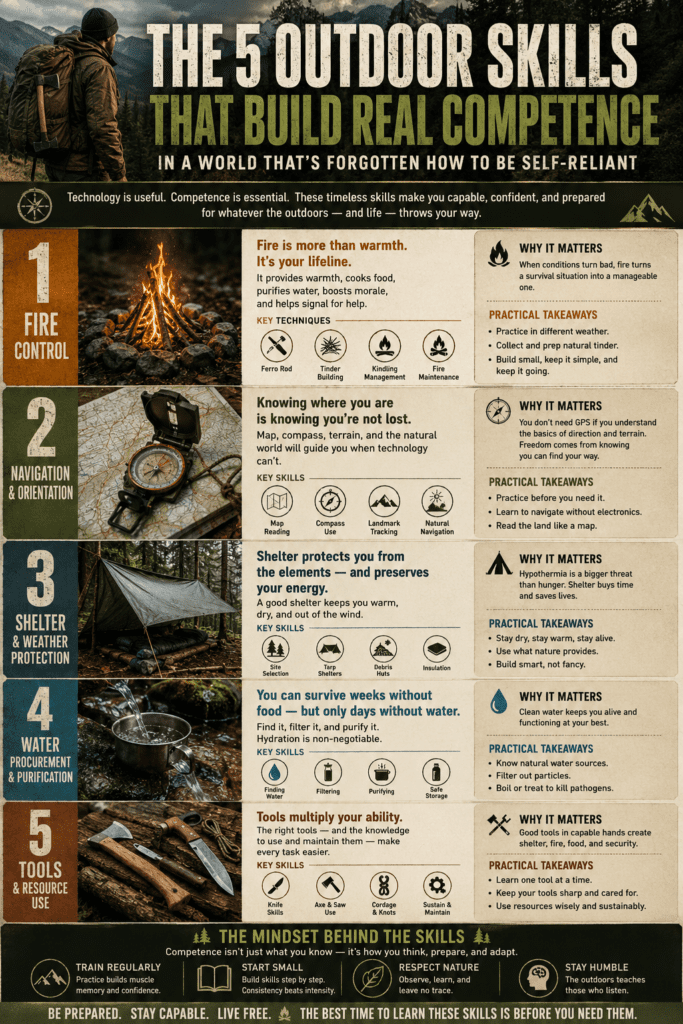
Before diving into the five major skills, it helps to understand what practical outdoor competence actually looks like. It is not about carrying the most expensive gear. It is about understanding systems: heat, water, shelter, movement, and tools.
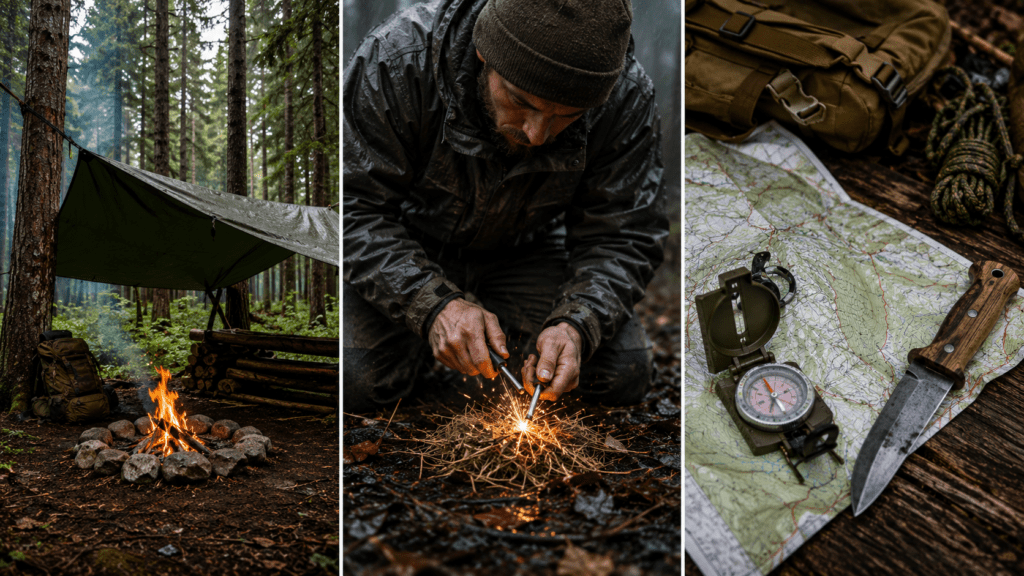
Here are some visuals that capture the atmosphere and practical reality behind modern bushcraft and self-reliance skills.
Skill #1 — Fire Starting
Fire changes everything outdoors. It provides warmth, light, dry clothing, morale, cooked food, safer water, and psychological stability. People underestimate the emotional effect of fire until they spend a cold, wet evening outdoors without one.
The mistake beginners make is assuming fire-starting is easy because lighters exist. In perfect conditions, it usually is easy. The problem comes when the environment stops cooperating. Wet wood, wind, snow, freezing temperatures, numb hands, exhaustion, and rain quickly expose whether someone actually understands fire or merely owns a lighter.
Good fire starting begins with understanding fuel stages. Tinder catches first. Kindling bridges the flame into larger material. Fuel wood sustains heat long-term. Beginners often skip steps and try to light oversized wood immediately, then wonder why the fire keeps dying.
Natural tinder becomes incredibly important outdoors. Birch bark is famous because of its oil content and ability to burn even when damp. Dry grasses, pine needles, cedar bark, cattail fluff, and feather sticks all become valuable. Feather sticks especially are one of the best beginner bushcraft skills because they teach knife control and wood preparation simultaneously.
A ferro rod is another useful tool because it works when wet and forces people to improve their technique. Unlike a lighter, it requires preparation and understanding. The sparks themselves are not magic. The real skill lies in building a tinder bundle capable of capturing and growing that heat.
Many experienced outdoorsmen also stress something beginners rarely think about: fire location matters almost as much as fire-making ability. Wind direction, overhead cover, moisture in the ground, nearby fuel availability, and safety all matter. A poorly positioned fire wastes energy and increases frustration.
There is also a surprisingly calming effect to learning fire skills. Fire creates focus. It forces patience. In a strange way, sitting beside a successful campfire reconnects people with something ancient and deeply human.
Skill #2 — Navigation Without GPS
Modern navigation technology is extraordinary, but it has also weakened natural orientation skills in many people. Phones quietly make decisions for us. We follow arrows instead of paying attention to terrain, direction, landmarks, and distance.
The danger is not that GPS is bad. The danger is dependency. When people stop observing their environment entirely, losing navigation suddenly becomes psychologically overwhelming.
Real navigation begins long before someone gets lost. Good outdoorsmen constantly build awareness while moving. They notice terrain features, water flow, ridgelines, trails, unusual trees, road sounds, and changes in elevation. They create a mental map without consciously realizing it.
One of the simplest navigation concepts is the “handrail.” A river, ridgeline, road, shoreline, or power line can guide movement while reducing the chance of disorientation. Even basic awareness like knowing which side of a lake or valley you are traveling beside dramatically improves confidence.
Compass skills are still extremely useful because they work independently of batteries or signal. But a compass is only valuable if paired with terrain interpretation. A person who blindly follows a compass line without understanding obstacles can create new problems.
Topographic maps are another underappreciated skill. Contour lines reveal terrain shape, valleys, elevation changes, and movement difficulty. Once someone understands them, landscapes become much easier to predict.
Pacing distance is another classic technique. By learning roughly how many steps equal a certain distance, people can estimate movement even when visibility becomes poor. This sounds old-fashioned until fog, snow, darkness, or thick forest removes visual references.
Interestingly, panic is often what truly causes people to become lost. Many rescue situations involve people making increasingly irrational decisions after disorientation sets in. Calm thinking matters more than speed. Often the smartest move is to stop, assess, and stabilize rather than rushing deeper into confusion.
Navigation skills build awareness in everyday life too. People who practice orientation outdoors often become more observant generally. They pay more attention to direction, weather, terrain, and movement patterns without relying entirely on devices.
Skill #3 — Shelter Building
Exposure kills faster than hunger in many outdoor environments. Wind, rain, snow, and cold temperatures drain energy quickly, especially when clothing becomes wet. Shelter is not about luxury. It is about controlling heat loss.
One of the biggest beginner mistakes is focusing too heavily on overhead cover while ignoring insulation from the ground. Cold ground pulls heat from the body constantly. Even a good roof means little if someone lies directly on frozen or wet earth.
Tarp shelters are one of the best modern bushcraft systems because they are lightweight, flexible, and practical. A properly set tarp can block rain, trap heat, reduce wind exposure, and create surprisingly comfortable living space. Different setups work better for different conditions.
The lean-to is simple and effective for reflecting heat from a fire. The A-frame offers better rain protection. The plow-point setup handles wind efficiently. More advanced tarp users learn how terrain and weather influence setup choice.
Natural shelters teach similar lessons. Debris huts rely on insulation more than appearance. A properly built debris shelter can retain remarkable heat using leaves, branches, and forest material. But they require labor and time, which is why many survival instructors emphasize building shelters before exhaustion becomes severe.
Campsite selection matters enormously. A beautiful-looking spot can become miserable if cold air pools there overnight or if wind exposure becomes excessive. Low ground often traps cold air and moisture. Widow-makers — dead hanging branches — create another danger people frequently ignore.
Shelter building also teaches a powerful lesson about comfort versus necessity. Many people discover they need far less than expected to remain reasonably comfortable outdoors. Once someone learns how to create warmth and dryness efficiently, the outdoors becomes far less intimidating.
Skill #4 — Water Sourcing and Purification
People can survive surprisingly long without food. Water is another story. Dehydration affects judgment, energy, coordination, and morale much faster than most people realize.
Movies and survival television sometimes create dangerous misconceptions about wilderness water. Clear water is not necessarily safe water. Parasites, bacteria, agricultural runoff, dead animals upstream, and contamination can exist even in beautiful-looking streams.
The safest approach is understanding multiple purification methods. Boiling remains one of the most reliable because heat destroys many pathogens effectively. Filters are convenient and increasingly lightweight, especially modern backpacking systems. Chemical purification tablets provide another layer of backup.
Collection matters too. Rainwater collection can reduce risk dramatically because fresh rainwater is generally cleaner than surface water. Snow can provide water in winter, although eating snow directly lowers body temperature and wastes energy.
Experienced outdoorsmen also learn to think ahead about water. Waiting until dehydration begins is a mistake. Smart campers notice water sources early and plan around them.
Water discipline changes behavior. It teaches anticipation and resource management. People stop assuming resources will always appear conveniently when needed.
One fascinating psychological detail is how strongly hydration affects emotional state outdoors. Exhaustion and dehydration often combine into panic surprisingly fast. Many outdoor mistakes begin with subtle fatigue and poor decision-making rather than dramatic survival scenarios.
Skill #5 — Knife and Tool Skills
Tools multiply human ability. A good knife processes wood, prepares food, creates shelter material, repairs gear, and solves countless small problems. But owning a knife is not the same thing as understanding tools.
The internet often glamorizes giant “survival knives,” but practical outdoorsmen usually prioritize control, reliability, and maintenance. A smaller sharp knife often outperforms oversized tactical designs for ordinary bushcraft tasks.
Sharpening is one of the most overlooked outdoor skills. A dull knife wastes energy and becomes more dangerous because it forces excessive pressure. Learning how to maintain an edge changes how efficiently someone works outdoors.
Feather sticking is a classic bushcraft exercise because it develops several skills simultaneously. It teaches wood selection, knife control, pressure management, and fire preparation. The goal is creating thin wood curls that ignite easily.
Batoning — splitting wood using another piece of wood to strike the knife spine — is another widely discussed technique. Used carefully, it allows access to dry inner wood even when exterior surfaces are wet.
Tool safety matters enormously. Many outdoor injuries happen because tired people become careless with axes, saws, and knives. Respecting cutting angles, body positioning, and controlled movement is critical.
Axes and folding saws also deserve attention. Saws are often safer and more energy-efficient than people expect. A folding saw can process shelter poles and firewood surprisingly quickly with less injury risk than reckless axe use.
There is also a philosophical side to tool skills. Tools represent capability. Throughout human history, people who maintained tools maintained independence. That idea still resonates deeply today.
The Skeptical View: Are Outdoor Skills Romanticized?
There is a fair criticism that modern bushcraft culture sometimes romanticizes hardship. Social media can turn ordinary outdoor experiences into theatrical performances. Suddenly everyone is a “primitive survival expert” carrying expensive gear into forests for carefully edited videos.
That skepticism is healthy.
Outdoor skills should not become cosplay or ego performance. They should remain grounded in practicality. Most people do not need to survive alone in the wilderness for months. But almost everyone benefits from becoming more capable, resilient, and calm under discomfort.
Another reality is that outdoor competence cannot be learned entirely online. Watching videos helps, but skills require repetition. Fire-making in ideal conditions teaches little compared to making fire while cold and tired. Navigation skills require real movement. Shelter building requires actual setup and failure.
There is also no shame in modern equipment. Water filters, GPS devices, lightweight tarps, and quality clothing are valuable tools. The goal is not rejecting technology. The goal is avoiding helpless dependence on it.
Balanced outdoor competence combines modern tools with older skills.
Why These Skills Matter Today
Modern life increasingly removes friction from daily existence. Food arrives through apps. GPS removes navigation decisions. Climate control removes weather exposure. Entertainment removes boredom. Convenience itself becomes the default environment.
Yet many people feel mentally exhausted despite having easier lives physically.
Part of the reason may be that humans evolved around direct problem-solving and environmental interaction. Outdoor skills restore some of that engagement. They force focus. They demand presence.
There is growing interest in hiking, camping, homesteading, gardening, bushcraft, hunting, fishing, and off-grid living partly because people are searching for that feeling again. They want to feel capable instead of constantly consuming convenience.
Outdoor skills also create confidence that transfers into ordinary life. Someone who learns to stay calm during storms, navigate uncertainty, manage discomfort, and solve physical problems outdoors often becomes mentally steadier elsewhere too.
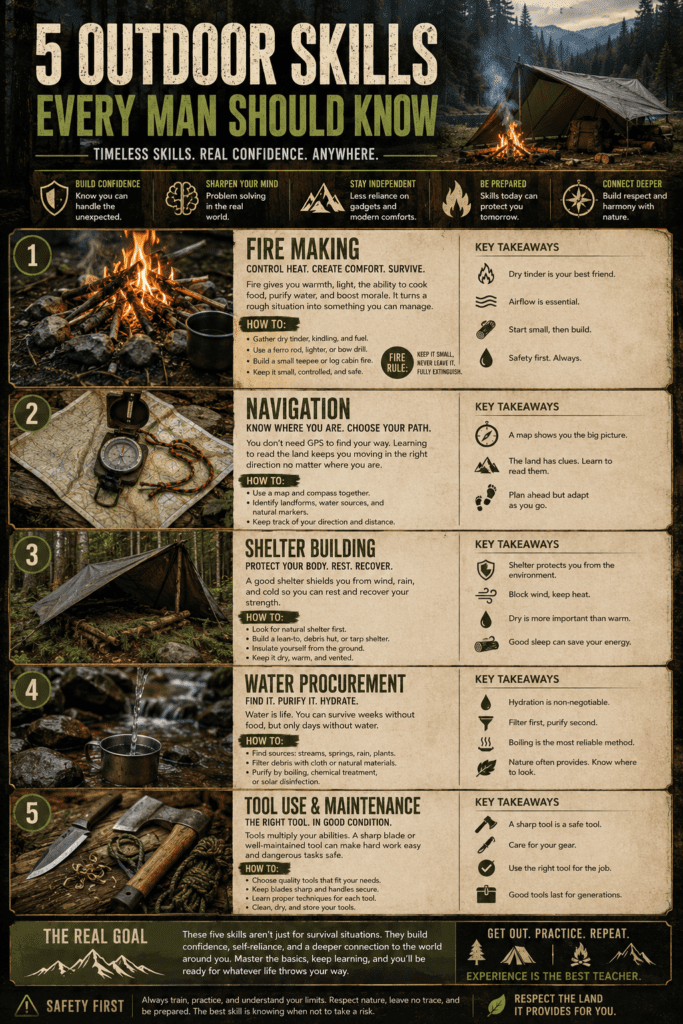
The interesting thing is that many of these skills connect directly to broader self-sufficiency. Fire skills connect to cooking and heating. Navigation connects to awareness. Shelter connects to preparedness. Water management connects to resilience. Tool skills connect to building and repair.
They are not isolated survival tricks. They are pieces of competence.
Helpful External Resources
The National Park Service offers practical wilderness safety guidance for navigation, weather awareness, and outdoor preparedness: https://www.nps.gov/subjects/trails/safety.htm
REI’s expert advice section contains detailed guides on camping, navigation, shelter systems, water treatment, and backcountry skills: https://www.rei.com/learn
Final Verdict: Competence Is Becoming Rare
The deeper value of outdoor skills is not fear-based survivalism. It is competence.
Modern life is increasingly optimized for convenience, but convenience often creates fragility. The more dependent people become on perfectly functioning systems, the harder it becomes to adapt when those systems fail.
Learning outdoor skills reverses some of that fragility. Fire teaches patience. Navigation teaches awareness. Shelter teaches preparation. Water management teaches foresight. Tool skills teach discipline and control.
None of this requires abandoning modern life. You do not need to live in the woods or reject technology to benefit from these skills. In fact, the healthiest approach is probably balance: use modern tools while still understanding the underlying principles that humans depended on for thousands of years.
In the end, outdoor competence changes something subtle but important. It reduces helplessness.
And in a world full of noise, stress, and dependence, that may be one of the most valuable skills a person can develop.