
Can Biochar Improve Your Garden Soil? The 2,000-Year-Old Idea Canadian Scientists Are Testing
Every few years, gardening seems to discover another substance that is supposedly going to fix everything. Coffee grounds will transform your soil. Eggshells will cure blossom-end rot. Epsom salt will rescue struggling tomatoes. Then somebody arrives with a bag of black, charcoal-looking material and makes an even bigger promise: mix this into your garden and you may improve the soil for years.
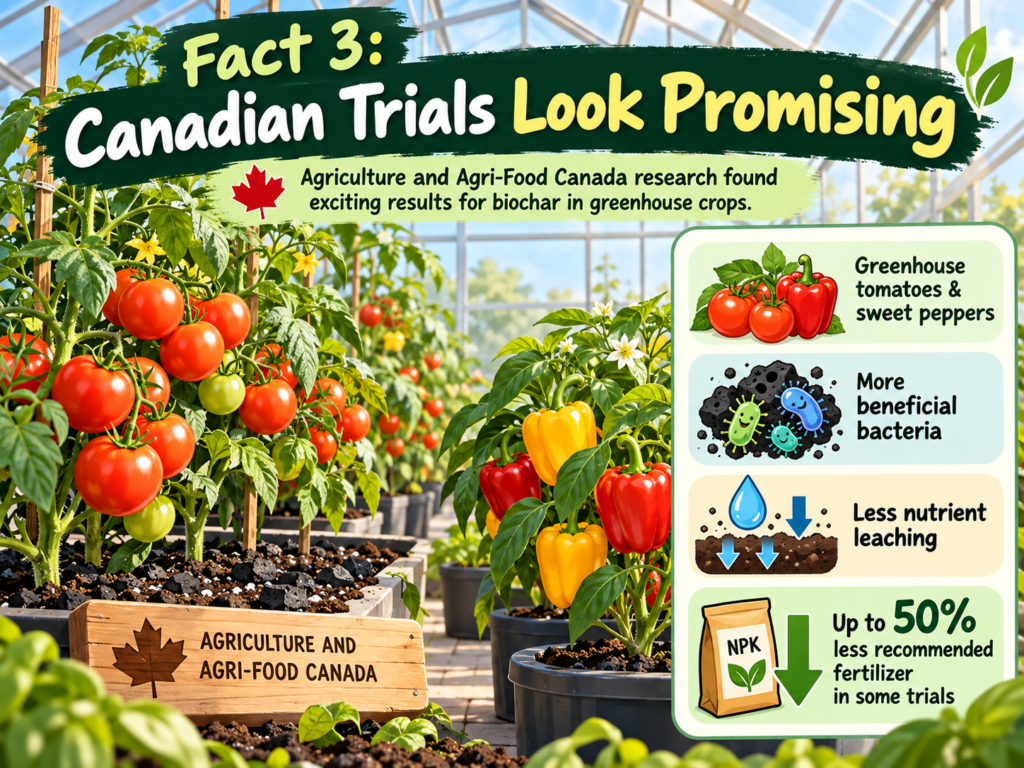
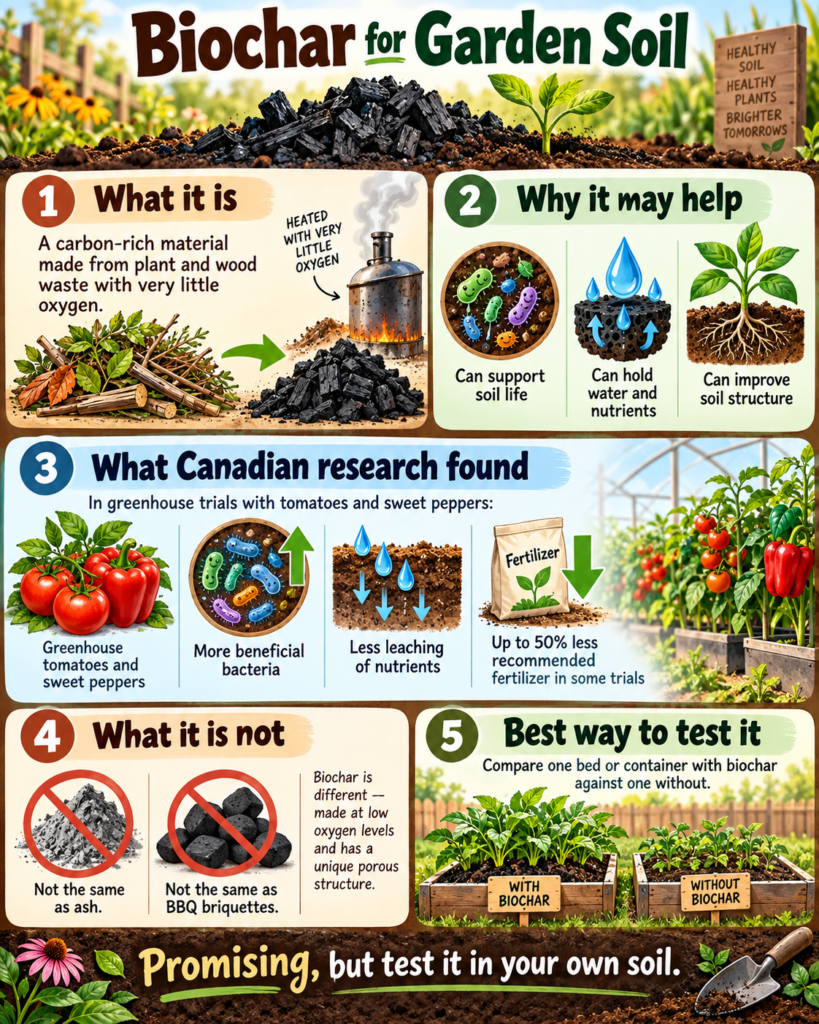
That black material is called biochar, and unlike many internet gardening tricks, there is some genuinely interesting science behind it. Agriculture and Agri-Food Canada researchers have tested biochar with greenhouse tomatoes and sweet peppers in Canadian growing conditions and reported improvements in soil health, beneficial bacteria, crop productivity and nutrient retention. In some of their trials, fertilizer use was reduced by as much as 50 percent of the recommended application while maintaining positive results.
Those findings sound impressive enough to make you want to order a truckload immediately, but I wouldn’t. The more interesting story is that biochar is not one magical substance, it does not perform the same way in every soil, and researchers are still figuring out where it makes the most sense. Yet the idea behind it stretches back more than two thousand years, to unusually fertile patches of dark soil in the Amazon that still fascinate soil scientists today.
So is biochar something worth adding to a backyard garden, or have we taken an ancient soil-building practice and turned it into another expensive bag on a garden-centre shelf?
The Strange Black Soils of the Amazon
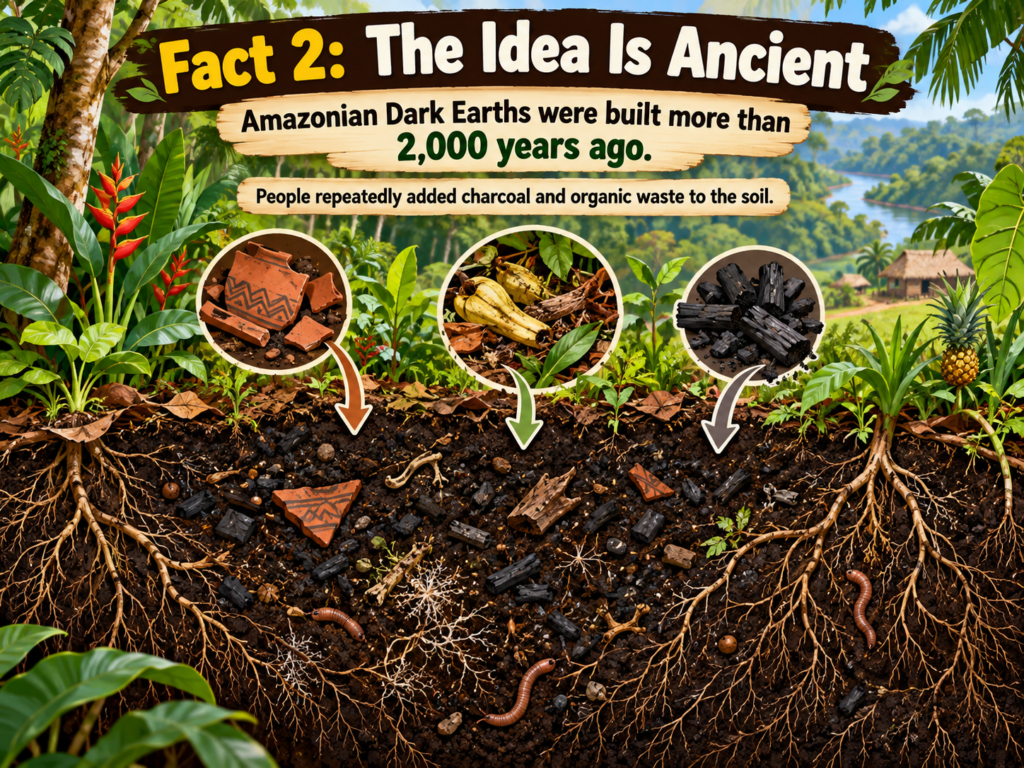
Scattered through parts of the Amazon are patches of unusually dark, fertile soil often called Amazonian Dark Earths, or terra preta. They stand out because many surrounding tropical soils are relatively poor in nutrients, yet these dark patches can remain remarkably productive. They were not simply a fortunate accident of geology.
People created them over long periods of time by repeatedly adding charcoal along with materials such as animal bones, manure and other organic residues. Whatever the original intentions were, those additions produced soils rich in carbon and nutrients that remained noticeably different long after the people who created them were gone.
That longevity is what makes the story interesting. Compost is enormously useful, but compost eventually decomposes, and much of the carbon in fresh organic matter is consumed by microorganisms and returned to the atmosphere. Charred carbon behaves differently because part of it becomes much more resistant to decomposition.
Instead of disappearing after a couple of growing seasons, some of that material can persist in soil for a very long time. Modern biochar research is essentially asking whether we can take part of that old idea, understand it scientifically, and use it deliberately.
What Biochar Actually Is
At first glance, biochar looks a lot like the blackened remains at the bottom of a campfire. That resemblance is real, but it is also where a lot of confusion begins.
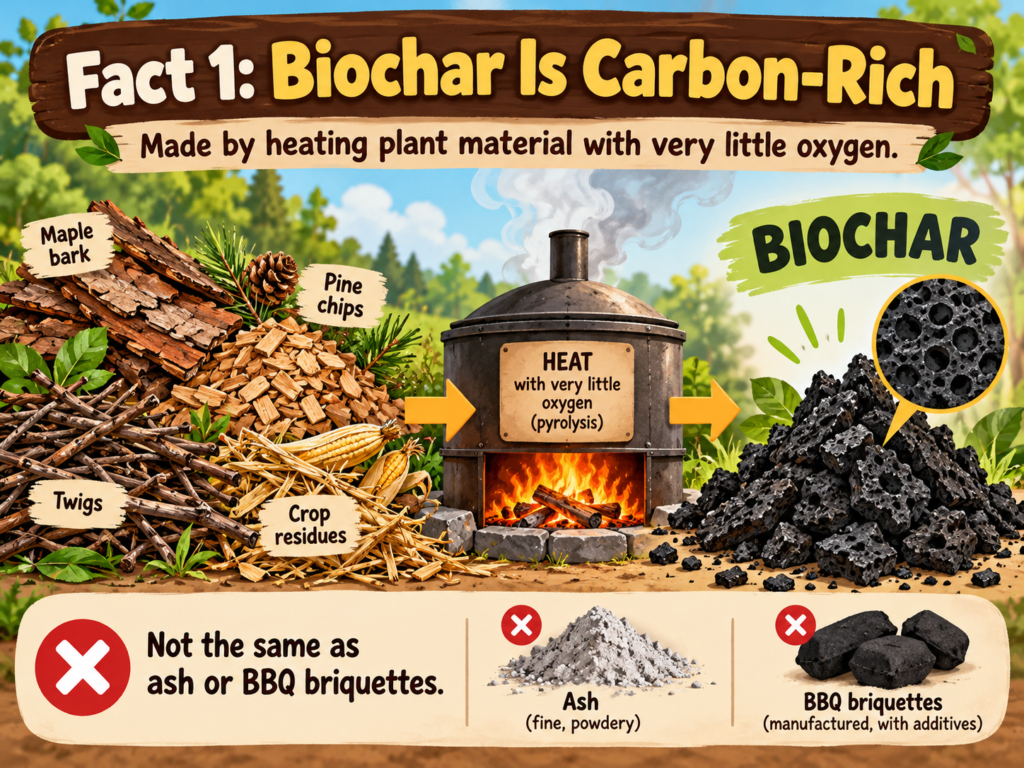
Biochar is made from biomass such as wood waste, crop residues, bark, grasses or other organic material. Instead of simply burning that material in an open fire until little remains except ash, it is heated under conditions with little or no oxygen in a process generally known as pyrolysis.
Without enough oxygen for normal combustion, much of the material does not simply burn away. What remains is a lightweight, carbon-rich, porous substance resembling charcoal, and Agriculture and Agri-Food Canada research has used feedstocks including materials such as maple bark and pine chips.
That means three things that look vaguely similar are not necessarily interchangeable: biochar, fireplace ash and barbecue charcoal are different products. Wood ash is largely what remains after much of the carbon has already burned away, while barbecue briquettes may contain binders or additives designed for cooking rather than gardening.
If you want to experiment with biochar, use material intended for soil use rather than emptying the barbecue into your raised beds and hoping ancient Amazonian wisdom takes over.
Why Would Black Charcoal Help a Plant?
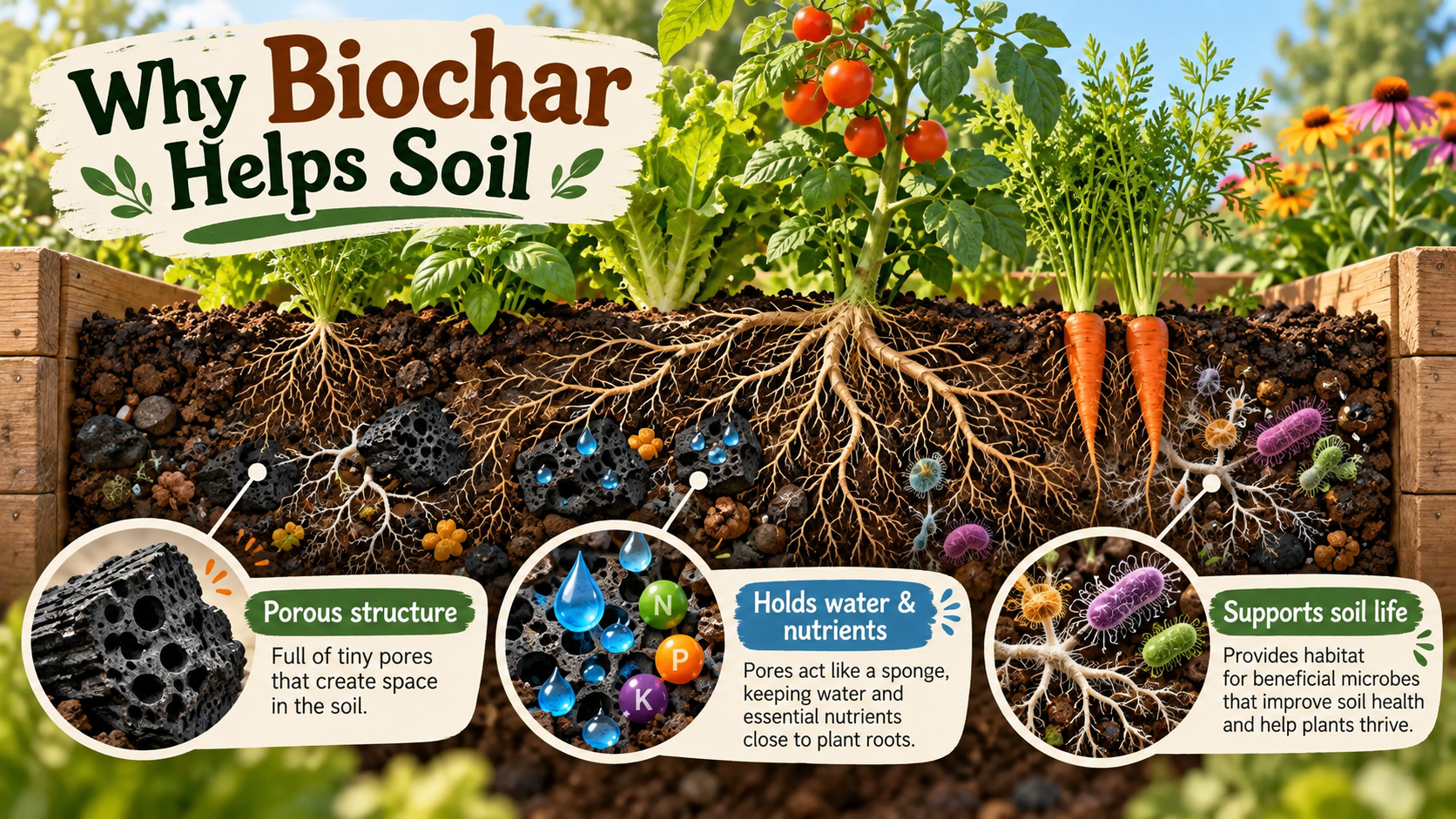
The interesting thing about biochar becomes obvious when you look at its structure closely. It contains an enormous number of tiny pores, cavities and surfaces, so a piece that looks solid to us can contain a complicated microscopic landscape.
That structure can affect the soil around it in several ways. Water can occupy some of those spaces, nutrients can interact with its surfaces, and microorganisms can colonize them. Instead of acting like a fertilizer in the ordinary sense, biochar behaves more like a long-lived piece of infrastructure inside the soil.
Canadian research has found increases in beneficial soil bacteria and reductions in nutrient losses through leaching, alongside positive crop responses in greenhouse trials involving tomatoes and sweet peppers. That distinction matters because a tomato plant does not “eat” biochar; the idea is that biochar changes the environment in which roots, water, nutrients and soil organisms interact.
Think of the difference between placing groceries on an empty parking lot and putting them into a pantry with shelves. The pantry did not create the food, but it made the system better at holding and organizing it. Biochar may play a similar role in certain soils.
The 50 Percent Fertilizer Claim Needs Some Context
This is probably the number that would get plastered across a bag of biochar if marketing departments had their way. In some Agriculture and Agri-Food Canada trials, biochar treatments allowed fertilizer use to be reduced by as much as 50 percent of the recommended application while still producing positive soil and crop results.
That is legitimately interesting, but it does not mean you should dump biochar into your vegetable garden tomorrow and cut every fertilizer application in half. The phrase “as much as” matters, and so do the crop, soil type, biochar type, application rate and growing conditions.
A controlled greenhouse experiment involving tomatoes in a particular soil is not a universal instruction for every blueberry bush, lawn, raised bed and apple tree in Canada. This is where gardening claims often go bad: a promising result gets stripped of all its conditions and turned into a rule.
The better conclusion is that biochar appears capable of improving nutrient-use efficiency under some conditions, which creates the possibility of using less fertilizer. That is worth investigating without pretending the number applies everywhere.
Biochar Is Not One Product
Imagine somebody telling you, “Wood is strong.” The obvious question would be: what wood? Cedar, pine, maple and balsa are all wood, but they behave very differently.
Biochar has a similar problem. The name describes a broad category of materials rather than one perfectly standardized substance, and its properties can change depending on the original material used and the temperature at which it was produced.
A wood-based biochar manufactured at one temperature may behave differently from a manure-based biochar produced under different conditions. The pH can differ, nutrient content can differ and porosity can differ.
The crop and existing soil matter too. That is why “Does biochar work?” may actually be the wrong question.
A better question is: Which biochar, in which soil, for which crop, at what rate? That answer is considerably less exciting than a miracle amendment, but it is probably much closer to reality.
Raw Biochar Can Also Be a Little Too Hungry
There is another detail worth understanding before mixing fresh biochar into every bed. Because biochar contains so much surface area, freshly produced material can interact strongly with nutrients and water.
Some growers therefore “charge” or inoculate biochar before adding it to soil by mixing it with compost or another nutrient-rich material. The basic idea is to let those pores and surfaces begin interacting with nutrients and microorganisms before the material ends up beside plant roots.
For a backyard gardener, this suggests a pretty sensible approach: instead of viewing biochar as a substitute for compost, think about using the two together. Compost provides decomposable organic matter, nutrients and biology, while biochar provides a much more persistent carbon structure.
Those are not the same job, and treating them as though they are interchangeable misses the point.
Soil Organic Matter Is Bigger Than Biochar
The enthusiasm around biochar makes more sense once you look at the larger problem researchers are concerned about. Healthy soil is not merely pulverized rock holding roots upright; it contains organic matter, living organisms, water, air, mineral particles and a network of structures created by roots, fungi, bacteria and decomposition.
Agriculture and Agri-Food Canada describes soil organic matter as critical to fertility, soil structure, erosion resistance and the movement and storage of water, air and nutrients. Its soil indicators also show that parts of Canadian cropland remain vulnerable to organic-carbon loss.
Biochar is interesting partly because it adds a relatively stable form of carbon to soil, but it is not the only way to build healthier soil. Compost, manure, cover crops, crop residues, reduced tillage and keeping living plants in the ground all matter.
If your garden soil is terrible because it has been left bare, compacted, repeatedly tilled and starved of organic matter, sprinkling expensive biochar over it while ignoring everything else would be missing the point.
The Water Question May Be Just as Interesting
Gardeners often focus first on fertilizer because plant food is easy to understand. Water management may turn out to be equally important.
A porous material mixed through soil has the potential to influence the way water is retained and moves around roots. The size of that effect depends heavily on the soil and biochar being used, so I would be wary of universal claims such as “biochar cuts watering in half.”
The underlying possibility is still intriguing, particularly in soils that drain too aggressively or struggle with structure. This is one reason degraded soils attract so much biochar research: improving a beautiful loam that already grows excellent vegetables may produce only a small difference, while improving poor soil with limited organic matter or nutrient retention could produce a much more noticeable one.
The worse the starting point, the more room there may be for improvement. That is worth remembering before judging somebody else’s biochar experiment against your own garden.
Could Biochar Store Carbon for the Long Term?
This is where biochar moves from a gardening story into a climate story. Plants pull carbon dioxide from the atmosphere as they grow, and when those plants eventually decompose or burn completely, much of that carbon returns to the atmosphere.
Pyrolysis changes part of that biomass into a more stable carbon-rich material. Putting that material into soil can keep some of the carbon from cycling back as quickly, which is one reason researchers are interested in biochar beyond its effect on crops.
There is an appealing loop here. A sawmill produces wood residue, that residue becomes biochar, the biochar goes into soil, and some of the carbon remains there while the material may also improve the environment around plant roots.
That is the idealized version, anyway. The real environmental benefit still depends on how the feedstock is sourced, how efficiently the biochar is produced, how far it is transported and what happens when it enters the soil.
Nothing becomes automatically sustainable simply because it is black and made from trees.
So Why Isn’t Every Farmer Already Using It?
Money is one reason. Biochar can be expensive, especially when you start imagining applying it across hundreds of hectares instead of one raised bed.
That makes the economics much more attractive for higher-value crops than for broad-acre agriculture. An orchard, vineyard, greenhouse or intensive vegetable operation can potentially justify a soil amendment that would make far less sense across a massive field of commodity grain.
There is also uncertainty. Farmers need to know that an input will produce enough benefit to justify the expense, and if the outcome depends heavily on soil type, feedstock, production temperature and application rate, adoption becomes more complicated.
For a home gardener, though, the economics are different. You do not need a tractor trailer full of biochar.
You can test it in one container.
The Backyard Experiment I Would Actually Try
If I wanted to know whether biochar helped my own garden, I would avoid modifying the whole garden in the first season. Once biochar is mixed into soil, removing it again is not exactly an afternoon project.
Instead, I would run a simple comparison using two large containers or two small sections of the same raised bed. One would be the control using your normal garden soil, compost and fertilizer, while the other would use the same setup plus a modest amount of commercially prepared soil-grade biochar according to its instructions.
Plant the same variety in both areas on the same day and give them similar sunlight and water. Track plant growth, watering frequency, visible health and final harvest weight, and take photographs every week instead of relying on memory.
Tomatoes or peppers would be especially interesting because they connect directly with the crops used in Canadian greenhouse research. Radishes or lettuce would give you results faster, although they would obviously be a different experiment.
I would also use purchased, documented biochar for the first comparison rather than homemade material. That removes one enormous unknown from the test.
If the biochar side noticeably outperforms the control, great. If they look identical, that is useful information too, and if the biochar plants perform worse, you have learned that “researchers found a benefit” and “this product helps this soil in my backyard” are two very different statements.
Should You Make Your Own Biochar?
You certainly can find instructions for doing it, but I would not make homemade production the starting point for this experiment. Pyrolysis involves high temperatures, combustion gases and fire, and a poorly controlled backyard burn can create smoke, fire risk and an inconsistent product.
More importantly from an experimental perspective, you may have no idea what properties you actually created. If the goal is woodworking and experimenting with kilns, homemade biochar could eventually become a fascinating FinkleCraft project of its own.
But if the goal is simply figuring out whether biochar improves your tomatoes, buying a reputable soil-grade product gives you a much cleaner test. There is no shame in separating those two experiments.
First find out whether the soil amendment interests you, then decide whether making it interests you.
What I Would Not Put in the Garden
I would not substitute random barbecue briquettes, and I would not assume fireplace ash is equivalent. I would also avoid using treated, painted or glued lumber as feedstock for anything intended to enter vegetable soil.
Mystery charcoal from an unknown source would not be high on my list either. The entire appeal of biochar is that it becomes a long-lived part of your soil, and that is exactly why you should care about what went into it.
When something may remain in your raised bed for years, “it looked like charcoal” is not a very reassuring quality-control standard.
Does Biochar Replace Compost?
No, and this may be the easiest misconception to avoid. Compost and biochar overlap in some benefits, but they are fundamentally different materials.
Compost is actively decomposing organic matter that feeds soil organisms and releases nutrients as it changes. Biochar is far more resistant to decomposition and behaves more like long-term carbon structure.
If I had a limited gardening budget and had to choose between fixing an obvious shortage of organic matter with good compost or buying an expensive bag of biochar, I would probably address the compost problem first. Biochar becomes more interesting after the basic soil-health foundations are already in place.
You could think of it this way: compost is food and biochar is habitat. That is an oversimplification, but it is a useful one.
The Skeptical Verdict
Biochar occupies an unusual place in gardening because both the hype and the science contain something real. The hype sometimes treats it like magic black dust capable of fixing poor soil, eliminating fertilizer and solving climate change at the same time.
The evidence is more complicated. Canadian research is genuinely encouraging, with reported improvements in several soil and crop measures, increases in beneficial bacteria and reductions in nutrient loss under tested conditions.
At the same time, the type of biochar matters. The soil matters, the crop matters, the application rate matters, and the economics matter.
That is not a weakness in the idea. It is what real agriculture usually looks like once you get past the headline.
Final Verdict: Would I Put Biochar in My Garden?
Yes—but I would experiment before committing. The most interesting thing about biochar is not the claim that it can magically transform soil; it is the possibility that plant material which might otherwise decompose or be discarded can be converted into a stable carbon structure that may help soil hold nutrients, support microorganisms and improve crop production.
There is something wonderfully circular about that. Trees and plants pull carbon from the air, their residues become biochar, the biochar returns to the ground, and new plants grow around it.
More than two thousand years ago, people in the Amazon were creating extraordinarily dark, productive soils by repeatedly adding charcoal and organic wastes. Today, Canadian scientists are studying modern versions of the same basic idea using greenhouse crops, controlled experiments and laboratory measurements.
The ancient gardeners did not know about carbon sequestration, nitrous oxide measurements or microbial diversity, but they did know when soil produced good food. Maybe the most sensible thing a modern gardener can do is borrow a little from both worlds: keep the curiosity of the old experimenters, add the skepticism of modern science, and test the idea in a small patch of soil before believing the label on the bag.
Because if biochar really does make your garden better, you will not need a marketing claim to tell you.
The plants eventually will.