
How One Indoor Grow Rack Can Become a Year-Round Food and Side-Income System
A lot of people look at an indoor grow rack and see a messy shelf full of trays, lights, extension cords, seedlings, pots, and half-finished experiments. But if you step back and look at it the right way, that same rack can become something much more interesting. It can become a small year-round food production system. Not a fantasy farm. Not a “quit your job growing microgreens” scheme. A real, practical, compact system that helps you grow food, start your garden earlier, reduce grocery trips, and maybe sell enough extra seedlings in spring to make the whole thing feel worthwhile.
That distinction matters. The internet is full of exaggerated indoor farming promises. People love to claim you can make thousands of dollars from a shelf in your spare room, but they often leave out electricity costs, tray washing, failed germination, mold, pests, watering mistakes, local demand, and the fact that selling fresh produce is not the same as selling a digital product online. A grow rack is not magic. It is a tool. But in the hands of someone willing to experiment, it can become a surprisingly useful homestead asset.
The most realistic version of this idea starts with growing what you already eat. If your household actually uses tomatoes, cucumbers, green onions, lettuce, herbs, carrots, potatoes, and mushrooms, then your system has a clear purpose from day one. You are not trying to chase random high-profit crops because some YouTuber said they sell well. You are building a food system around your real meals. That means every successful tray has value, even if you never sell a single plant.
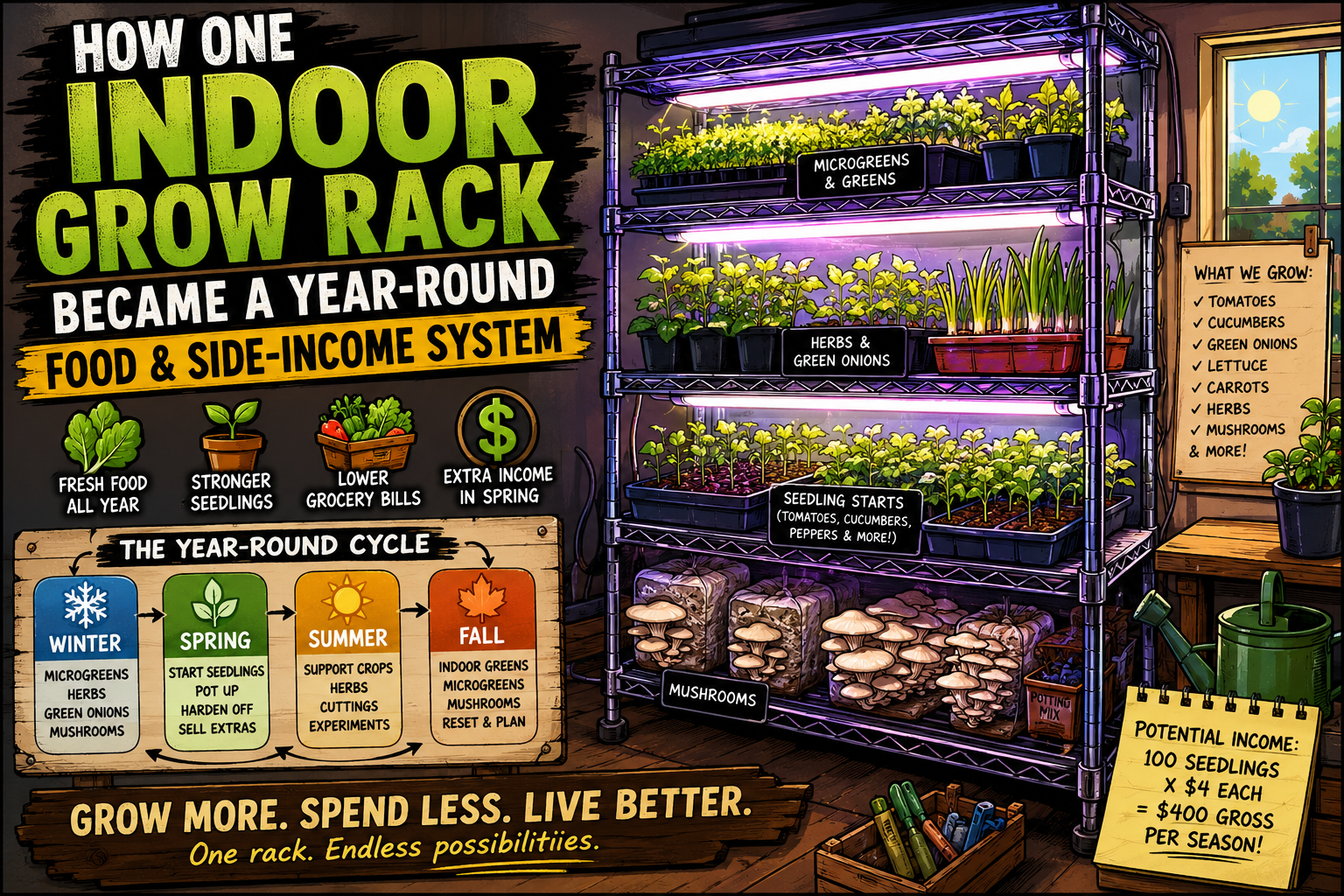
This is where an indoor rack becomes more than a hobby. In late winter, it can become a seedling nursery. In spring, it can become a small plant-sale engine. In summer, it can support herbs, backup starts, cuttings, and experiments. In fall and winter, it can shift toward microgreens, lettuce, green onions, and mushrooms. The same physical shelf changes roles through the year, and that is the real strategy.
What an Indoor Grow Rack Actually Is
An indoor grow rack is basically a vertical growing station. Instead of spreading plants across a floor, windowsill, or greenhouse bench, you stack production upward using shelves and grow lights. A typical metal wire rack gives you several levels of usable growing space, and a smaller side rack can act as overflow, staging space, or a lower-light area for hardening, herbs, supplies, or slower-growing plants.
In the setup shown here, the main metal rack has multiple illuminated shelves filled with seed trays, pots, foil pans, and young plants. The smaller side rack adds extra space for overflow and experimentation. The bottom of the main rack is currently used partly for storage, but that same lower shelf could eventually become a mushroom area, a humid microgreen zone, or a compact propagation space. That is what makes the setup interesting: it is not polished, but it is flexible.
A rack like this is not the same as a commercial greenhouse bench. You have less airflow, less natural sun, more heat buildup, more electrical clutter, and less working room. But you also have major advantages. You can run it indoors, use it during winter, protect seedlings from frost, and experiment without renting land or building a greenhouse. For a backyard homesteader or self-sufficiency-minded person, that is a big deal.
The best way to think about it is not as one project, but as a seasonal machine. The rack’s job changes depending on the calendar. That is what separates a productive rack from a random pile of trays under lights.
Why People Are Getting Interested in Grow Racks
Food prices, supply chain concerns, and the return of backyard gardening have made small-scale food production more appealing. People are realizing that self-sufficiency does not have to start with acres of land. Sometimes it starts with a shelf, a light, a tray of lettuce, and a few tomato seedlings on a cold March morning.
There is also a psychological side to it. Growing food indoors gives you momentum before the outdoor season starts. In cold climates, winter can feel like dead time for gardeners. A grow rack changes that. You can be starting onions, herbs, lettuce, tomatoes, peppers, or microgreens while snow is still on the ground. That gives the whole season a head start.
Extension guides commonly recommend starting many garden crops indoors several weeks before transplanting, especially plants that need a longer season than northern outdoor weather allows. The University of Minnesota Extension notes that seedlings may need to be moved into larger containers when they outgrow small cell packs, and it cautions gardeners to handle seedlings by the rootball or leaves rather than crushing delicate stems. That kind of detail matters because a grow rack only works if it produces healthy plants, not just crowded, leggy seedlings.
The fascination also comes from the idea of stacking value. One shelf might grow lettuce for your own salads. Another shelf might start tomato seedlings for your garden. Another might hold green onions regrowing from kitchen scraps. The bottom shelf might eventually hold mushrooms. If you sell a few extra seedlings in spring, the same system starts to offset its own costs.
The Seasonal Rack Strategy
The strongest way to use an indoor grow rack is to stop treating it as a static setup. It should not do the same thing all year. A smart rack changes jobs with the season.
In winter, the rack should focus on fresh food and experiments. This is the time for microgreens, herbs, green onions, lettuce, and maybe mushrooms. You are not trying to grow giant tomato plants indoors unless you have a serious lighting setup and enough space. You are using the rack for crops that make sense indoors: fast greens, small herbs, compact food, and low-light-friendly systems.
In late winter, the rack shifts into seed-starting mode. This is when tomatoes, peppers, herbs, brassicas, cucumbers, and flowers start to matter. For someone in a cold climate, this phase is huge. Starting seedlings indoors can extend the season and give warm-weather crops a fighting chance. Johnny’s Selected Seeds explains that starting your own seeds lets growers extend the season, access more varieties, and save money compared with buying all transplants.
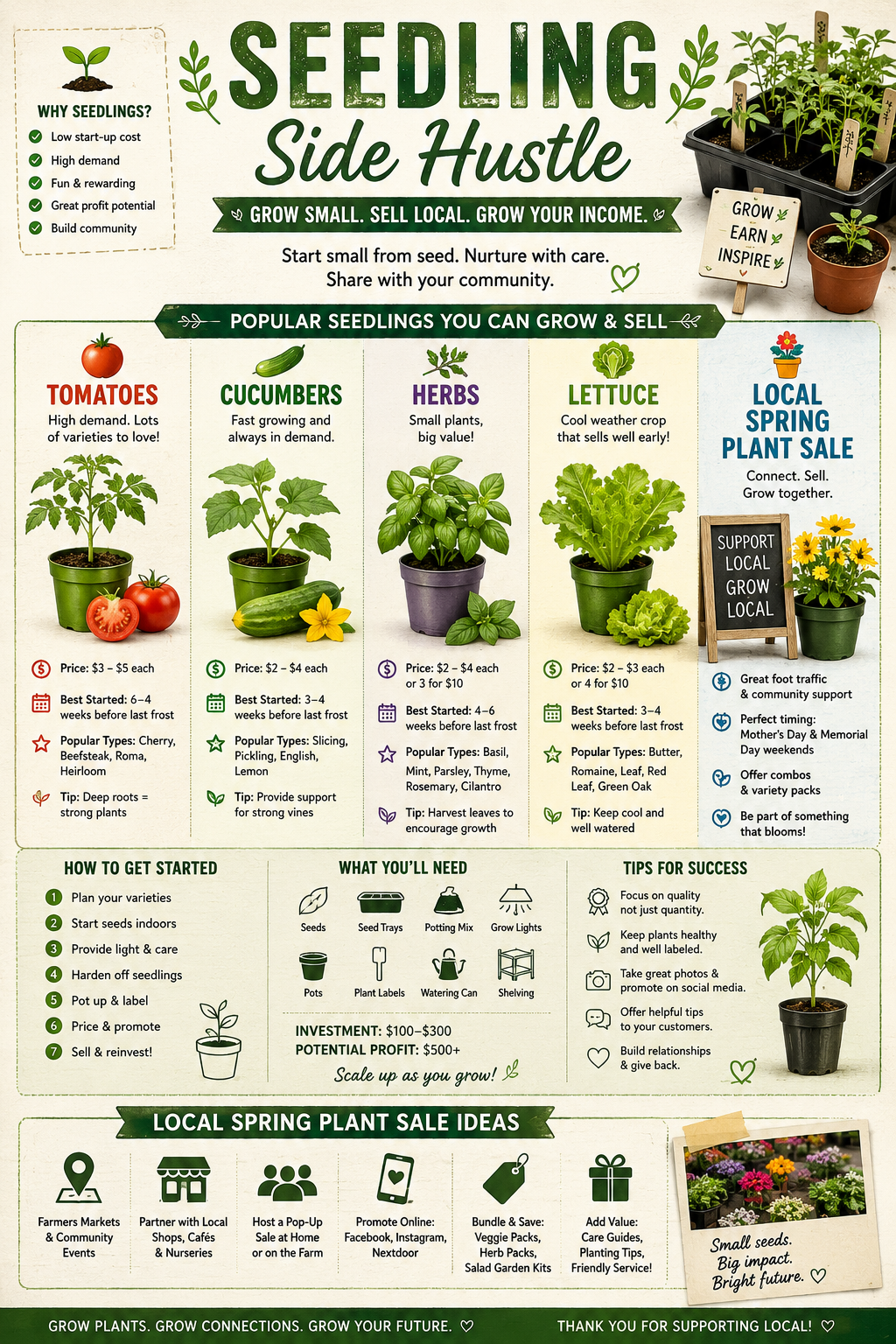
In spring, the rack becomes a nursery and sales system. This is the short window where extra seedlings can become side income. Healthy tomato, pepper, cucumber, herb, and flower seedlings are easy for gardeners to understand. People buy them because they want a shortcut. Many people start too late, fail their own seedlings, or simply see a nice plant and impulse-buy it at a local sale.
In summer, the rack should not sit dead. It can support herbs, backup starts, succession crops, cuttings, and experiments. You might start fall lettuce, brassicas, or herbs indoors while the outdoor garden is still producing. You can also use the rack to test varieties, clone basil, keep green onions going, or prepare late plantings.
In fall, the system transitions back indoors. Outdoor production slows, frost returns, and the rack becomes useful again for greens, microgreens, herbs, and mushrooms. This is when it starts feeling less like a spring seedling station and more like a year-round food tool.
Here is the image group that would fit naturally in this section, because it shows the reader how the same rack changes purpose through the year instead of staying locked into one use.
What Could This Size Rack Actually Produce?
Let’s be grounded. A rack like this will not feed a family completely. It will not replace an outdoor garden, a greenhouse, or a real farm. But it can produce meaningful value if you use the space intelligently.
A standard 10×20 nursery tray is the basic unit to think in. Depending on shelf width and depth, a large metal rack may hold several trays per shelf. With multiple shelves under lights, it is realistic to imagine dozens of trays moving through the system over the season, although not all at once if you need space for larger pots.
For seedlings, the production number depends on container size. Small cells let you start hundreds of seedlings, but larger sellable plants need more space. If you sell young but healthy plants in 3-inch or 4-inch pots, you might realistically fit somewhere around 100 to 200 decent sale-ready seedlings across a rack system like this during peak spring rotation, especially if the smaller side rack is used for overflow and staging.
At $4 to $5 each, 100 seedlings could gross $400 to $500 in a spring season. That does not mean pure profit. You still have soil, pots, seeds, electricity, labels, water, failed plants, time, and possibly market fees. But it does mean the rack could plausibly generate a few hundred dollars seasonally if you grow healthy plants people want. If you sell only 40 extra seedlings at $5 each, that is still $200 gross from surplus that might otherwise have been given away or composted.
The key word is surplus. The least stressful strategy is to grow first for your own garden, then sell extras. That way you are not depending on sales to justify the system. If the seedlings sell, great. If they do not, you plant them, gift them, trade them, or use them as backups.
What to Grow If You Actually Eat Tomatoes, Cucumbers, Green Onions, and Lettuce
This is where people often go wrong. They design their rack around what sounds profitable instead of what they actually consume. If you eat tomatoes, cucumbers, green onions, and lettuce regularly, those should anchor the system.
Tomatoes are perfect for the spring seedling phase. They are popular, easy to understand, and visually appealing once they are healthy. A good tomato seedling looks valuable to a buyer. It has a thick stem, deep green leaves, and obvious promise. If you grow too many, extras are easy to sell, gift, or plant in containers.
Cucumbers are also good, but they need more caution. They grow fast, dislike root disturbance, and can become oversized quickly indoors. For sales, they work best when timed close to planting season. A cucumber seedling that sits too long in a small pot becomes stressed and less attractive.
Lettuce is useful in two ways. First, it can be grown indoors for eating, especially leaf lettuce harvested young. Second, it can be started for outdoor transplanting or succession planting. Lettuce is not always the highest-value seedling to sell, but it is practical for your own food system because it grows fast and fits into small spaces.
Green onions might be one of the most underrated rack crops. You can regrow store-bought green onion bases in water or soil, start bunching onions from seed, and keep a steady supply going. They do not demand the same space as tomatoes, and they provide frequent kitchen value. That matters because a food system is only useful if you actually use the food.
Carrots and potatoes are different. Carrots usually make more sense outdoors because they need depth, loose soil, and direct sowing. Potatoes can be grown in containers, bags, or towers, but they require enough light, volume, and patience. They are worth experimenting with, but they should not be the main indoor rack crop unless you have a dedicated container system.
The Potato Tower Question
Potato towers are one of those gardening ideas that sound almost too good to be true. The basic concept is simple: plant potatoes in a vertical container, then keep adding soil, straw, or compost as the plants grow upward. The viral version claims you can produce huge harvests in a tiny footprint.
The problem is that many potato tower claims are exaggerated. Garden writers and experienced growers have pointed out that potatoes do not automatically produce endless new layers of tubers just because the stems are buried higher and higher. Some varieties set tubers in a limited zone, and if the tower is poorly watered, too hot, too dense, or underfed, the results can be disappointing. Garden Myths has criticized the “100 pounds in 4 square feet” style claims as highly misleading.
That does not mean vertical potatoes are useless. It means they should be treated as an experiment, not a guaranteed miracle. A potato grow bag, barrel, or modest tower can still be useful where space is limited. But for reliable food production, potatoes usually want strong light, consistent moisture, good soil volume, and enough time.
For your setup, I would not put a potato tower on the indoor rack itself. It is too bulky and the yield probably would not justify the shelf space. A better approach is to use the rack to start slips, experiments, or support crops, then use an outdoor barrel, grow bag, or circular tower once weather allows. That keeps the rack focused on higher-turnover crops like seedlings, lettuce, herbs, microgreens, and green onions.
Microgreens: Fast Food From a Small Space
Microgreens are the obvious year-round rack crop because they are fast, compact, and well suited to trays. Utah State University Extension describes microgreens as young vegetable or herb seedlings grown indoors or outdoors, and notes that they are typically harvested after the cotyledons expand or when the first true leaves appear. Many microgreen crops can be ready in roughly one to three weeks depending on species and conditions.
The advantage is speed. A tray of radish, pea shoots, sunflower, broccoli, or mixed microgreens can go from seed to harvest much faster than a tomato seedling or lettuce head. That makes microgreens useful for winter food production when outdoor gardening is impossible.
The downside is repetition. Microgreens require regular sowing, watering, harvesting, cleaning, and restarting. They can also develop mold if airflow, seed density, humidity, or sanitation are poor. Selling them adds another layer of pressure because customers expect freshness, consistency, and food-safe handling.
For your rack, microgreens make the most sense as a grocery-reduction crop first. Grow them because you will eat them. Add them to eggs, sandwiches, wraps, soups, salads, and rice bowls. If you later find local buyers, fine, but do not start by promising yourself a restaurant microgreen empire.
Mushrooms on the Bottom Shelf
The bottom shelf is interesting because mushrooms do not need the same direct light as seedlings. That makes them a possible fit for the lower zone of the rack, especially if you create a controlled fruiting area with humidity and airflow. Oyster mushrooms are usually the beginner-friendly choice compared with more demanding gourmet varieties.
Theoretically, two small mushroom tubs or fruiting chambers could produce a meaningful amount of mushrooms over time. In a beginner home setup, a cautious expectation might be a few pounds per flush if conditions are decent, with yields varying wildly based on species, substrate, contamination, humidity, airflow, temperature, and technique. A more optimized setup could do better, but beginners should expect mistakes.
For grocery savings, mushrooms make sense. Fresh gourmet mushrooms are expensive, and homegrown oyster mushrooms are useful in stir-fries, eggs, soups, pasta, and rice dishes. If you produce more than you can eat, you can share them with friends and family or test local demand carefully.
Selling mushrooms is more complicated than selling extra tomato seedlings. Once you sell food, you may run into food handling expectations, local rules, customer trust issues, storage concerns, and liability questions. That does not mean you cannot eventually sell them. It just means seedlings are probably the easier first product.
Seedlings Are the Best First Side-Income Play
If the goal is a realistic $100-a-month-style side income during the growing season, seedlings are probably the cleanest starting point. They are understandable, seasonal, and emotionally appealing. People see a healthy tomato plant and immediately know what it is for.
Seedlings also fit your current system. You already have the rack, lights, trays, and a real outdoor garden to absorb anything unsold. That gives you a safety net. If you grow 100 seedlings and sell 60, the remaining 40 are not necessarily wasted. You can plant them, trade them, gift them, or keep the best and discard the weak.
The smartest crops to sell are usually the ones gardeners already want:
- tomatoes
- cucumbers
- peppers
- basil
- parsley
- lettuce packs
- kale
- cabbage
- marigolds
- maybe green onions or herbs in small bunches
The better you label them, the more professional they feel. A plant marked “Tomato” is forgettable. A plant marked “Scotia Tomato — early Canadian variety, good for short seasons” feels more valuable. A cucumber labeled “Spacemaster — compact cucumber, good for small gardens and containers” gives the buyer confidence.
That small detail matters. You are not just selling a plant. You are selling reduced uncertainty.
The Real Costs Nobody Mentions
This is where the hype articles usually fail. Indoor growing has costs. Electricity may not be huge with efficient lights, but it still matters. Soil and seed-starting mix add up. Pots and trays break or disappear. Labels cost money. Watering takes time. Some seedlings fail. Some get leggy. Some get fungus gnats. Some are started too early and become awkward before the weather is ready.
Hardening off is another hidden step. Seedlings grown indoors need gradual exposure to outdoor sun, wind, and temperature swings before transplanting. The Old Farmer’s Almanac recommends gradually introducing seedlings outdoors for about 7 to 10 days before transplanting. Skip this step, and even beautiful seedlings can stall, burn, or die outside.
There are also rules and local expectations to consider if selling becomes regular. Ontario’s farm-starting guidance notes that container production has its own handling, overwintering, equipment, and labour considerations, and CFIA nursery certification programs may apply in specific nursery/shipping contexts. For a few local extra seedlings, this may not be a big issue, but if you scale into a real business, you should check municipal, market, tax, and plant-health requirements instead of guessing.
That is not meant to scare anyone away. It is the opposite. A grounded plan is more likely to survive because it does not depend on fantasy math.
A Realistic Year-Round Rack Plan
The best rack plan is simple enough to repeat. Complexity kills consistency. If the system becomes too annoying, you will stop using it.
From December to February, focus on microgreens, green onions, herbs, and possibly mushrooms. Keep it simple. Grow small amounts you actually eat. Track which crops give the most value for the least hassle.
From February to April, shift hard into seed-starting. Tomatoes, peppers, herbs, brassicas, and flowers can begin depending on your frost date and crop timing. Do not start everything too early just because the rack is available. Bigger is not always better if seedlings become rootbound before outdoor weather cooperates.
From April to June, the rack becomes a spring nursery. Pot up the best seedlings. Label them clearly. Harden them off. Keep what you need for your own garden, then sell or trade extras. This is the most realistic money window.
From June to August, use the rack lightly. Start fall crops, maintain herbs, root cuttings, or test new varieties. Do not force the rack to be busy just for the sake of it.
From September to November, bring the system back indoors. Start lettuce, herbs, green onions, microgreens, and mushroom experiments again. Use the fall as a reset period where you improve the setup based on what failed earlier in the year.
Grocery Savings vs Selling Extras
The best way to measure this system is not just sales. It is total value. If you grow $40 worth of lettuce, herbs, and green onions in winter, that matters. If you avoid buying $60 worth of seedlings in spring, that matters. If you sell $300 worth of extra plants, that matters. If you produce mushrooms you would have paid premium prices for, that matters too.
Selling adds cash, but eating your own production reduces dependence. That is the homestead mindset. A dollar saved on groceries and a dollar earned from a seedling are not identical, but both improve your position.
For most people, the healthiest strategy is this order:
- grow what you eat
- start what you need for your garden
- produce a reasonable surplus
- sell the cleanest, strongest extras
- give away or trade the rest
That keeps the system enjoyable instead of turning every tray into pressure.
Why This Matters Today
A small indoor grow rack is not going to solve food insecurity by itself. But it does something important: it rebuilds practical competence. It teaches timing, propagation, plant health, crop value, airflow, lighting, humidity, and seasonal planning. Those skills compound.
The deeper value is that you stop being only a consumer. You become a producer, even at a small scale. You learn what food takes. You learn why seedlings cost $5. You learn why fresh greens are expensive. You learn why timing matters more than enthusiasm.
That is exactly where modern homesteading is heading. Not everyone can buy land. Not everyone can build a greenhouse. Not everyone can run a farm. But a lot of people can build a rack, start seeds, grow greens, and turn one corner of a room into a small food system.
Helpful External Links
University of Minnesota Extension — Starting Seeds Indoors:
https://extension.umn.edu/planting-and-growing-guides/starting-seeds-indoors
Utah State University Extension — Grow Your Own Microgreens:
https://extension.usu.edu/yardandgarden/research/grow-your-own-microgreens
Final Verdict: The Rack Is a Food Lab, Not a Get-Rich Machine
The most honest way to describe an indoor grow rack is this: it is a compact food lab. It helps you test crops, start seedlings, grow greens, reduce grocery costs, and maybe create seasonal side income. It is not passive income. It is not a tiny farm that runs itself. It takes watering, cleaning, timing, observation, and patience.
But that does not make it weak. That makes it real.
For a setup like this, the best path is clear. Use winter for microgreens, herbs, green onions, lettuce, and mushrooms. Use late winter and spring for seedlings. Use the outdoor garden to absorb your best starts. Sell the extra healthy seedlings when demand peaks. Use summer for support crops and experiments. Then cycle back indoors when the weather turns cold.
If you can sell 100 seedlings at $4 each, that is a meaningful seasonal gross return. If you only sell half that, it still helps. If you sell none, you still have plants for your garden, food for your kitchen, and skills that improve every year.
That is the real win. The rack is not just a shelf. It is a year-round engine for learning, food, and small-scale independence.
I wonder if a combined profit from a year round busy rack system would be realistic? taking into consideration money saved in groceries. that’s fairly significant I guess.