
Amish vs. Mennonite: The Real Differences in Beliefs, Daily Life, Technology, and Culture
Amish and Mennonite communities are often placed in the same mental category: horse-and-buggy travel, plain clothing, farms, handcrafted furniture, impressive barns, and roadside signs selling eggs or baked goods. There is some truth in that picture, but it is far too simple. The Amish and Mennonites share deep historical roots, yet they are not identical groups, and “Mennonite” covers a much wider range of people and lifestyles than most outsiders realize.
Some Mennonites dress like anyone else, drive cars, use smartphones, attend university, and work in regular jobs in cities. Others are Old Order Mennonites who dress plainly, drive horse-drawn buggies, and limit certain technologies. Amish communities are generally more visibly traditional, but even the Amish are not frozen in time, and different Amish church districts make different decisions about tools, phones, solar power, construction equipment, and business practices.
The most useful way to understand the difference is not to ask, “Which group is more old-fashioned?” A better question is, “How does each community decide what kind of life helps it protect faith, family, and community?” That is where the biggest differences begin to show.
Quick Answer: What Is the Difference Between Amish and Mennonite?
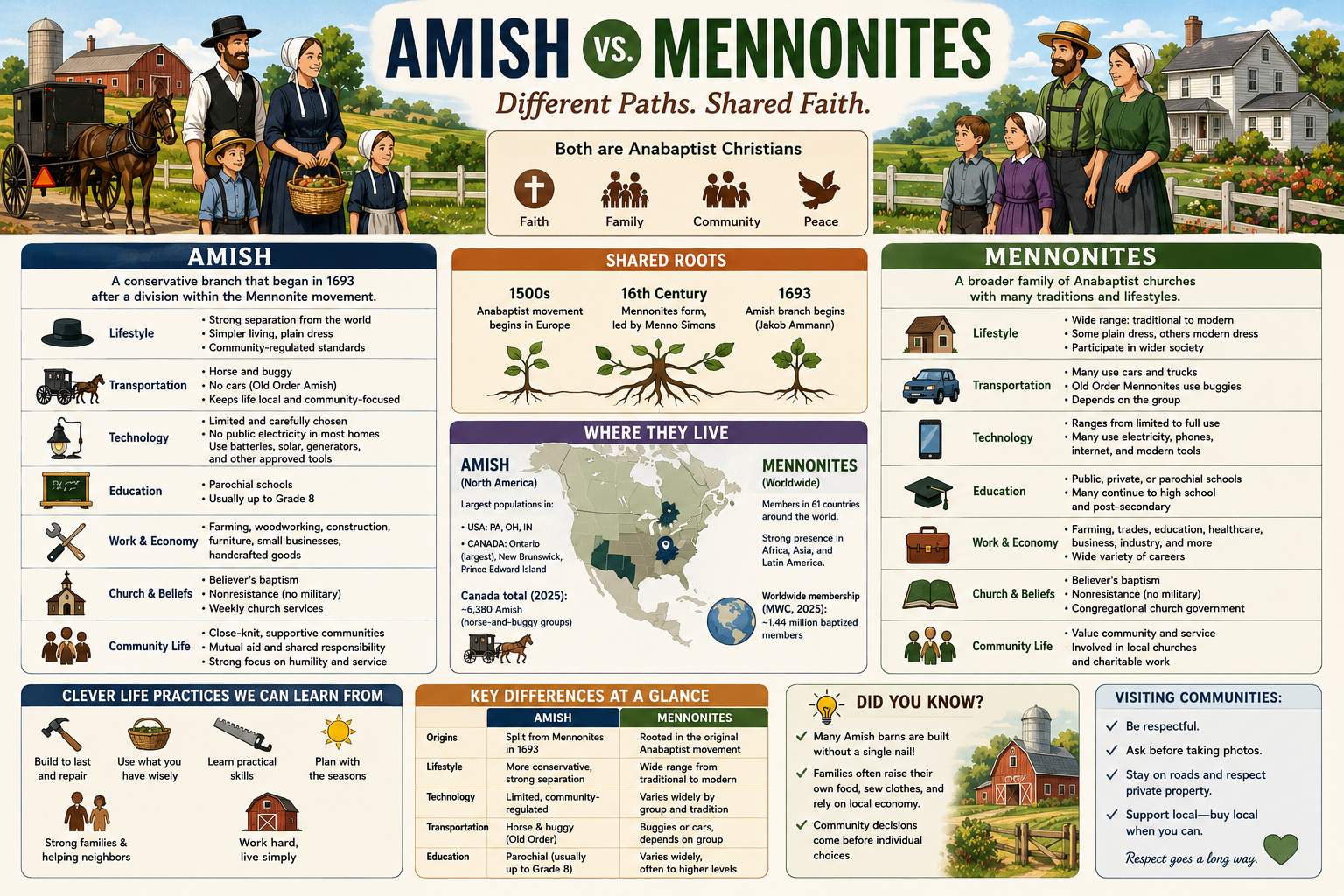
Both Amish and Mennonites are Anabaptist Christians. Their shared roots go back to the Radical Reformation in Europe during the 1500s, when Anabaptists emphasized voluntary adult baptism, living out faith in everyday life, close-knit church communities, and a commitment to peace. The Amish began as a stricter branch within the Mennonite world after a division in the late 1600s.
The main difference today is usually lifestyle and technology, not that one group follows a completely separate religion. Amish communities tend to follow more conservative rules around transportation, public electricity, media, dress, and separation from mainstream culture. Mennonites range from highly traditional Old Order groups to modern congregations whose daily lives look much like those of other Canadians.
A simple overview looks like this:
- Amish: Usually more conservative, often horse-and-buggy based, plain-dressed, community-regulated, and selective about technology.
- Old Order Mennonites: Often visibly traditional too, though their rules and practices differ from Amish communities.
- Conservative Mennonites: May use modern technology carefully while maintaining plain dress and traditional religious values.
- Mainstream Mennonites: Often use cars, electricity, phones, computers, and modern careers, while still identifying with Anabaptist Christian beliefs and community values.
Shared Roots: Where Amish and Mennonites Came From
The Mennonite story begins in Europe during the 1500s. The Anabaptist movement emerged alongside the Protestant Reformation, but Anabaptists believed that baptism should be a voluntary adult commitment rather than something done to infants. They also tended to resist government control over the church, object to military service, and emphasize practical Christian living rather than just formal religious identity.
The name “Mennonite” comes from Menno Simons, a Dutch Anabaptist leader whose writings helped shape and organize many Anabaptist communities during the sixteenth century. Mennonites faced persecution in several European regions, which pushed many communities to migrate over generations through places such as Switzerland, the Netherlands, Germany, Prussia, Russia, and eventually North America.
The Amish split from the larger Mennonite body in the 1690s under the influence of Jakob Ammann, a Swiss Mennonite leader. The disagreement involved church discipline, modest dress, foot washing, and how strictly communities should separate from members who had been disciplined by the church. That split created the Amish tradition, which remained especially strong in North America while most Amish-descended European communities eventually blended back into Mennonite groups.
So the cleanest explanation is this: Amish people are part of the wider Anabaptist family and historically came out of the Mennonite world. They are not simply “Mennonites without electricity,” but they are close religious relatives with shared roots.
Why “Mennonite” Is a Much Bigger Category Than Most People Think
One reason people get confused is that Mennonite identity is extremely diverse. In Canada alone, there are many Mennonite traditions shaped by different migration histories, languages, regions, and church backgrounds. Some families trace their roots to Swiss-German communities that came through Pennsylvania and Ontario, while others descend from Dutch and German-speaking Mennonites who migrated through Russia before settling in Manitoba, Saskatchewan, Alberta, and other parts of Canada.
That means a Mennonite family in Winnipeg, a traditional Old Colony Mennonite family in southern Ontario, a Mennonite Brethren church in British Columbia, and an Old Order Mennonite community near Waterloo may share historical roots but live very differently. They may not dress alike, worship alike, speak the same language at home, or make the same decisions about school, technology, work, and media.
This is why it is not accurate to say that Mennonites “do not use technology” or that all Mennonites are farmers. Many Mennonites are ordinary suburban and urban Canadians. They may work as teachers, tradespeople, business owners, nurses, farmers, engineers, office workers, pastors, and trades contractors.
The Amish are also diverse, but the range is usually narrower in visible lifestyle. Some Amish groups are very strict, while others permit more business technology or limited use of battery power, solar charging, hired drivers, and equipment designed to fit their community rules. The key point is that Amish communities decide technology questions together, not simply as individual consumer choices.
Daily Life: What Does Amish Life Actually Look Like?
Amish life is structured around church, family, work, community, and shared expectations. Most Amish communities follow an Ordnung, which is a set of local rules and customs that guides everyday practices. The Ordnung may cover clothing, transportation, technology, worship, education, business methods, and other details of daily life.
There is no single universal Amish rulebook that applies everywhere. One community may allow a certain kind of battery-powered light, solar charger, or shop tool while another does not. A person who assumes every Amish family lives exactly the same way will quickly get confused, because local church districts can make different decisions.
Many Amish households avoid connecting their homes to the public electrical grid. That does not mean they live without all power, tools, or equipment. Some communities use batteries, propane, compressed-air systems, diesel equipment, solar power, generators kept away from the house, or shop tools adapted to fit local rules.
Horse-and-buggy transportation remains a defining feature of Old Order Amish communities. The purpose is not just nostalgia or dislike of engines. Limiting car ownership helps keep families geographically connected to their local church district, slows down constant travel, and makes it harder for work, entertainment, and social life to pull people away from the community.
Amish families often operate farms, repair shops, construction businesses, furniture shops, markets, food businesses, or other small enterprises. Farming is still important, but it is no longer the only livelihood in many communities. Land prices, family size, and modern economic realities mean that many Amish households need practical trades and small-business income alongside agriculture.
What Is Mennonite Life Like?
Mennonite life depends heavily on the particular congregation or community. A mainstream Mennonite family may have a lifestyle that looks very familiar to most Canadians: cars in the driveway, children in public or private schools, internet access, regular careers, modern homes, and church services in a meetinghouse. Their faith may still place strong emphasis on service, humility, peace, community responsibility, and practical care for others.
Old Order Mennonites are more visibly traditional. They may use horse-and-buggy transportation, plain clothing, limited technology, and separate schools, depending on the group. They are often mistaken for Amish because the outward appearance can be similar, but they are not the same community and do not necessarily follow the same rules.
Conservative Mennonite groups can sit somewhere between Old Order communities and mainstream Mennonite churches. They may use electricity, phones, cars, and certain business tools while still placing more limits on dress, entertainment, media, and church life than mainstream congregations do. There is no single line where one category ends and another begins.
The practical lesson for outsiders is simple: do not assume a person is Amish or Mennonite based only on clothing, a buggy, a farm sign, or a market stand. It is better to let people describe their own community and avoid treating one family as a spokesperson for an entire religious tradition.
Technology: It Is More Selective Than Most People Realize
The popular stereotype is that Amish people reject technology. That is not quite right. A more accurate explanation is that Amish communities evaluate technology based on whether it strengthens or weakens family, faith, humility, local community, and independence from outside pressures.
A cellphone, internet connection, car, or television is not usually judged only on whether it is useful. The question is also whether it makes a household more isolated, more distracted, more consumer-driven, or less connected to the local church community. This is why a tool may be accepted for work but not welcomed inside the home, or why battery power may be allowed while a public utility hookup is not.
Mennonites make technology decisions across a much broader range. Mainstream Mennonites generally use modern technology in the same way as other Canadians. Conservative and Old Order Mennonite groups may place limits on television, internet use, clothing, vehicles, household electricity, or entertainment, but those limits depend on the group.
That difference is one of the reasons people sometimes see Amish-owned businesses using modern-looking tools and think the community is being inconsistent. The real issue is not whether a machine exists; it is how, where, and for what purpose it is used. Technology is treated as something to manage carefully, not automatically accept or automatically reject.
Are Amish and Mennonite People Especially Good Builders?
It is fair to say that many Amish and Mennonite communities have strong reputations for construction, woodworking, farming, repair work, and practical trades. But it is better not to turn that into a myth that every individual is naturally a construction genius. The real strength usually comes from culture, repetition, apprenticeship, high standards, family businesses, and the fact that practical skills are often learned early and used constantly.
A young person who grows up around framing crews, cabinetry shops, barns, roofing, repairs, livestock, gardens, and family-owned businesses gets a lot of hands-on exposure. Skills are often passed down through relatives and local networks instead of being treated as something learned only through a formal course. That creates a deep bench of practical knowledge.
There is also a strong habit of maintaining and repairing things instead of replacing them at the first inconvenience. Tools are cared for, materials are reused when sensible, and work processes may be standardized because the same families and crews do similar jobs repeatedly. None of that requires a person to be Amish or Mennonite, but it does show why these communities are often respected for craftsmanship.
Practical Lessons Worth Learning—Without Romanticizing the Lifestyle
There are useful lessons in Amish and Mennonite community life, but it is important not to turn another group’s faith into a collection of “secret hacks.” Their routines are connected to religious conviction, family structure, church expectations, history, and community support. You cannot copy one habit and expect to recreate an entire way of life.
Still, there are practical ideas that almost anyone can use:
- Build skills through repetition instead of constantly buying new solutions.
- Repair, sharpen, maintain, and clean tools before replacing them.
- Keep a small number of reliable tools rather than a garage full of random gadgets.
- Learn from older or more experienced people in your community.
- Plan food, work, maintenance, and projects around seasons.
- Make time for shared meals, neighbourly help, and hands-on work.
- Be more intentional about which technologies are genuinely useful and which ones mainly create distraction.
- Support local tradespeople, farm stands, markets, and small businesses when possible.
These are not exclusively Amish or Mennonite ideas. They are simply practices that become more visible in communities where family, faith, local work, and self-reliance are treated as priorities.
Where Do Amish and Mennonites Live Today?
The Amish are overwhelmingly based in North America. The largest Amish populations are in the United States, especially in Pennsylvania, Ohio, and Indiana. The Young Center’s 2025 estimate counted more than 410,000 Amish in North America, with the vast majority in the United States.
Canada has an active Amish population too. The Young Center’s 2025 figures list approximately 6,380 Amish in Canada, with the largest concentration in Ontario. It also lists smaller Amish communities in Prince Edward Island and New Brunswick. These figures specifically count horse-and-buggy Amish groups and exclude car-driving groups such as Beachy Amish and Amish Mennonites, which is an important detail when comparing numbers.
Mennonites are much more globally distributed. Mennonite World Conference reported in late 2025 that its member churches included around 1.44 million baptized believers in 61 countries, with most members living in Africa, Asia, and Latin America rather than Europe or North America. That figure does not represent every person who may identify culturally or historically as Mennonite, but it shows that Mennonite life is very much a global Christian movement.
In Canada, Mennonite communities are especially associated with Ontario, Manitoba, Saskatchewan, Alberta, British Columbia, and parts of Quebec, but Mennonites live across the country. Statistics Canada recorded more than 155,000 people identifying as Mennonite in the 2021 Census. That includes people with a wide range of lifestyles, from plain-dressed Old Order communities to urban congregations with fully modern daily lives.
Amish and Mennonite Communities in Canada
Ontario is one of the most visible places to encounter Amish, Old Order Mennonite, and other Mennonite communities. Areas around Waterloo Region, St. Jacobs, Elmira, Wellesley, Milverton, Aylmer, and other rural parts of southern Ontario are well known for Mennonite and Amish history, farms, markets, businesses, and craftsmanship.
Amish communities in Ontario have more than one migration story. Some trace their roots to Amish Mennonite families who came directly from Europe in the 1820s, while other Old Order Amish communities formed through later migration from American states such as Ohio, Pennsylvania, and Iowa. That helps explain why practices can differ even between communities that are only a few hours apart.
When visiting a market, farm stand, bakery, furniture shop, or rural community, treat people respectfully. Ask before taking photos of individuals, do not wander onto private property, be patient around horse-and-buggy traffic, and remember that a handmade product or local food item does not automatically tell you the seller’s exact religious identity. “Amish,” “Mennonite,” and “Old Order” are not interchangeable marketing labels.
Final Thoughts
The Amish and Mennonites share a powerful history, but they are not one uniform group and they are not simply people who “live without modern things.” Both belong to the wider Anabaptist Christian tradition, yet Amish communities generally maintain stronger boundaries around transportation, public electricity, dress, media, and separation from mainstream culture. Mennonite communities range from highly traditional to fully modern, with many different branches in between.
The interesting part is not just the horse and buggy or the plain clothes. It is the deeper question both traditions raise: what kind of habits, technology, work, and community structure helps people live according to their values? Even if you never adopt their religious beliefs or lifestyle, that is a worthwhile question for anyone trying to build a more capable, grounded, family-centred life.
Related External Links
- Amish Population, 2025 — Current estimates for Amish population, settlements, and Canadian provincial distribution from the Young Center for Anabaptist and Pietist Studies.
- Who Are the Mennonites? — A Canadian university resource explaining Mennonite diversity, history, and the differences among Mennonite, Old Order, and Amish communities.
At times I feel envious of these people. A simpler life where there is no such thing as indecision. To be able to just be born into your niche of being a craftsman or whatever and not have to figure out, fail and readjust your own path in life sounds perfect. I don’t think I could live without the Internet or TV though 😂