
When to Harvest Vegetables: A Crop-by-Crop Guide
Growing vegetables requires patience, but harvesting them requires judgment. A seed packet can estimate when a crop should mature, yet weather, soil, sunlight, watering, variety, and planting date all influence the actual harvest. The vegetable itself usually provides a more reliable answer than the calendar.
Picking too early can mean underdeveloped flavour, thin yields, or fruit that never ripens properly. Waiting too long can be equally disappointing. Cucumbers become yellow and seedy, zucchini turn into clubs, eggplants lose their glossy finish, beans become stringy, and lettuce sends up a bitter flower stalk.
Some crops provide a generous harvest window, while others demand close attention. Mature potatoes can wait underground under suitable conditions, but sweet corn may pass through its prime eating stage surprisingly quickly. Zucchini, cucumbers, beans, and lettuce should be inspected frequently once production begins.
This crop-by-crop guide covers the vegetables commonly found in a Canadian backyard garden, including potatoes, tomatoes, cucumbers, zucchini, pumpkins, winter squash, peppers, onions, eggplant, sweet corn, beans, and lettuce. More importantly, it explains the physical signs that tell you when each crop is truly ready.
Vegetable Harvest Guide at a Glance
| Vegetable | Primary sign it is ready | Check or harvest frequency |
|---|---|---|
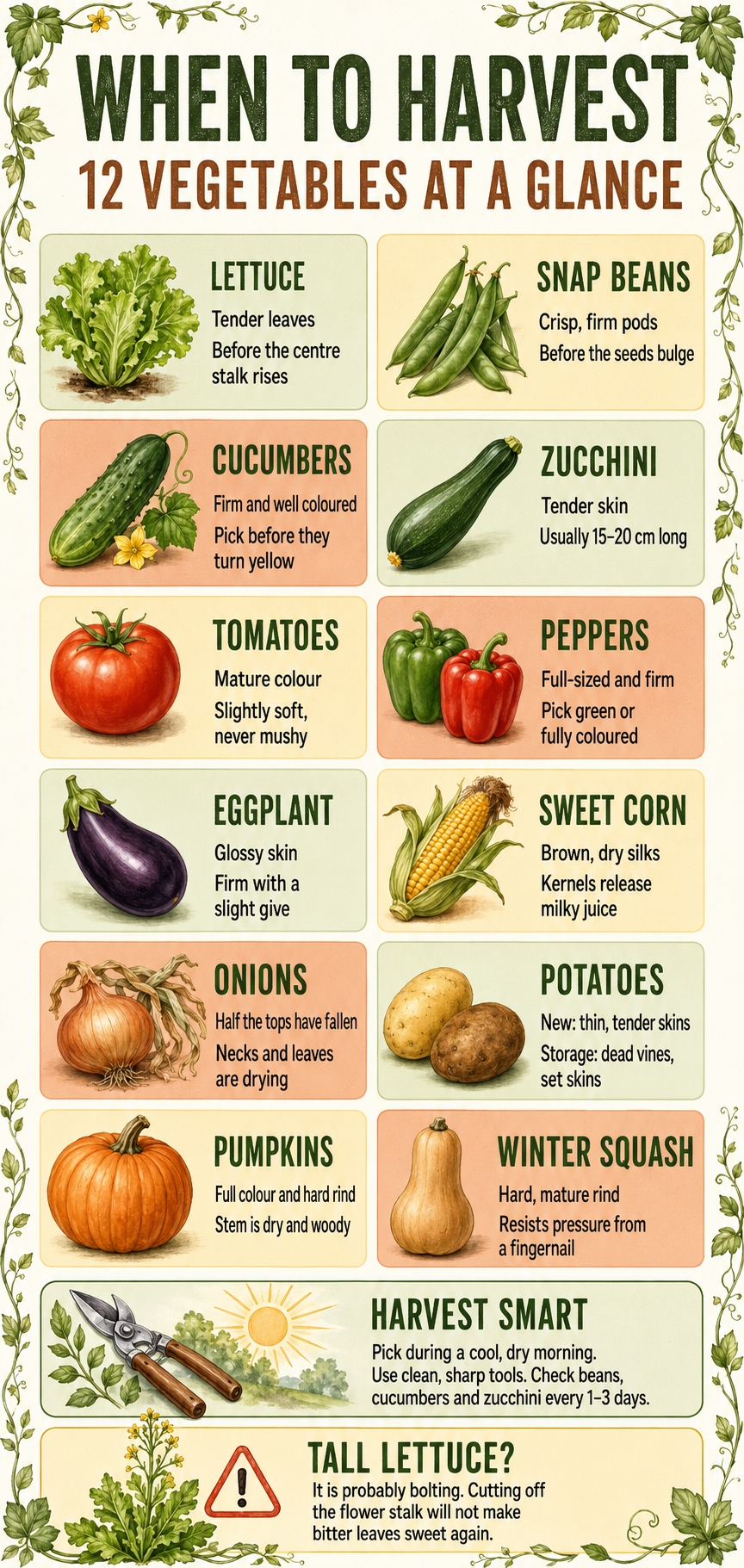
| Lettuce | Tender leaves before the centre stalk elongates | Every few days |
| Snap beans | Firm pods with small, undeveloped seeds | Every one to three days |
| Cucumbers | Firm, dark-coloured fruit at the desired size | Every one to three days |
| Zucchini | Tender skin and relatively small fruit | Every one to two days |
| Tomatoes | Mature colour and slight softening | Every few days |
| Peppers | Full-sized, firm fruit at the preferred colour | Every few days |
| Eggplant | Glossy skin and firm but responsive flesh | Every few days |
| Sweet corn | Brown silks and kernels containing milky juice | Daily once nearly ready |
| Onions | About half the tops have fallen and begun drying | One main harvest |
| Potatoes | New potatoes when young; storage potatoes after vines die | As needed or one main harvest |
| Pumpkins | Full colour, hard rind, and woody stem | One main harvest |
| Winter squash | Hard rind that resists a fingernail and a drying stem | One main harvest |
Learn to Read the Crop
“Days to maturity” should be treated as a planning estimate, not an appointment. Depending on the seed company and crop, the number may be calculated from sowing or transplanting. Cool weather, heat, drought, transplant shock, nutrient problems, and limited sunlight can all delay maturity.
Size is also an imperfect guide. A compact cucumber variety may be fully mature at a size that would seem small beside a long slicing cucumber. A green bell pepper can be harvested before it develops its final red, yellow, orange, or purple colour, while a winter squash must remain on the vine until its rind matures.
Use several clues together: size, colour, firmness, skin texture, stem condition, and the appearance of the plant. Seed packets and variety descriptions remain useful because they reveal the expected mature colour and approximate size. When uncertain, harvest one vegetable, cut it open, and inspect its texture and seed development before picking the entire crop.
Whenever possible, harvest during the cooler part of the morning, after heavy dew has dried. Produce generally loses moisture more slowly when it is not field-hot, and harvesting is easier on both the gardener and the plant. Use clean, sharp scissors, a knife, or pruning shears where appropriate rather than tearing fruit from the plant.
Lettuce: Harvest Before It Bolts
Leaf lettuce can be harvested as soon as the leaves are large enough to use. For a continuous cut-and-come-again harvest, remove the larger outer leaves while leaving the central growing point intact. Another option is to cut the entire plant a few centimetres above the soil, although regrowth depends on the variety, weather, and condition of the crown.
The best lettuce is tender, crisp, and harvested during cool weather. Morning harvesting is particularly helpful during summer because the leaves are hydrated and have not yet been heated by the afternoon sun. Wash the leaves in cool water, dry them thoroughly, and refrigerate them promptly.
A lettuce plant that suddenly grows tall from the centre is usually bolting. Bolting is the plant’s transition from producing leaves to producing flowers and seeds, commonly triggered by heat, long days, or plant stress. The leaves become increasingly tough and bitter as the flower stalk develops.
Cutting off the top of a bolting stalk may temporarily prevent it from flowering, but it does not normally return the plant to its earlier sweet, leafy stage. Once a plant has clearly bolted, the practical options are to taste the remaining leaves and use them if acceptable, pull the plant, or allow a healthy open-pollinated variety to produce seed. Replanting a heat-tolerant variety or waiting for cooler late-summer conditions will generally produce better lettuce than repeatedly trimming a bitter plant.
Snap Beans: Pick Before the Seeds Bulge
Snap beans are harvested while the pods and seeds are still immature. The ideal pod is firm, crisp, and close to its expected full length, but the individual beans inside should not be heavily swollen. Pods that become lumpy, leathery, or difficult to bend have usually passed their best fresh-eating stage.
Once beans begin producing, inspect the plants every day or two. Frequent picking encourages many varieties to continue flowering and setting pods, while overlooked mature beans can slow further production. Hold the stem or vine with one hand while pinching or cutting the pod with the other so that you do not pull out a bush bean or damage a climbing vine.
Do not assume an oversized bean is completely wasted. Mature pods can sometimes be shelled and cooked as fresh beans, while fully dried pods may provide dry beans or seed if the variety is suitable. That is a different harvest stage, however, from the tender snap bean stage.
Cucumbers: Smaller Is Usually Better
Harvest cucumbers when they are firm, well coloured, and appropriate in size for their variety. Many slicing cucumbers are ready around 15 to 20 centimetres long, while pickling cucumbers are deliberately harvested smaller. The exact size matters less than tenderness, colour, and seed development.
A cucumber left on the vine too long often becomes oversized, pale, or yellow. Its seeds enlarge, the flesh becomes watery, and the skin may toughen. Overripe fruit also directs the plant’s energy toward seed maturity rather than continued production.
During warm weather, check productive cucumber vines every one to three days. Fruit can hide beneath leaves and seemingly double in size between inspections. Cut the stem with scissors or pruning shears rather than twisting the cucumber from the vine, which can damage the stem or disturb nearby fruit.
Misshapen cucumbers are not necessarily unripe. Crooked, narrow-ended, or uneven fruit can result from incomplete pollination, inconsistent moisture, or environmental stress. Harvest them while they are still firm and tender rather than waiting for the shape to correct itself.
Zucchini and Other Summer Squash: Do Not Wait for Maximum Size
Zucchini is technically edible at many sizes, but the best quality usually comes from relatively young fruit with tender skin and small, soft seeds. A common target is approximately 15 to 20 centimetres long, although round, striped, yellow, and specialty varieties may have different ideal dimensions.
The rind should appear fresh and should yield easily to a fingernail. Large zucchini are not poisonous, but they develop thicker skin, larger seeds, and a more fibrous or watery interior. They remain useful for baking, stuffing, shredding, soup, or animal feed, but they are no longer at the premium fresh-eating stage.
Once the first fruits appear, inspect the plants daily or every second day. Zucchini grows rapidly during warm weather, and harvesting regularly encourages the plant to keep producing. Cut the fruit with a clean knife or pruning shears, leaving a short section of stem attached.
Avoid damaging the broad leaves and hollow stems while searching beneath the plant. The stems can be prickly, so gloves and long sleeves are helpful. Handle young zucchini carefully because its skin scratches easily.
Tomatoes: Colour, Texture, and Intended Use
A tomato is ready for fresh eating when it has developed the mature colour expected for its variety and has begun to soften slightly. Red tomatoes should no longer have a hard green shoulder unless that colouring is normal for the cultivar. Yellow, orange, purple, striped, and green-when-ripe tomatoes require variety-specific colour cues.
A ripe tomato often releases from the plant with a gentle lift or twist, although cutting the stem avoids unnecessary stress. Pick tomatoes before they become extremely soft, split, or begin attracting insects. During periods of heavy rain, harvesting at the first definite colour change can also reduce losses from cracking.
Tomatoes do not have to become completely ripe on the vine. Once a mature tomato begins changing from green toward white, pink, yellow, or its final colour—the early ripening or “breaker” stage—it can finish ripening indoors. This is useful when animals, cracking, disease, or an approaching frost threaten the crop.
Place ripening tomatoes in a single layer at room temperature and inspect them regularly. Sunlight is not required for ripening; reasonable warmth is more important. Truly immature, dark-green tomatoes may soften without developing the flavour of mature fruit, so do not strip the plant unnecessarily early.
Peppers: Green or Fully Coloured Are Both Valid
Most peppers can be harvested when they reach their expected full size and feel firm. A green bell pepper is generally an immature version of the fully coloured fruit, not a different crop. Leaving it on the plant may allow it to become red, orange, yellow, purple, or another mature colour depending on the variety.
Fully coloured sweet peppers are often sweeter and may have a more developed flavour, but waiting longer exposes them to insects, sunscald, rot, and weather damage. A practical approach is to harvest some green for immediate use and allow others to colour fully. Regular harvesting can also encourage the plant to continue producing.
Hot peppers may change in heat, sweetness, and flavour as they mature, but the pattern depends on the variety. Do not judge every pepper by the behaviour of a jalapeño or bell pepper. Consult the seed description and use gloves when harvesting or processing hot varieties, particularly if you may touch your eyes or face.
Use scissors or pruning shears because pepper branches are brittle. Pulling a fruit can break an entire productive branch. Reject peppers with extensive rot or soft, water-soaked areas, but harmless surface marks can simply be trimmed when the fruit is used promptly.
Eggplant: Harvest While the Skin Is Glossy
Eggplant is best harvested while the fruit is firm and its skin still has a bright, glossy appearance. Press the skin gently with a fingertip; it should yield slightly and then recover. Fruit size varies dramatically among long Asian, small round, white, striped, and large purple varieties, so size alone is unreliable.
An eggplant that becomes dull, bronze, very hard, or excessively soft is usually overmature. Inside, the seeds become more noticeable and the flesh may become spongy or bitter. Waiting for a small-fruited variety to reach supermarket eggplant dimensions will almost certainly result in poor quality.
Cut the stem with pruning shears or a sharp knife and leave the cap attached. Many eggplant calyxes and stems have small spines, making gloves worthwhile. Handle the fruit gently because bruises may not become obvious until later.
Sweet Corn: Catch the Milk Stage
Sweet corn has one of the narrowest harvest windows in the garden. Begin checking when the silks have turned brown and dry but the husks remain green. The ear should feel filled from base to tip rather than narrow and undeveloped at the end.
Peel back a small section of husk and puncture a plump kernel with a thumbnail. Clear liquid indicates that the corn is still immature, while a milky liquid signals the desirable “milk stage.” Thick, pasty material suggests that the kernels are becoming overmature and starchy.
The milk stage often arrives roughly two to three weeks after silks appear, but hot or cool weather can alter that timing. Once the first ear tests ready, inspect the patch daily. Different stalks—and even different ears on the same stalk—may mature at slightly different times.
Harvest by gripping the ear, pulling it downward, and twisting. Cool or cook sweet corn promptly because its sugars begin changing after harvest. Modern varieties differ in how long they retain sweetness, but freshly harvested corn still benefits from quick handling.
Onions: Separate Fresh Onions From Storage Onions
Onions can be harvested early as green onions or used at nearly any stage when a fresh bulb is wanted. Storage onions require more patience. They are generally ready when approximately half of the tops have naturally fallen over and begun drying.
Do not force healthy green tops down in an attempt to make the bulbs mature. Wait for the plant to enter dormancy naturally, then lift the onions carefully with a fork rather than pulling hard on weakened tops. Harvest during a stretch of dry weather if possible.
Onions intended for long-term storage must be cured in a warm, dry, well-ventilated place until the outer skins are papery and the necks are dry and tight. Avoid piling freshly harvested bulbs deeply because trapped moisture encourages decay. Thick-necked, damaged, or flowering onions should be used first rather than placed into long storage.
Potatoes: New Potatoes and Storage Potatoes
Potatoes have two useful harvest stages. New potatoes are young tubers harvested before their skins have set, often beginning several weeks after planting or around flowering, depending on the variety and growing conditions. Their thin skins and waxy texture make them excellent for immediate cooking, but they do not store well.
Carefully dig beside a plant to check tuber development, or gently feel through loose soil and remove a few potatoes while leaving the plant growing. Avoid exposing the remaining tubers to sunlight. Any uncovered potatoes should be reburied because light can cause greening and undesirable glycoalkaloid accumulation.
For mature storage potatoes, wait until the foliage has yellowed, dried, or died back. Allowing the tubers additional time underground after the tops die can help their skins set, provided the soil is not waterlogged and pests are not causing damage. A mature skin should resist rubbing off easily with a thumb.
Dig on a dry day with a garden fork, working far enough from the plant to avoid piercing the tubers. Sort out cut, bruised, diseased, or insect-damaged potatoes for immediate use. Do not wash sound storage potatoes before curing and storing them in darkness.
Pumpkins and Winter Squash: Wait for a Hard Rind
Pumpkins and winter squash—including butternut, acorn, spaghetti, hubbard, and similar storage squash—must mature more fully than zucchini. Look for the characteristic mature colour, a hard rind that resists puncture from a fingernail, and a stem that has become firm, dry, corky, or woody. The vine may also begin declining as maturity approaches.
These crops do not reliably improve from a truly immature state after harvest. Leave them attached until the rind has hardened, but bring them in before a hard frost or prolonged cold conditions damage the fruit. Minor colour changes may occur in storage, but that is not the same as developing full eating quality on the vine.
Cut the stem with a knife or pruning shears, leaving several centimetres attached. Never carry a pumpkin or squash by its stem because the stem can break away and create an entry point for rot. Handle the rind gently even when it appears tough.
Many pumpkins and winter squash benefit from curing under warm, dry, well-ventilated conditions, but curing recommendations vary by species and variety. Acorn squash, for example, is handled differently from some longer-storing types. Confirm the guidance for the variety you grew before placing it into storage.
What to Do Immediately After Harvest
Do not leave harvested vegetables sitting in direct sun while you continue working. Move them into shade and cool appropriate crops promptly. Lettuce, beans, and sweet corn lose quality quickly, while onions, potatoes, pumpkins, and winter squash require drying or curing rather than immediate refrigeration.
Separate damaged produce from sound produce. A cut zucchini or fork-pierced potato may still be perfectly usable that evening, but it should not be placed into long-term storage beside undamaged crops. One decaying vegetable can spread moisture and microorganisms through a container.
Record useful observations in a garden notebook. Note the variety, approximate harvest date, flavour, ideal picking size, pest problems, and how well it stored. Those details will be more useful next summer than the generic maturity number on the seed packet.
Most importantly, inspect the garden regularly once production begins. Harvesting is not a single event at the end of summer. For lettuce, beans, cucumbers, zucchini, tomatoes, peppers, and eggplant, it is a continuous conversation with the plants.
The goal is not to grow the largest possible vegetable. It is to catch each crop at the stage when its flavour, texture, and intended use come together. Learn those signals, and the garden will tell you when dinner is ready.
- University of Minnesota Extension Vegetable Harvest and Storage Guide — Find research-based harvest signs and storage recommendations for commonly grown vegetables.
- Iowa State University Vegetable Harvest Guide — Compare crop maturity indicators, expected sizes, colours, and recommended harvest frequency.
My lettuce is as tall as Yao Ming and as bitter as Donald Trump on Jan 6. I did harvest some yummy leaves before the growth spurt though 😋