
How to Use a South-Facing Patio to Extend Your Growing Season
There is a space attached to many older homes that gardeners tend to overlook. It is not quite part of the house, not quite outdoors, and definitely not a proper greenhouse. It might be called a sunroom, enclosed porch, three-season room, or patio, and for much of the year it ends up holding lawn chairs, tools, and whatever else needs somewhere to go.
But what if that room happens to face south?
I have an enclosed patio with several large south-facing windows and another window facing east. In summer, the place can get ridiculously hot—hot enough that growing plants in there would probably be more trouble than simply carrying them outside. But once I started looking at it from the opposite direction, I realized that the summer overheating problem could become an advantage in October, November, March, and April.
The goal does not have to be turning an old patio into an expensive four-season greenhouse capable of producing tomatoes in January. In a cold climate, that could mean serious insulation, supplemental lighting, significant heating costs, and an uncomfortable dependency on equipment during the coldest nights of the year. A much more practical idea is to use an enclosed south-facing patio as a season-extension room: grow cold-tolerant vegetables later into fall and use the same space to get seedlings going earlier in spring.
Done properly, a room that spends most of the year as a glorified storage area could potentially give a gardener several extra weeks—and under favourable conditions perhaps a month or two—on both ends of the gardening season.
Why a South-Facing Patio Is So Useful
The biggest advantage is free solar energy. In the Northern Hemisphere, south-facing windows receive strong sunlight during the colder part of the year when the sun travels lower across the southern sky. That sunlight does two useful things at once: it provides light for plants and heats everything inside the room.
This is the same basic principle behind cold frames and passive solar greenhouses. Utah State University Extension specifically recommends south- or west-facing locations for season-extension structures because buildings can provide reflected heat, retained warmth, and wind protection. A patio that already has walls, a roof, windows, and a door essentially gives you much of that structure for free.
The effect can be surprisingly dramatic on a sunny day. A cold enclosed growing space can become comfortably warm without the heater running at all. In fact, protected structures can become too warm in sunshine; Utah State notes that even winter high tunnels can climb to about 100°F while still falling close to outdoor temperatures at night.
That last part is important. Sunshine provides an excellent daytime boost, but it does not eliminate the nighttime problem.
Think Season Extension, Not January Tomatoes
The easiest way to make this project expensive and frustrating would be to insist that the patio remain tropical all winter. Keeping tomatoes, peppers, cucumbers, and other heat-loving crops productive while temperatures outside plunge far below freezing is a completely different project from protecting kale in November.
A true winter greenhouse actively controls temperature, ventilation, humidity, and often lighting. That works, but heating a poorly insulated glazed structure during a northern winter can become expensive very quickly. Utah State Extension points out that complete greenhouses can be impractical for many homeowners precisely because winter heating and supplemental lighting costs become substantial.
I would rather use the patio aggressively when nature is already doing most of the work.
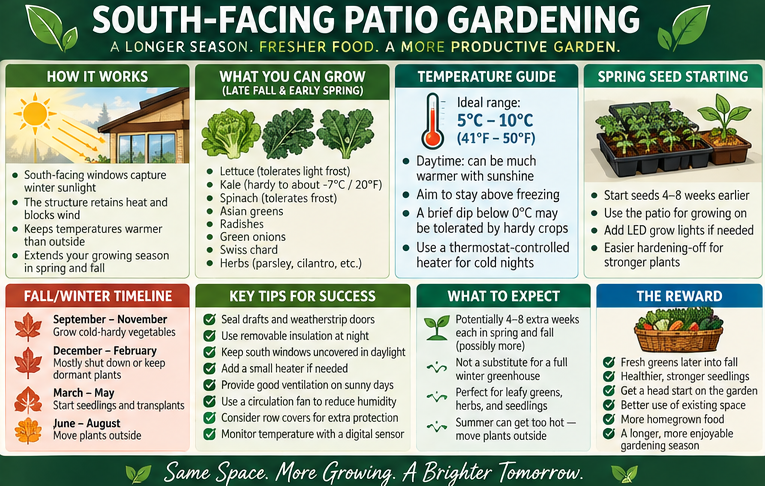
My rough schedule would look like this:
- September through November or December: cold-weather vegetables such as kale, lettuce, spinach, Asian greens, and possibly herbs.
- January and February: mostly shut the growing operation down rather than fighting the worst weather of the year.
- Late March through May: seedlings, cool-season vegetables, transplants, and plants waiting to move into the garden.
- June through August: move the plants outdoors and mostly leave the patio empty unless it has excellent shading and ventilation.
That gives the room a clear purpose without asking it to perform like a commercial greenhouse twelve months a year.
Could This Really Extend the Growing Season by Two Months?
Possibly, but I would not promise a specific number until I had actually monitored the room for a season.
If your normal garden starts getting serious frost in October, but your enclosed patio remains several degrees warmer and receives supplemental heat when necessary, you may be able to keep suitable crops going well into November or December. At the other end of winter, a patio that becomes pleasant during sunny March days could become useful long before outdoor soil is ready for warm-weather planting.
The total difference between gardening exclusively outside and using the protected room could therefore be substantial. But “two extra months” should be treated as a goal to test rather than a guarantee, because everything depends on the construction, drafts, window quality, heating capacity, outside climate, and crops involved.
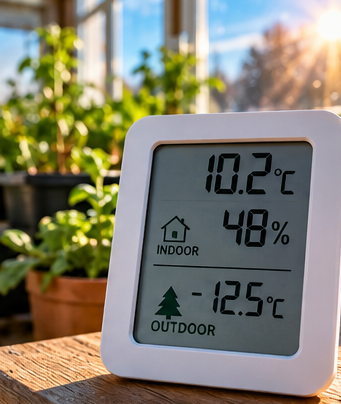
This is where a cheap digital thermometer becomes one of the most valuable pieces of gardening equipment you can own. Put a temperature-and-humidity sensor in the room before doing major renovations and record its minimum temperature every night. Compare that with the outdoor low and you will quickly learn exactly how much protection the room already provides.
What Happens to Lettuce and Kale When It Freezes?
This was one of my biggest questions. Suppose the room is working perfectly in autumn, there are trays of lettuce and kale everywhere, and then one unusually cold November night arrives. Does one dip below freezing destroy the whole crop?
Fortunately, below freezing does not automatically mean dead.
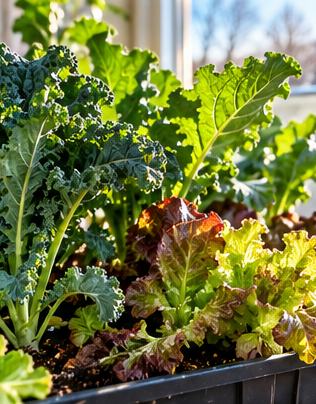
Cool-season vegetables vary tremendously in cold tolerance. University of Minnesota Extension lists established kale as hardy to around 20°F, or approximately -7°C, while leaf and head lettuce can survive light frost. Cabbage and collards are similarly hardy, while crops such as spinach can survive frost and may even overwinter under suitable protection.
That does not mean I would deliberately leave potted kale at -7°C all night just because a chart says it can survive that temperature. Cold tolerance depends on the variety, how gradually the plant acclimated, how long the temperature remains low, wind exposure, plant health, and whether the roots are protected in the ground or sitting in a small pot.
Container plants deserve extra caution. Garden soil contains a huge amount of thermal mass and protects roots much better than a small pot surrounded by freezing air. A kale plant that survives a cold night in the garden may suffer considerably more root damage in a six-inch plastic container.
Lettuce is another plant I would protect sooner. A brief light frost may do very little damage, but repeated hard freezes eventually turn tender leaves into mush. The goal of the patio is not to discover the absolute minimum temperature each plant can survive; it is to keep them comfortably within a range where they continue producing useful food.
What Temperature Should the Patio Stay Above?
For fall greens, I would not try to maintain household temperatures. That defeats much of the economic advantage.
If possible, I would aim to keep the room generally above freezing, with something around 5°C to 10°C (41°F to 50°F) being a much more comfortable buffer for a mixed collection of cold-season vegetables. Sunny daytime temperatures can naturally climb considerably higher, while nighttime temperatures can fall.
That does not mean a brief drop to 0°C destroys everything. Hardy crops may handle it perfectly well. The buffer simply protects you against the problem of thinking the room is at 1°C while the shelf beside a drafty window is actually several degrees colder.
A thermostat-controlled heater becomes useful here because the heater does not need to run continuously. If the room naturally remains above the thermostat setting, it stays off. When nighttime temperatures fall toward the danger zone, the heater provides enough supplemental energy to prevent a hard freeze.
The Real Danger Is the Exceptional Cold Night
Average autumn weather is not the part that worries me. It is that one night when a cold front arrives and temperatures fall dramatically farther than expected.
In an unheated greenhouse or patio, the indoor temperature can eventually approach the outside temperature after sunset. Sunlight stored some energy in the structure during the day, but unless that heat is retained or replaced, it gradually escapes. Extension guidance for season-extension structures warns that nighttime temperatures may end up only a few degrees warmer than outside.
That means the system should be designed around the coldest realistic night of the season you intend to use it, not the average afternoon.
Fortunately, you do not need to heat the room through the entire winter to solve that problem. If your planned growing season ends around December, the heater only has to handle unusual cold events during that limited period. After that, harvest what remains and shut the system down until spring.
Use Layers of Protection Instead of Relying on One Heater
I would not want an entire crop depending on one space heater operating perfectly all night. Heaters fail, breakers trip, power goes out, doors get left slightly open, and thermostats are not always perfectly accurate.
A better strategy is to create protection in layers.
The patio itself is the first layer. Weatherstripping and basic insulation are the second. The heater is the third. On exceptionally cold nights, you can place floating row cover over the plants or even create a small temporary tunnel around the shelving inside the patio.
That “greenhouse inside a greenhouse” approach might seem excessive, but the smaller enclosed volume around the plants is much easier to protect than the entire room. It can provide another useful temperature buffer without requiring you to raise the whole patio to 18°C.
If a truly extreme cold event is forecast, trays and small containers have another enormous advantage: you can move them. Carrying a few flats into the house for one brutal night is much cheaper than designing an entire structure around the coldest temperature that occurs once every few years.
Insulate the Patio Without Turning It Into a Construction Project
My first instinct was to start insulating everything. Then another thought occurred to me: this room already becomes unbearably hot in summer. Would adding insulation make that even worse?
Insulation actually works in both directions. It slows heat movement through walls and ceilings rather than generating heat by itself. The bigger summer problem is usually sunlight pouring through south-facing glass and becoming trapped inside.
Still, I would keep the upgrades simple. I would not tear the entire patio apart and rebuild it like a living room just to grow some lettuce.
The best places to start are boring but effective:
- Weatherstrip the exterior door.
- Seal obvious drafts around windows and trim.
- Insulate accessible opaque walls or ceiling areas where heat is clearly escaping.
- Use removable insulated curtains or panels over glazing at night if practical.
- Leave the valuable south-facing windows uncovered during sunny winter days.
- Add a simple circulation fan to reduce cold pockets and condensation.
The advantage of removable window insulation is that you can collect sunshine all day and then reduce heat loss after sunset. In the morning, open everything again and let the sun take over.
Don’t Cover the Best Windows With Reflective Insulation
Reflective insulation has its uses, but permanently covering south-facing windows with foil-faced material would defeat much of what makes this room valuable.
Those windows are free heaters.
If I wanted reflective material, I would put it on walls that receive little useful sunlight or behind shelving where reflected light could be directed toward plants. Even plain white surfaces can reflect a useful amount of diffuse light without making the room feel like the inside of a spacecraft.
At night, removable insulated panels are a different story. Once there is no sunlight to collect, those same windows become major heat-loss surfaces. A panel that can be installed in the evening and removed in the morning could make much more sense than permanent window covering.
A Word About Space Heaters
A portable electric heater sounds like the easiest solution, but this is one area where convenience should not overrule safety.
Health Canada advises keeping portable heaters at least one metre away from combustible materials, plugging them directly into a wall outlet rather than an extension cord or power bar, and unplugging them before leaving home or going to sleep. That obviously conflicts with the idea of casually leaving a household space heater operating unattended in a patio all night.
For occasional supervised heating, a certified portable heater may still be useful when operated according to its instructions. For an automated system intended to protect plants overnight while nobody is watching it, I would rather investigate a properly installed thermostatically controlled electric heating system rated for the environment, potentially with advice from an electrician.
I would also stay away from improvising with unvented propane heaters in an enclosed attached space. Natural Resources Canada warns that unvented portable fuel heaters should not be used indoors because combustion gases, including carbon monoxide, can create serious hazards.
The vegetables are not worth burning down the house for.
The Patio Could Be Even More Useful in Spring
Fall vegetables were what first made me interested in this idea, but spring may ultimately be where the patio earns its keep.
Many garden plants are normally started indoors weeks before they can safely go outside. University of Minnesota Extension recommends starting peppers roughly eight weeks before outdoor planting and tomatoes about five to six weeks beforehand. Broccoli, cabbage, cauliflower, lettuce, onions, celery, flowers, and many other plants have their own early-start schedules.
A heated south-facing patio could become a dedicated seedling room during that period. Instead of covering tables and windows throughout the house with trays, you could move much of the operation into one bright space built specifically for making a mess.
I would still germinate heat-loving plants under appropriate warmth. Pepper seeds, for example, prefer much warmer germination conditions than an early-spring patio may naturally provide. But once seedlings are established, the patio could become an excellent place for growing them on, especially with supplemental lighting.
Don’t Depend Entirely on Window Light for Seedlings
South-facing windows are valuable, but seedlings have one annoying habit: when they do not receive enough light, they stretch.
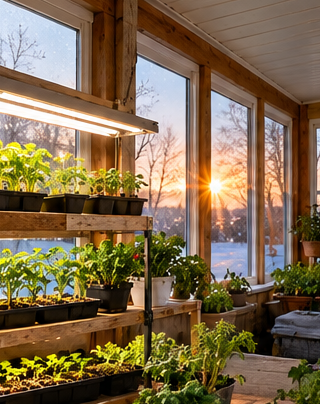
Long, weak seedlings leaning desperately toward the glass are not the head start we are looking for. Spring sunlight helps tremendously, but cloudy weeks and short day length can still leave seedlings underlit. Supplemental LED grow lights over shelving would make the system far more reliable.
You also do not need to light the entire patio like a sports stadium. Put lights directly above the growing shelves and concentrate the electricity where plants are actually located. That allows the windows to contribute free daylight while LEDs provide consistency.
The result could be better than either system alone: sunlight when available, supplemental lighting when needed, and a room that can tolerate the moisture and potting-soil mess far better than the dining-room table.
Spring Hardening-Off May Become Easier Too
Seedlings grown completely inside a heated home experience a shock when they move outdoors. Suddenly there is stronger sunlight, wind, cooler nights, and wider temperature swings.
Gardeners normally solve this through hardening off, gradually exposing seedlings to outdoor conditions over a week or two. An enclosed patio naturally sits somewhere between the house and the garden, which may make it an excellent transition zone.
That does not eliminate hardening off completely, but plants accustomed to cooler temperatures and stronger natural light may already be partly acclimated to outdoor conditions. University of Minnesota recommends gradually exposing seedlings to outdoor sunlight and wind while protecting them if nighttime temperatures approach freezing.
It is another reason I like this project more as a bridge between indoors and outdoors than as an attempt to create permanent indoor agriculture.
What Should You Grow in the Fall?
The best crops are the ones that already prefer cool weather.
Kale is almost an obvious choice because it handles significant cold and can actually taste sweeter after exposure to cool temperatures. Spinach, lettuce, Asian greens, mustard greens, radishes, green onions, Swiss chard, and certain brassicas are also reasonable candidates depending on available space.
University of Minnesota’s fall-crop guidance lists kale, cabbage, Brussels sprouts, and collards among the hardiest crops, surviving temperatures around 20°F under suitable conditions, while many other greens tolerate light frost.
I would avoid filling the patio with plants that immediately collapse at the first frost. Basil, beans, cucumbers, squash, and tomatoes are warm-season crops. You can protect them temporarily, but keeping them comfortable as autumn progresses requires considerably more energy for increasingly less reward.
Choose plants that actually want the conditions you are creating instead of spending money trying to convince summer vegetables that November is July.
Ventilation Matters Even When It Is Cold Outside
One strange problem with a south-facing growing space is that you may need a heater at night and ventilation the very next afternoon.
This sounds ridiculous until you see how quickly sunlight heats a closed glass structure. Season-extension guidance repeatedly warns about daytime overheating, and temperatures inside protected structures can become damaging even when outside air feels cool.
So the room needs an easy way to dump heat. An operable window, door, exhaust fan, or other ventilation system can accomplish that.
Air circulation also helps with humidity. Soil, wet trays, transpiring plants, and cold glass are an excellent recipe for condensation. A small circulation fan can reduce stagnant pockets of damp air, but persistent condensation on wood framing or walls is a sign that the room needs better moisture management.
What About Summer?
I would not fight summer.
If the patio is already scorching hot in July, move the plants outside and let the patio take the season off. You have an entire outdoor growing environment available at that point, so pouring electricity into cooling an enclosed room would solve a problem that does not need to exist.
If the room ever needs to be usable during summer, exterior shading and ventilation are more useful than trying to undo winter insulation. Shade cloth stops a significant portion of the solar energy before it enters the structure, while open windows and fans allow accumulated heat to escape.
But for a dedicated season-extension strategy, simplicity wins. Fall and spring are when this room earns its keep.
Start With Measurements Before Spending Money
The temptation with any DIY gardening project is to start buying insulation, heaters, lights, fans, shelves, thermostats, and fancy controllers before learning what the building actually needs.
I would do the opposite.
Put temperature sensors in the patio first—ideally one near the windows and another farther inside. Record daytime highs and overnight lows for several weeks while also noting the outdoor temperature.
Then start making inexpensive improvements. Seal the door and check the numbers again. Add weatherstripping or removable night insulation and see whether the overnight temperature improves. Only after understanding the natural performance of the room would I choose the heating system.
This turns the project into an experiment instead of a renovation based on guesses.
Why This Is More Practical Than Building a Greenhouse
A dedicated greenhouse would certainly provide more growing space and better light, but it also means purchasing or building an entire structure from scratch. If you already own a south-facing enclosed patio, a large portion of that investment already exists.
The floor is there. The roof is there. The glazing is there. The walls are there. Electricity may already be available, and the room is attached to a building that can provide some thermal buffering.
You are essentially asking whether a space you already own can perform one additional job.
That is the part of this idea I find most attractive. It is not about buying an expensive greenhouse kit to save $18 worth of lettuce. It is about taking an underused part of a property and figuring out whether a few inexpensive changes can make the garden more productive.
For anyone considering the same experiment, University of Minnesota Extension has an excellent overview of ways to extend the growing season with protected structures.
Final Verdict: A South-Facing Patio Can Be a Powerful Gardening Tool
I would not call an enclosed patio a greenhouse just because it has windows, and I would not expect it to grow tropical vegetables through a brutal northern winter without major upgrades. That is where this idea can become expensive very quickly.
But as a season extender, the concept makes a lot of sense.
Seal the major drafts. Preserve the south-facing sunlight. Add modest insulation where it actually helps. Monitor temperature rather than guessing, choose genuinely cold-tolerant crops, and provide supplemental heat only when necessary. Once the worst part of winter arrives, shut down instead of fighting it.
Then, when the sun starts climbing higher again in March, bring the room back to life.
Fill the shelves with seed trays. Start greens. Grow tomatoes and peppers under lights before they are ready to move outside. Use the patio as a protected transition zone while the garden is still waking up.
The goal is not to defeat winter. It is to steal a few extra weeks from it on both sides.
And if a mostly unused south-facing patio can give you fresh kale in late November, shelves full of seedlings in March, and a garden ready to explode into growth by May, that seems like a much better use of the space than storing lawn chairs.