
What’s Growing in My Backyard? Mystery Plums, Strange Vines, Wild Berries & August Garden Lessons
Sometimes the most interesting things growing in a garden are the things you never planted.
That became obvious during a walk around my property in late summer. Beside the vegetables I intentionally planted were several plants I couldn’t immediately explain: a tree covered in hard green fruits that looked almost like giant grapes, a strange vine covered in little pepper-shaped pods, a small flowering shrub, and another bush carrying reddish and black berries at the same time. Meanwhile, the tomatoes had practically taken over a chain-link fence and some of my lettuce was rotting right through the middle.
Instead of treating these as unrelated garden problems, I started looking at the backyard like a little ecosystem. What exactly was growing here? Was any of it edible? Which plants were useful, which were invasive, and what could the garden teach me before the growing season started winding down?
The answers turned out to be surprisingly interesting.
One important warning before getting into the mystery plants: identifying wild plants from photographs is never an absolute guarantee of edibility. Several poisonous or irritating plants produce fruits that look perfectly appetizing. Always confirm an unfamiliar plant independently before eating it, particularly when berries are involved.
The photographs below show some of the most interesting finds from this backyard walk. They also demonstrate why looking at the entire plant—leaves, fruit, stems and growth pattern—is far more useful than judging a plant by its fruit alone.
Mystery #1: The Tree Covered in Hard Green “Apple-Grapes”
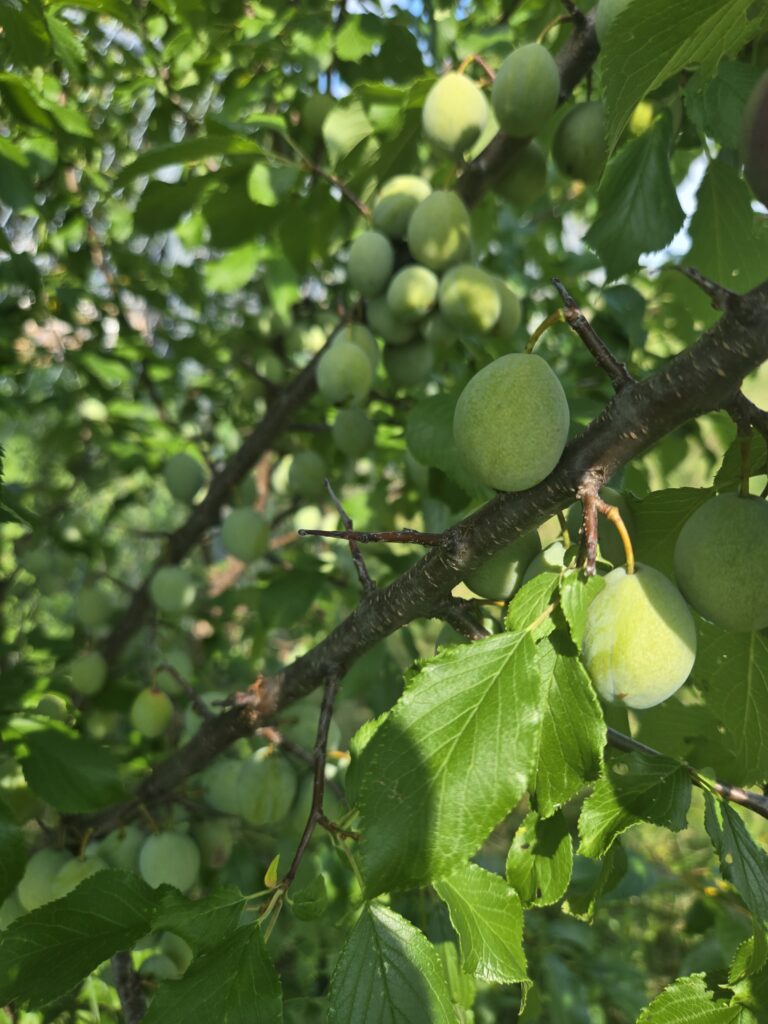
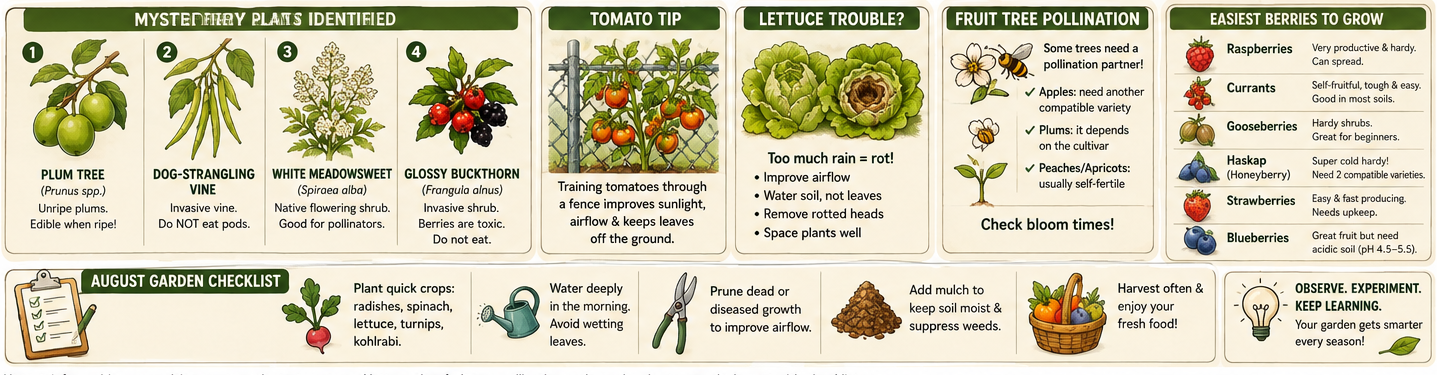
This was probably my favourite discovery because the strange little fruits aren’t grapes at all. Looking closely at the fruit, serrated leaves, branches and stone-fruit appearance, this is clearly a plum-type tree in the genus Prunus, and it looks most consistent with a European-type plum or a related cultivated plum. I would not try to identify the exact cultivar while the fruit is still green, because many plum varieties look almost identical at this stage.
Those hard green fruits are simply immature plums.
As they mature, they’ll soften and may turn purple, blue, reddish, yellow or remain partially green depending on the cultivar. Ontario grows numerous European and Japanese plum cultivars, and the province’s recommended varieties differ considerably in harvest dates, colour, size and pollination requirements.
The sheer amount of fruit on this tree is impressive. It is carrying clusters all through the canopy, meaning that whatever its pollination situation is, something clearly went right this spring.
If the plum identification is confirmed as the fruit ripens, the flesh can obviously become a real backyard food source. Plums can be eaten fresh and are also excellent for jams, preserves, sauces, baking and dehydration. The hard central pit, however, should not be eaten.
What fascinates me is how easily a productive fruit tree can blend into the background when nobody is paying attention. For months it is simply another green tree. Then suddenly August arrives and you realize the branches are hanging with food.
I would absolutely keep this tree.
Mystery #2: Are Those Peppers or Beans Growing on a Vine?
The next plant is much less welcome.
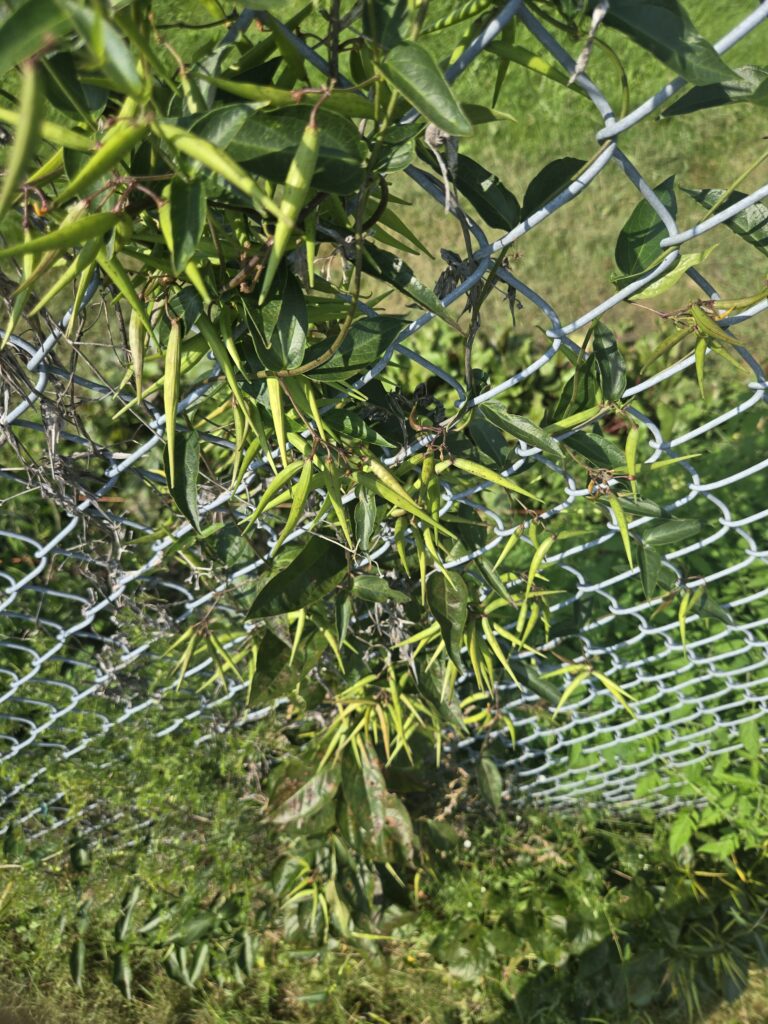
At first glance, the long skinny pods genuinely look like little green peppers or beans. The plant is winding itself through the chain-link fence and producing them everywhere. But those aren’t vegetables.
The plant appears to be dog-strangling vine, a name commonly used in Ontario for invasive swallow-wort species. The combination of a twining growth habit, opposite pointed leaves and long narrow seed pods strongly matches dog-strangling vine. Ontario describes the plant as an invasive perennial vine whose pods eventually release large numbers of wind-carried seeds.
The plant has an interesting—and unfortunate—history. Dog-strangling vine is native to parts of Eurasia and was brought to North America in the 1800s, apparently as an ornamental plant. It escaped cultivation and eventually became a serious invasive plant in Ontario.
Those strange pepper-shaped structures are seed pods. Once mature, they split and release seeds equipped with silky hairs that allow the wind to carry them away. Ontario reports that dense infestations can produce enormous numbers of seeds and that the plant can also regenerate from root fragments.
So despite the vegetable-like appearance, I would not eat the pods, and I would not intentionally keep this plant.
In fact, if you spot the pods before they open, this is a good time to prevent them from spreading seed. With an established vine, simply snapping off the visible top growth may not permanently kill the root system, so controlling it can take repeated effort.
This is also one of the best examples in the garden of why “that looks edible” is not botanical identification. Nature produces an astonishing number of things that resemble beans, grapes, blueberries and cherries without actually being those foods.
Mystery #3: The Little Flowering “Tree”
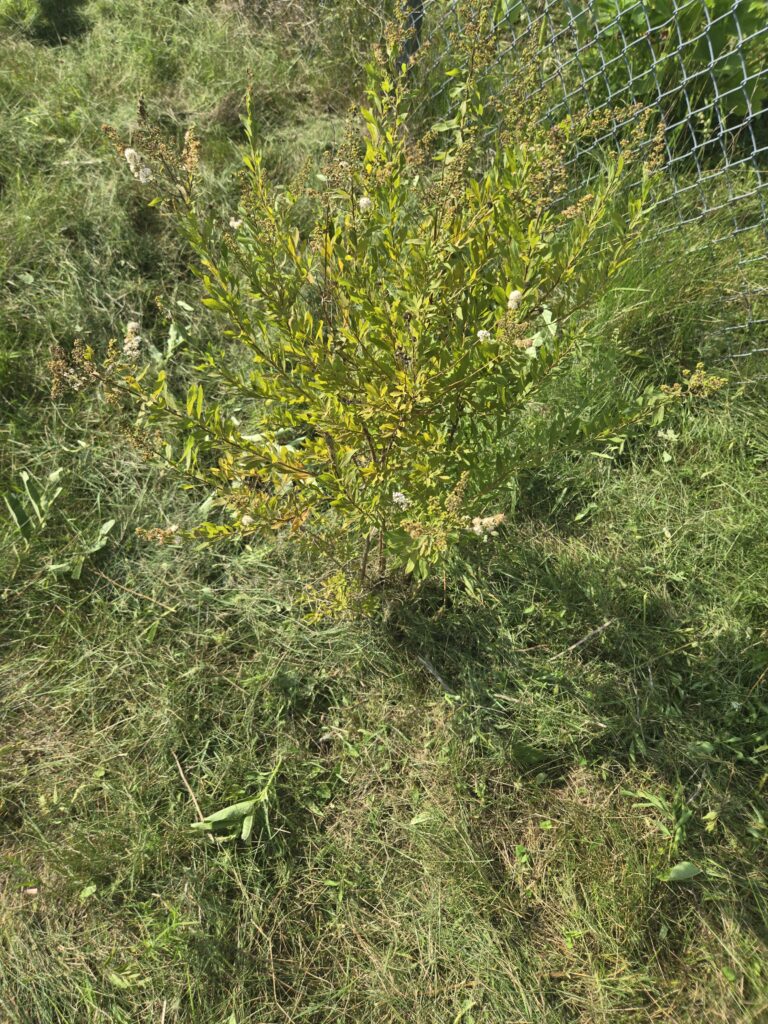
Another plant growing near the fence initially looks like a tiny tree. It has narrow leaves, many woody stems and upright clusters of small white flowers.
My best identification from the photographs is white meadowsweet, Spiraea alba, or a closely related Spiraea. I would call this one a probable identification rather than an absolute one, but the narrow foliage, shrubby form and white flower clusters fit very well.
White meadowsweet is a North American shrub found in moist open habitats, including meadows and similar areas. Canadian ecological documents list Spiraea alba among native vegetation occurring in these kinds of habitats.
Unlike the invasive vine beside it, this is the kind of volunteer shrub I would be inclined to investigate before removing. Native flowering shrubs can provide cover and seasonal flowers while adding some ecological diversity to an otherwise rough fence line.
I would not treat the plant as a food source simply because some wild plants have historical herbal uses. “Historically used” and “safe everyday edible plant” are very different things.
For this one, its greatest value may simply be that it belongs in the landscape.

Mystery #4: Why Does One Bush Have Red AND Black Berries?
The berry shrub is probably the most deceptive plant in the group.
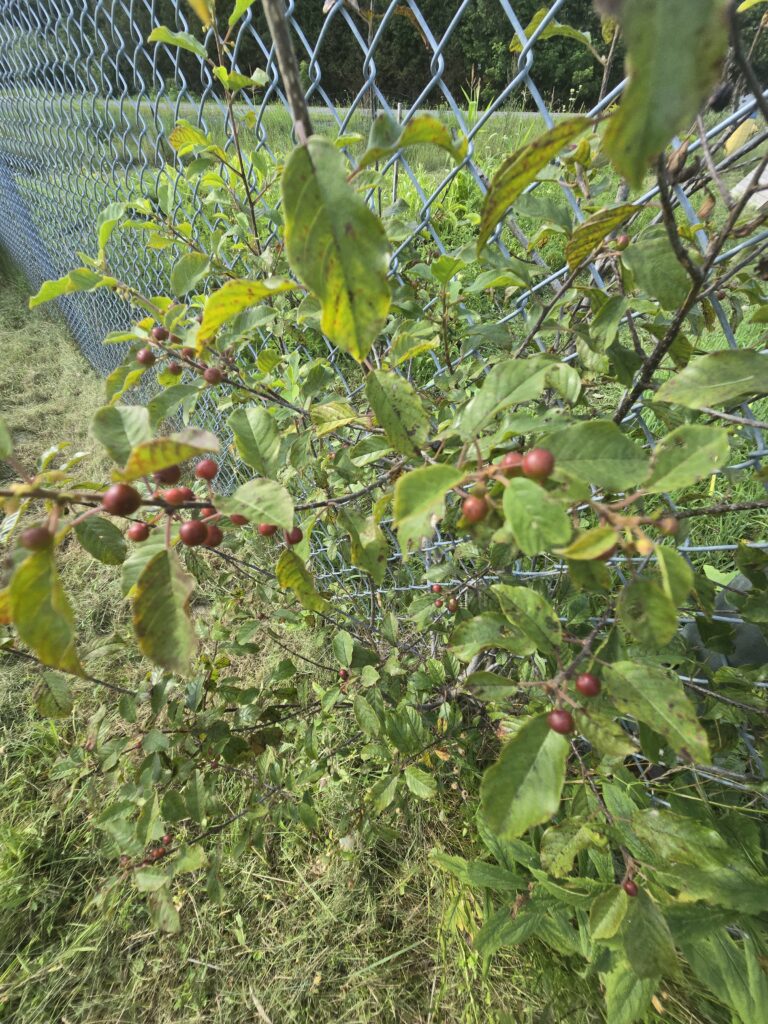
Some berries are reddish or burgundy while others on the same plant are nearly black. That makes it look almost as though two berry species have become tangled together.
However, the foliage, fruit placement and especially that simultaneous red-to-black ripening pattern strongly suggest glossy buckthorn, Frangula alnus. I would still describe this identification publicly as “likely glossy buckthorn,” because a close look at buds, bark and leaf arrangement would make the identification more definitive.
One particularly helpful identification clue is exactly what appears in the photographs: glossy buckthorn fruit progresses from green to red and finally purple-black, and red and black fruit can occur simultaneously on the same shrub.
Unfortunately, glossy buckthorn is invasive in North America.
It can grow into dense stands and compete heavily with other vegetation. Birds and other wildlife consume its fruits and spread the seeds, which is one reason buckthorn can show up repeatedly along fences, forest edges and neglected areas.
And despite their tempting appearance, do not eat these berries. Glossy buckthorn fruit contains compounds associated with laxative and gastrointestinal effects. North Carolina State Extension classifies the plant as poisonous to humans at a relatively low severity, with symptoms including nausea and vomiting.
That makes this plant considerably less exciting than the plum tree.
It also reinforces one of the recurring themes of this little garden investigation: sometimes the plants that look the most edible deserve the most suspicion.
The Tomato-Through-the-Fence Experiment
Then there are the tomatoes.
Instead of installing another complicated trellis, I started feeding tomato branches through the openings of an existing chain-link fence. The idea was simple: spread out the enormous plant, expose more foliage to light and prevent everything from becoming one giant tangled pile on the ground.
It turns out the basic idea is pretty solid.
Training or staking tomatoes increases airflow through the foliage and helps leaves dry more quickly. It also reduces contact between leaves and potentially contaminated soil, which is one reason staking and trellising are recommended as part of disease management for tomatoes.
The chain-link fence therefore becomes a giant free trellis.
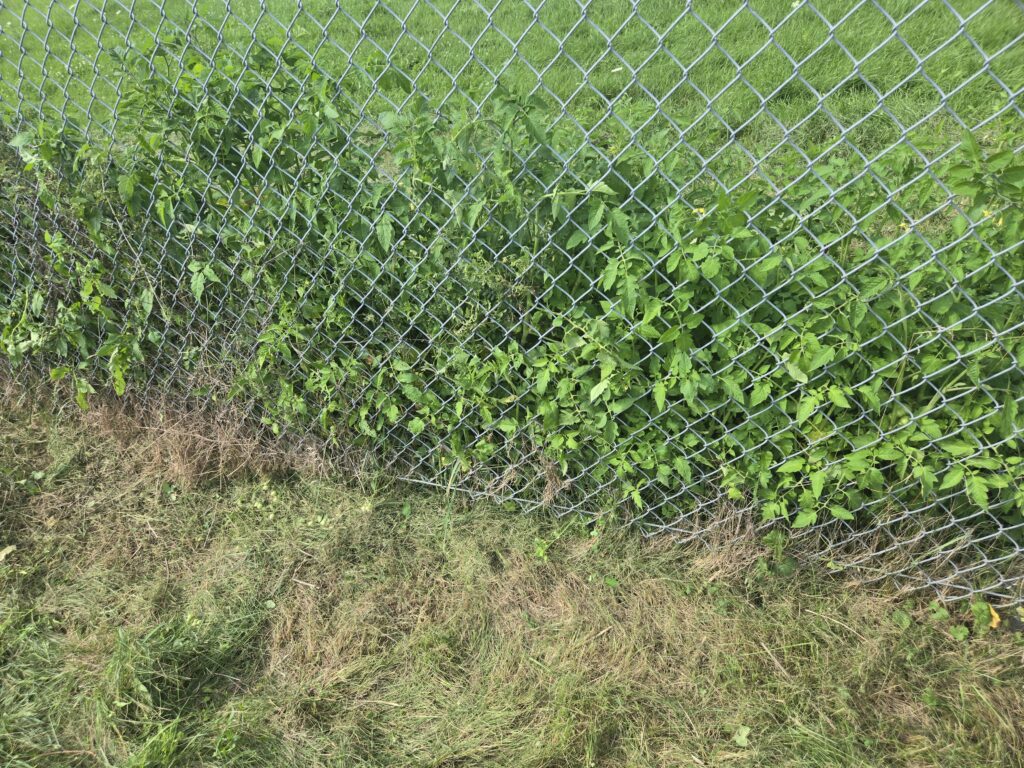
I would make one adjustment, however. Rather than tightly weaving thick tomato stems back and forth through the openings, gently guide younger growth through the fence or loosely attach it with soft plant ties. Tomato stems can become surprisingly thick as the season progresses, and a rigid metal opening can pinch a branch that was loose when it was young.
I would also gradually clear away badly dead or diseased lower foliage. Don’t strip every healthy leaf off the plant—the leaves are what power fruit development—but removing dying foliage near the ground and opening up an extremely dense canopy can improve conditions around the plant.
For a free backyard experiment, though, this one is a success.
Why Is My Romaine Lettuce Rotting in the Middle?
The lettuce problem is less fun.
After a stretch of heavy rain, several heads started looking rotten in the centre. Without a close-up photograph of the actual damaged tissue, I would not claim to know the exact disease, but excessively wet conditions definitely make several lettuce diseases more likely.
One possibility is lettuce drop, also called white mold. It can produce water-soaked tissue and eventually rot right into the heart of the lettuce head. A major clue would be white cotton-like fungal growth and eventually small hard black structures near the base of the plant.
Downy mildew is another wet-weather problem. It commonly causes yellow or brown areas along with whitish fuzzy growth underneath leaves, and damaged tissue can subsequently rot from secondary fungal and bacterial infections.
Regardless of the exact pathogen, the general strategy is similar. Remove severely rotting heads instead of leaving them decomposing among healthy plants, increase airflow where possible, keep foliage dry when you are in control of watering, and avoid watering late in the day.
A few useful habits are:
- Water near the soil rather than regularly spraying the entire plant.
- Give lettuce enough spacing for air to circulate.
- Remove severely diseased plants.
- Don’t work excessively around plants while they’re soaking wet.
- Rotate where lettuce and other susceptible crops are planted.
- During hot, humid summers, consider loose-leaf lettuce rather than relying entirely on tightly packed heads.
The cruel part is that rain usually feels like free irrigation. Sometimes it is. But weeks of wet foliage can turn that free water into ideal disease conditions.
Fruit-Tree Pollination Without the Confusing Jargon
If you’re thinking about planting fruit trees, pollination is probably one of the most confusing parts of buying them.
Fortunately, it is much simpler than garden catalogues sometimes make it sound.
A fruit flower needs compatible pollen in order to produce fruit. Some varieties can successfully fertilize themselves. These are commonly called self-fruitful or self-fertile varieties.
Other varieties cannot reliably use their own pollen. They require pollen from another genetically different but compatible variety. These are self-incompatible varieties.
The key detail is that this usually does not mean you need a “male tree” and a “female tree.”
Apple blossoms contain reproductive structures, but most apples still need pollen from another compatible apple variety. University of Minnesota Extension recommends two different apple varieties for reliable pollination; a suitable crabapple can sometimes provide the second pollen source.
Plums become more complicated because the answer depends on the cultivar. Ontario lists European cultivars including Damson, Stanley and Voyageur as self-fruitful, although even self-fruitful plums may benefit from cross-pollination. Other plum cultivars require appropriate pollen partners.
Some fruits are considerably easier. Ontario recommends peach and nectarine cultivars that are self-fruitful, meaning another cultivar is not required simply to obtain fruit. Apricots are normally self-fruitful as well, although exceptions exist.
So the best rule isn’t:
“Do plum trees need two trees?”
It is:
“Does this exact plum cultivar need a pollinating partner?”
That’s the question to ask at the nursery.
You also need compatible bloom times. Two varieties are not useful pollination partners if one finishes flowering before the other has properly begun.
And interestingly, planting more than one compatible cultivar can sometimes improve fruit set even on plants capable of setting fruit alone. Ontario notes that cross-pollination can improve fruit production in crops such as elderberry.
Which Berry Is Actually Easiest to Grow?
This question became especially interesting after previous attempts at growing blueberries ended badly.
Blueberries have an incredible reputation as an easy backyard fruit because wild blueberries seem to grow perfectly happily on their own. Cultivated blueberries, however, can be unexpectedly fussy about soil.
Ontario recommends acidic soil around pH 4.5–5.0 for blueberries, with some tolerance extending toward 5.5. If your ordinary garden soil is substantially less acidic, simply planting a blueberry shrub and hoping for the best can end in disappointment.
That is why I wouldn’t automatically make blueberries the first fruit for a beginner.
For a cold-climate garden, I’d seriously look at raspberries, currants, gooseberries and haskap.
Raspberries are vigorous and can become extremely productive once established, provided drainage is decent. Their downside is almost the opposite of blueberries: instead of struggling to survive, they can start spreading beyond where you intended them to grow. Ontario provides several raspberry cultivars suited to provincial conditions.
Currants and gooseberries are another underrated choice. Ontario notes that the commonly grown cultivars are self-fruitful, so you don’t need a second cultivar purely for pollination, and they perform in the relatively ordinary soil pH range of roughly 6–7 rather than requiring the highly acidic conditions blueberries prefer.
Then there is haskap, also known as honeyberry.
This might be one of the coolest fruits for northern gardeners. University of Saskatchewan describes haskap as hardy to Zone 1, making it extraordinarily tolerant of cold winters. The major catch is pollination: haskaps are self-incompatible, so you need two compatible varieties flowering at roughly the same time.
If I wanted to build a low-drama backyard berry patch, my starting list would look something like this:
- Raspberries: extremely productive and tough, but contain their spreading canes.
- Currants: hardy, compact and relatively forgiving.
- Gooseberries: another hardy shrub with comparatively straightforward care.
- Haskap: excellent cold tolerance, but buy two compatible varieties.
- Strawberries: quick to produce, although the bed requires ongoing maintenance.
- Blueberries: fantastic once established in properly acidic soil, but not my first recommendation for an “I just want this thing to survive” garden.
I would probably start with raspberries and currants, then add two compatible haskaps.
That gives you three very different crops without making soil chemistry into a second career.
August Isn’t the End of the Garden
Another important lesson from walking the property this time of year is that August doesn’t have to mean the garden is finished.
Some plants are ripening. Some are struggling. Others are starting to die back. But there is still time for a second round of fast cool-season vegetables.
In northern climates, early August can still work for crops including leaf lettuce, radishes, spinach, turnips and kohlrabi. University of Minnesota Extension specifically lists those crops for early-August planting for fall production, and radishes can sometimes be harvested only several weeks after planting.
That means empty spaces don’t necessarily need to stay empty after summer crops come out.
Radishes are probably the easiest experiment. Spinach is another excellent candidate because shortening days reduce the tendency of the plant to bolt compared with midsummer conditions.
August is also a great time to stop merely watering the garden and actually inspect it. Look underneath leaves. Remove heavily diseased growth. Harvest vegetables before they become oversized. Stop weeds from going to seed. Take photographs of problem areas and make notes about which plants thrived and which clearly hated their location.
Gardening gets easier when each season becomes information for the next one.
What This Random Garden Walk Actually Taught Me
What looked like a collection of unrelated backyard plants turned into a surprisingly useful little investigation.
The strange hard “apple-grapes” appear to be immature plums, potentially turning an overlooked tree into a legitimate food source. The bizarre pepper-producing vine appears to be dog-strangling vine—not a vegetable at all, but an invasive plant worth controlling. The small flowering shrub appears to be white meadowsweet, while the mysterious red-and-black berry shrub is most consistent with glossy buckthorn, another plant I would rather remove than eat.
Meanwhile, the deliberate garden is doing its own experiments. The chain-link tomato trellis is basically working. The wet summer is exposing weaknesses in tightly headed lettuce. Previous blueberry failures may have had more to do with soil chemistry than gardening ability. And fruit-tree pollination is finally much easier to understand once you stop thinking in terms of “male and female trees” and start thinking in terms of compatible cultivars.
The bigger lesson might be that a backyard becomes far more interesting when you stop seeing it simply as “grass, trees and weeds.”
Every mystery plant has a story. Some travelled across an ocean before becoming invasive. Some are native shrubs quietly doing exactly what they have done for thousands of years. Some are old fruit trees that may produce food year after year with practically no help at all.
And once you start noticing those details, even an ordinary walk along a chain-link fence becomes a little lesson in botany, food production and self-reliance.
That is exactly the kind of garden I want: not perfect, not sterile, but productive—and always teaching me something new. 🌱
Government of Ontario — Dog-Strangling Vine
https://www.ontario.ca/page/dog-strangling-vine
Government of Ontario — Growing Raspberries and Blackberries for Home Gardens
https://www.ontario.ca/page/growing-raspberries-and-blackberries-home-gardens