
What to Plant in August for a Fall Harvest in Canada
By the time August arrives, many Canadian gardens look as though they are approaching the finish line. Pea vines are beginning to yellow, early lettuce has bolted, radishes are long gone, and empty spaces are appearing where spring crops once grew. It is easy to look at those bare patches and assume the growing season is nearly over.
That assumption can waste some of the most productive weeks of the gardening year.
August is not necessarily the beginning of the end for a Canadian vegetable garden. In many regions, it is the beginning of a second growing season built around quick-growing roots, leafy greens, hardy brassicas, herbs, and vegetables that actually perform better when the weather begins to cool. The real challenge is knowing which crops can realistically finish before winter and which optimistic seed-packet promises should be treated with caution.
A gardener in coastal British Columbia does not have the same August planting window as someone in Edmonton, Winnipeg, Ottawa, Halifax, or northern Ontario. Canada is far too large for one universal planting calendar. However, almost every Canadian gardener can still grow something from seed at the end of July or during August, even if the final harvest consists of baby greens, pea shoots, and small radishes rather than baskets of full-sized vegetables.
Is August Really Too Late to Plant a Garden?
August is usually too late to start tomatoes, peppers, melons, pumpkins, winter squash, corn, and most other heat-loving crops from seed outdoors in Canada. These plants require a long stretch of warm days and nights, followed by enough time to flower, pollinate, develop fruit, and ripen. Planting them in August might produce healthy-looking seedlings, but healthy seedlings are not the same thing as an edible harvest.
Cool-season vegetables operate differently. Radishes, spinach, lettuce, turnips, kale, peas, beets, carrots, and many Asian greens can grow in cooler conditions and tolerate at least some frost. Some of these vegetables become sweeter and more tender after exposure to cool autumn nights.
The practice of replacing harvested vegetables with another crop is known as succession planting. Rather than planting the entire garden once in May, gardeners continue sowing throughout the season. Once peas, garlic, early potatoes, lettuce, onions, or beans are harvested, the empty space can immediately be replanted.
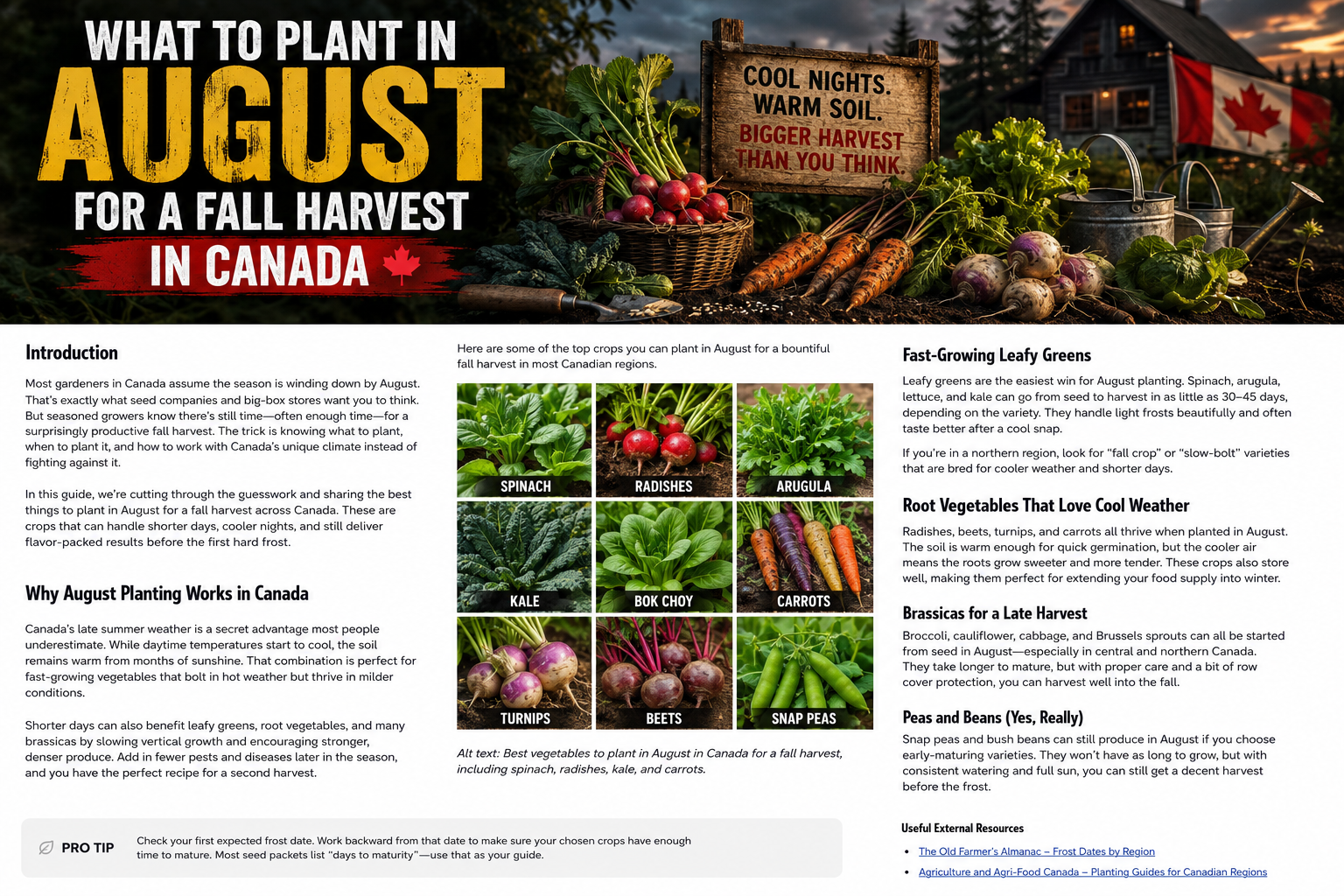
The following image group would fit naturally here because it helps readers identify the vegetables that have the best chance of producing before the first hard frost.
Use Your First Frost Date, Not Just Your Hardiness Zone
Plant hardiness zones are useful, but they are frequently misunderstood. Hardiness zones are primarily designed to estimate whether perennial plants, shrubs, and trees can survive winter conditions in a particular region. They do not tell you exactly when frost will arrive in your backyard or how many usable growing days remain for an annual vegetable.
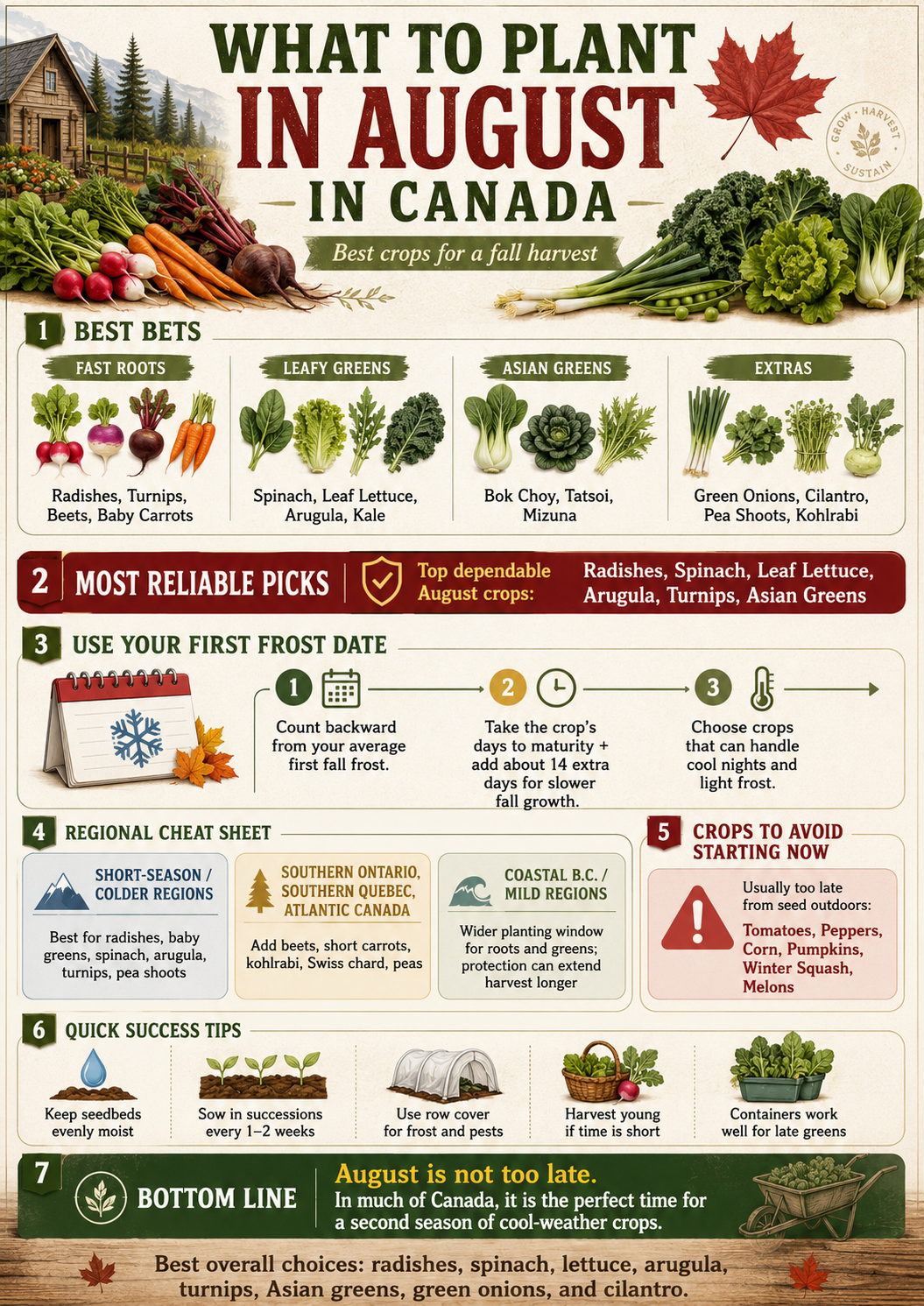
For fall planting, your average first frost date is usually more useful. Search for the average first fall frost in your community and count backward from that date. Then compare the remaining time with the crop’s germination period and listed days to maturity.
Do not take the days-to-maturity number too literally. Seed packets generally assume reasonably favourable growing conditions. Autumn vegetables grow more slowly as the days shorten, sunlight weakens, and nighttime temperatures fall.
A sensible approach is to add approximately two weeks to the maturity estimate. A radish listed as maturing in 28 days should probably be given around 40 days when planted late in the season. A carrot listed at 70 days may need considerably longer, especially if it is planted in the second half of August.
Imagine that your average first frost is October 5. A fast radish planted on August 20 may still have enough time to develop. A 75-day carrot planted on the same date is much less likely to reach full size unless it is protected, harvested as a baby carrot, or left in the soil beneath heavy mulch.
The other important question is whether the crop can survive frost. Frost-sensitive beans may be destroyed by one cold night, while spinach, kale, carrots, turnips, and some Asian greens can continue growing or remain harvestable after light frost.
The Best Vegetables to Plant in August in Canada
Radishes
Radishes are probably the safest vegetable to plant in August. Many varieties mature in approximately three to five weeks, germinate quickly, tolerate cool temperatures, and can be harvested at nearly any useful size. This makes them ideal for gardeners working with a short and uncertain fall season.
Choose quick spring-style varieties such as Cherry Belle, French Breakfast, Easter Egg, or Early Scarlet Globe. Larger winter radishes can also be planted in some regions, but they generally need more time and space.
Plant a small row every seven to ten days rather than sowing the entire packet at once. This spreads the harvest and prevents every radish from becoming ready at the same time. Keep the soil consistently damp because irregular moisture can cause radishes to become woody, excessively spicy, hollow, or cracked.
Radishes are realistic August crops across most populated parts of Canada. Even gardeners with an early September frost may still harvest small roots or edible radish greens under row cover.
Turnips
Turnips are one of the most underrated fall vegetables. Fast varieties can produce baby roots in roughly 35 to 45 days, while their leafy tops can be harvested much sooner. Both the roots and leaves are edible, making turnips useful even when the growing season ends earlier than expected.
Small salad turnips, including Hakurei-style varieties, are especially useful for late planting. They are harvested young and do not require months to produce a large storage root. Their flavour is mild, crisp, and slightly sweet.
Traditional purple-top turnips can also work, although gardeners in short-season regions should expect smaller roots. Thin the seedlings aggressively because crowded turnips often produce impressive foliage but disappointing bulbs.
Cool weather generally improves the flavour of turnips. The roots become milder and sweeter, while the greens remain tender when they are protected from severe frost.
Beets
Beets are useful late-season crops because both the leaves and roots can be eaten. Even if the roots do not reach full size, the greens can still be harvested for salads, soups, stir-fries, and cooked dishes. Young beet greens have a flavour and texture similar to Swiss chard.
Choose varieties described as early, baby, round, or quick-maturing. Sow them slightly more densely than you might in spring, then harvest some of the seedlings as baby greens. This naturally thins the remaining plants and gives their roots more space to develop.
Many traditional beet seeds are actually clusters containing more than one seed. Several seedlings may emerge from what appears to be a single seed, so thinning is usually necessary.
Beets are a strong August option in southern Ontario, southern Quebec, much of Atlantic Canada, and coastal British Columbia. In colder Prairie and northern regions, they are more reliable when planted at the end of July or grown primarily for baby roots and greens.
Carrots
Carrots can be planted for fall, but they are one of the vegetables most likely to be exaggerated in generic August planting guides. Many full-sized carrots need between 60 and 85 days under good conditions. Growth also slows considerably during cool autumn weather.
That does not make August carrots pointless. Short, round, finger, baby, and early-maturing varieties can still produce a useful crop, particularly in southern Ontario, southern Quebec, the Maritimes, and coastal British Columbia. Even partially developed carrots can be harvested and eaten.
Carrots are also fairly cold tolerant. Their flavour may become sweeter after cool weather, and they can remain in the soil after light frost. Gardeners sometimes cover the bed with a thick layer of straw or dry leaves so the roots can be dug later in autumn.
The greatest challenge is germination. Carrot seeds are tiny, slow, and easily killed when the surface of the soil dries out. Water the bed before planting, sow shallowly, and keep the top layer continuously damp.
Some gardeners place a board, damp burlap, cardboard, or lightweight fabric over the row for several days to reduce evaporation. Check beneath the cover every day and remove it as soon as the first seedlings begin emerging.
Leaf Lettuce
Leaf lettuce is a much safer August crop than large head lettuce. Loose-leaf varieties can be harvested one leaf at a time, cut as baby greens, or gathered as small heads before they reach their advertised mature size.
Heat is the main obstacle. Lettuce seed may germinate poorly when the soil is extremely warm, and young plants can bolt during a prolonged August heat wave. Planting in a bed that receives morning sun and partial afternoon shade can improve the odds.
Containers are another useful option. They can be kept in a cooler location during germination and moved into brighter light after the seedlings become established.
Instead of sowing one enormous row, plant a short row every week or two. Staggered sowing reduces the chance that one heat wave, rainstorm, pest outbreak, or early frost will destroy the entire crop.
Arugula
Arugula is one of the easiest fall greens. It grows quickly, can be eaten at a very young stage, and generally prefers cooler weather. Baby leaves may be ready in approximately one month, depending on the variety and growing conditions.
The peppery flavour often becomes milder as temperatures cool. Plants that become harsh and bitter in midsummer may produce more pleasant leaves in September.
Flea beetles are one of the most common problems. These tiny insects chew numerous small holes through the leaves. A lightweight insect cover placed over the bed immediately after planting can protect the crop.
Arugula can be planted repeatedly during August in many Canadian regions. Gardeners in milder coastal areas may continue sowing it considerably later.
Spinach
Spinach is one of the best vegetables for a fall garden, but planting it during the hottest part of August can be frustrating. Spinach prefers cooler soil than most summer crops, and germination may be poor when the ground is hot.
In warmer Canadian regions, waiting until the second half of August may actually produce better results. Gardeners can also pre-sprout the seeds indoors, refrigerate them briefly before planting, or sow them in a shaded section of the garden.
Once established, spinach handles cold surprisingly well. It may stop actively growing once daylight becomes limited, but mature leaves can remain harvestable beneath row cover after tender summer vegetables have died.
Spinach can also overwinter in some regions when protected. The plants may remain small through winter and resume growth early the following spring.
Asian Greens
Bok choy, pak choi, tatsoi, mizuna, komatsuna, Chinese mustard, and other Asian greens are among the best vegetables for a Canadian fall garden. Many can be harvested as baby leaves in 25 to 35 days or as small heads in approximately 40 to 55 days.
These vegetables frequently perform better in fall than in spring because cool temperatures reduce bolting. Instead of rapidly producing flowers and seeds, the plants direct more energy toward tender leaves and compact heads.
Pests remain a concern. Flea beetles, cabbage worms, aphids, and slugs may still be active in August and September. A fine insect mesh or lightweight row cover can make the difference between clean leaves and plants that resemble green lace.
Asian greens are excellent choices for containers, raised beds, small garden spaces, and harvested potato beds. They also tolerate close spacing when grown specifically for baby leaves.
Kale
Kale is extremely cold tolerant, but kale planted from seed in mid-August may not reach the towering size shown in seed catalogues. That is not necessarily a problem. Baby kale can be harvested quickly, while partially mature plants may continue producing leaves late into autumn.
Choose fast-growing varieties and harvest the outer leaves rather than waiting for one large final harvest. The centre of the plant will continue producing new growth as long as the weather remains suitable.
Kale can also be started earlier in trays or small pots and transplanted into spaces cleared by peas, potatoes, onions, or garlic. In colder Canadian regions, transplants are much more reliable than direct-seeding in August.
A light frost can improve kale’s flavour by encouraging the plant to convert stored starches into sugars. Severe cold will eventually damage unprotected plants, but established kale can survive conditions that kill lettuce, beans, basil, and cucumbers.
Swiss Chard
Swiss chard is not as cold tolerant as kale or spinach, but it grows rapidly in warm soil and can produce baby leaves before frost. It is especially useful when planted in early August in regions with a moderate autumn.
Do not wait for enormous stalks. Harvest leaves while they are small and tender. Baby chard can be eaten raw, while larger leaves can be sautéed, steamed, added to soup, or cooked like spinach.
Chard is attractive enough to grow in containers near a porch or entrance. Bright Lights and similar varieties produce red, yellow, orange, pink, and white stems.
Protecting the plants from light frost can extend the harvest. Containers can also be moved into an unheated garage, porch, shed, or greenhouse during unusually cold nights.
Kohlrabi
Kohlrabi looks unusual, but it is one of the better compact vegetables for fall. Early varieties can form small, tender bulbs in approximately 45 to 60 days, and the leaves are edible as well.
The swollen stem develops above the soil rather than underground. It has a mild flavour that resembles a cross between cabbage, broccoli stems, and turnips.
Harvest kohlrabi while it is young. Plants allowed to become oversized can turn tough or woody, especially when growth is interrupted by heat or drought.
Maintain consistent moisture, provide enough spacing, and select a variety advertised for early production. Gardeners in colder areas may have better success using transplants rather than starting from seed in mid-August.
Peas and Pea Shoots
Fall peas are possible, but they are less reliable than radishes, spinach, or lettuce. Peas dislike intense summer heat, yet they still require enough time to flower and produce pods before severe frost arrives.
Gardeners in southern Ontario, southern Quebec, the Maritimes, and coastal British Columbia may harvest pods from a fast dwarf variety planted in late July or very early August. Choose varieties with the shortest listed maturity period.
In regions with a shorter season, grow pea shoots instead. Pea shoots can be harvested young without waiting for flowers or pods. Their tender stems, leaves, and curling tendrils have a sweet pea flavour.
Sow pea seeds densely in a container or garden row and cut the shoots when they are several inches tall. Under good conditions, the plants may produce additional growth after the first cutting.
Green Onions
Green onions, scallions, and bunching onions are worth planting because they do not need to form mature bulbs. They can be harvested at almost any stage once the stems become large enough to use.
Sow them densely in rows or containers and harvest the largest plants first. The remaining onions will gain more room as the row is gradually thinned.
Do not confuse green onions with storage onions. An onion grown from seed in August is extremely unlikely to produce a large, cured storage bulb before winter. The realistic goal is a tender green stalk with a small white base.
Green onions tolerate cool weather and work well in mixed containers alongside lettuce, spinach, arugula, or cilantro.
Cilantro and Dill
Cilantro frequently bolts during hot summer weather, making late summer and early fall one of the better times to grow it. Sow cilantro directly in the garden because it dislikes having its roots disturbed.
Harvest the leaves when they are young. Planting a small amount every two weeks can provide a more continuous supply.
Dill can also produce useful foliage before frost, even when there is not enough time for mature seed heads. Young dill leaves can be used in pickling, potatoes, soups, sauces, and fish dishes.
Both herbs can fill gaps around slower root vegetables. Any plants allowed to flower may also attract beneficial insects, although whether they reach that stage depends on the remaining growing season.
Bush Beans: Possible, but Risky
Bush beans deserve a cautious mention. Many fast varieties can produce beans in approximately 50 to 55 days under warm and favourable conditions.
That makes a late-July planting realistic in many parts of Canada. An August planting is much more of a gamble. Beans are damaged by frost and require warm conditions to flower and develop pods.
Gardeners in southern Ontario, the warmest areas of Quebec, coastal British Columbia, and protected urban gardens may succeed with a very early variety planted around the beginning of August. However, most Canadian gardeners will get a more reliable harvest by using that space for radishes, greens, turnips, or spinach.
Planting beans in August is not impossible. It simply carries a much greater risk than most online planting lists admit.
A Practical Regional Breakdown
Canada’s climate varies so dramatically that the safest August crops depend more on the remaining frost-free days than provincial boundaries. Even two gardens in the same city can experience different temperatures.
Cold air settles into low areas, while urban yards, south-facing walls, fences, rocks, and paved surfaces may hold additional warmth. Gardens exposed to strong wind may cool faster than sheltered spaces.
As a general guide:
- Prairies, northern Ontario, northern Quebec, and colder inland regions: Focus on radishes, baby turnips, arugula, mustard greens, spinach, lettuce, pea shoots, baby kale, microgreens, and transplanted brassicas. Plant as early in August as possible.
- Southern Ontario, southern Quebec, and much of Atlantic Canada: Add beets, short carrots, kohlrabi, Swiss chard, Asian greens, green onions, peas, cilantro, and possibly very early bush beans.
- Coastal British Columbia and Canada’s mildest zones: Gardeners can plant a wider range of greens and roots throughout August. Some hardy vegetables may continue producing into winter beneath protection.
- Very short-season and northern gardens: Concentrate on containers, cold frames, row covers, indoor microgreens, pea shoots, and baby-leaf crops. A small guaranteed harvest is more valuable than a large bed of vegetables that never mature.
These are general guidelines rather than guarantees. Local frost records, microclimates, soil conditions, variety selection, and short-term weather can all change the result.
What About Fruit?
There is no meaningful fruit crop that most Canadian gardeners can start from seed outdoors in August and harvest during the same fall. Tomatoes, cucumbers, melons, squash, pumpkins, ground cherries, and similar fruiting plants require time to establish, flower, pollinate, develop fruit, and ripen.
By August, the remaining growing season is generally too short. Even if the plant grows quickly, the fruit itself may not mature before cold weather arrives.
Strawberries, raspberries, currants, blueberries, grapes, fruit trees, and other perennial fruits can sometimes be planted in late summer or early fall. The goal is to allow their roots to begin establishing before winter.
These plantings are investments in future harvests, not quick fall crops. Many may not produce meaningful fruit until the following year or several years later.
Cucumbers and summer squash are occasionally included in midsummer succession planting guides. A late-July planting may still produce in a warm region, but an August planting should be considered a regional gamble rather than a dependable Canadian recommendation.
The Biggest Mistakes in an August Garden
The first mistake is treating the days-to-maturity number as a guarantee. Those numbers are generally based on reasonably favourable conditions, and autumn growth slows as temperatures and daylight decrease.
Give every crop additional time. Harvest vegetables young when necessary, and assume that growth during October will be slower than growth during August.
The second mistake is allowing the seedbed to dry out. Late-summer soil can become hot and dry within hours. Small seeds may begin germinating and then die if the surface loses moisture.
Water the soil before planting and check it regularly. Temporary shade, lightweight mulch, boards, damp burlap, or row cover can reduce evaporation.
The third mistake is planting cool-weather seeds into blazing hot soil and then assuming that the seeds were defective. Lettuce and spinach may struggle to germinate during a heat wave, even when the seed is perfectly viable.
Choose a shaded location, plant later in the month, or begin the crop in containers. As temperatures cool, the same varieties may germinate with far less effort.
The fourth mistake is refusing to harvest immature vegetables. A small beet, baby carrot, young kale leaf, pea shoot, miniature turnip, or handful of lettuce is still food.
The goal of a fall garden is not necessarily to recreate the oversized vegetables shown on seed packets. The goal is to produce something useful before winter shuts the garden down.
How to Give Fall Crops a Better Chance
Begin by clearing vegetables that are no longer producing. Remove diseased plants completely, but leave healthy summer vegetables that are still providing a harvest.
Loosen the top layer of soil and remove weeds. Add a modest amount of finished compost if the bed has already supported a heavy crop.
Avoid adding excessive fertilizer. Too much nitrogen can create soft, leafy growth that is more vulnerable to pests, disease, and cold damage.
Water the soil before sowing rather than attempting to soak a dry bed afterward. Plant slightly more seed than you might in spring because heat, insects, birds, and inconsistent moisture can reduce germination.
Thin the seedlings once they become established. Crowded vegetables compete for light, water, nutrients, and root space.
A lightweight row cover is one of the most valuable tools in a Canadian fall garden. It can reduce insect damage, soften strong wind, conserve some warmth, and protect vegetables during light frost.
A simple low tunnel can be made with flexible pipe, wire hoops, wooden supports, or other available materials. Cover the frame with frost fabric, but secure the edges so wind cannot lift it.
Plastic sheeting can trap more heat, but it also requires careful ventilation. A sealed plastic tunnel can become dangerously hot on a sunny autumn day.
Containers are another useful option. They can be shifted into better light, placed against a warm wall, moved away from severe weather, or brought into an unheated porch during cold nights.
Lettuce, spinach, arugula, radishes, cilantro, green onions, pea shoots, baby kale, and Asian greens are particularly suitable for containers.
Why an August Garden Matters
Fall planting is not only a way to squeeze a few more vegetables out of the year. It improves the efficiency of the garden, keeps the soil occupied, reduces space available to weeds, and spreads food production over a longer period.
For homesteaders and self-reliant households, this matters. A productive vegetable garden should not operate as a single annual event where everything is planted in May and harvested in September.
A better system keeps changing throughout the season. One crop replaces another whenever weather, time, and space allow.
Early radishes can be replaced with beans. Peas can be followed by kale. Garlic beds can be replanted with lettuce, turnips, or Asian greens.
There is also something satisfying about harvesting fresh vegetables after the first cold nights arrive. A bowl of spinach, kale, radishes, turnips, or late lettuce in October feels different from a summer tomato.
It proves that the end of summer does not have to mean the end of food production. With thoughtful crop selection and basic protection, Canadian gardens can remain productive much later than many people expect.
Final Verdict: What Should You Actually Plant?
For the safest return, plant radishes, turnips, arugula, Asian greens, leaf lettuce, spinach, pea shoots, baby kale, green onions, and cilantro.
Add beets, short carrots, kohlrabi, Swiss chard, and peas when your local frost date gives them enough time. Treat bush beans, cucumbers, squash, broccoli from seed, and full-sized cabbage as calculated risks unless you live in one of Canada’s mildest regions or already have established transplants.
The real answer is not hidden in a universal Canadian planting chart. It comes from combining your local first frost date, the crop’s realistic growth time, its tolerance for cold, and your willingness to provide protection.
Planting in August is never completely guaranteed. Leaving good soil empty, however, guarantees that it will produce nothing.
Start with one cleared bed, one container, or a few short rows. Sow the fastest crops first, keep the soil damp, and use frost protection when the nights begin to cool.
Canada’s growing season may be short, but in many regions, it is longer than gardeners think.
Dalhousie University — Succession Planting
https://www.dal.ca/faculty/agriculture/news-events/news/2020/07/28/succession_planting.html
Natural Resources Canada — Canada’s Plant Hardiness Site
https://planthardiness.gc.ca/
Definitely going to give radishes and green onions a shot. The rest of my seeds like cucumbers will be planted in containers inside. I should try giving micro greens another shot. The Asian greens sound interesting though I might sow those and I’d like to prep a bed for a garlic harvest the following year.