

The Mosquito Bucket of Doom: Does This Simple Backyard Mosquito Hack Actually Work?
There is something wonderfully backwards about the idea behind the so-called “Mosquito Bucket of Doom.” For years, homeowners have been told that standing water is the enemy: dump your buckets, empty the wheelbarrow, clean the gutters and never leave stagnant water sitting around your property. Then along comes a mosquito-control trick that tells you to deliberately fill a bucket with water, throw dead leaves or grass into it, let the whole thing get nasty, and actually encourage mosquitoes to lay their eggs inside.
It sounds like exactly the wrong thing to do. In fact, if you leave out the most important ingredient, it is exactly the wrong thing to do. But when the bucket contains an approved larvicide based on Bacillus thuringiensis israelensis, better known as Bti, the idea starts making considerably more sense. Instead of trying to repel every adult mosquito flying through your yard, you’re attempting to trick egg-laying females into sending the next generation into a dead end.
And despite the ridiculous name, this isn’t just another social-media gardening hack built entirely on wishful thinking. Versions of the mosquito bucket have been discussed by university extension programs and mosquito-control specialists, while Bti itself is a well-established biological mosquito larvicide. The real question isn’t whether Bti can kill mosquito larvae—it can—but whether placing one or more deliberately attractive breeding buckets around a backyard can make enough of a difference to actually notice.
What Is a Mosquito Bucket of Doom?
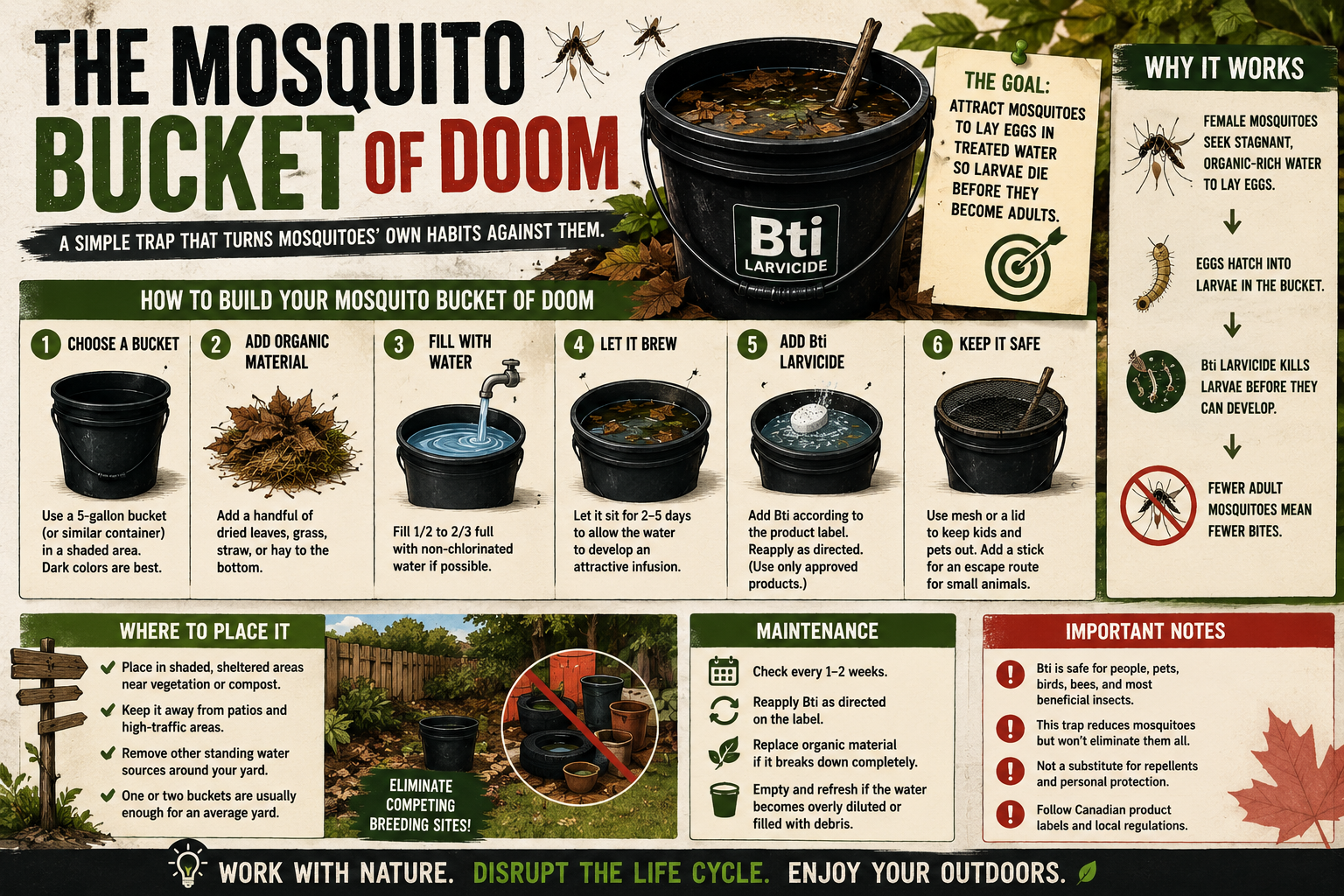
A Mosquito Bucket of Doom is essentially a simple homemade larval trap. You take a bucket or similar water-holding container, add water and decomposing plant material, and allow the mixture to become attractive to female mosquitoes looking for somewhere to lay eggs. The water is then treated with an appropriately labelled Bti mosquito larvicide so that larvae that hatch in the bucket die before they become flying adults.
This is related to the concept of an ovitrap, a type of trap that exploits the egg-laying behaviour of mosquitoes. Mosquito surveillance programs have long used dark water-filled containers to attract certain mosquito species, particularly container-breeding mosquitoes. Black or dark containers are commonly used in professional ovitrap designs, although colour is only one factor influencing where a mosquito decides to lay eggs.
The rotting leaves, grass, hay or straw aren’t there to feed mosquitoes deliberately. As the vegetation decomposes, microorganisms proliferate and the water develops the odours associated with an attractive larval habitat. University extension versions of the bucket commonly use dried leaves, straw, hay or grass clippings for exactly this reason.
The basic concept looks like this:
- A bucket or other water-holding container
- Water
- A handful of dried leaves, grass, hay or straw
- A Canadian-registered mosquito larvicide containing Bti
- Optional mesh or another barrier to keep children and animals out
- A stick or other escape route for small animals that could accidentally fall in
What makes this different from an ordinary forgotten bucket behind the shed is the Bti. Without larvicide—or frequent draining before larvae mature—you haven’t built a mosquito trap. You’ve built mosquito habitat.
Why Would Mosquitoes Voluntarily Go Into the Trap?
Mosquitoes don’t simply wander around looking for humans to annoy. After mating and taking the blood meals required by many species for egg production, females need appropriate places to deposit their eggs. Water is critical because mosquito larvae and pupae are aquatic, although different mosquito species use very different kinds of water and egg-laying strategies.
Some mosquitoes readily exploit artificial containers around homes. Buckets, tires, flowerpot saucers, rain barrels, toys, gutters and other objects capable of holding surprisingly small quantities of water can become breeding habitat. Culex mosquitoes can use stagnant water, and some species form floating rafts containing many eggs, while several Aedes mosquitoes deposit eggs individually on container surfaces near the waterline.
This is where the fermented plant material becomes useful. Instead of offering fresh tap water in a sterile bucket, the trap attempts to mimic the sort of nutrient-rich little aquatic ecosystem that some gravid female mosquitoes investigate as a nursery. Researchers and mosquito surveillance programs have used hay infusions and other organic mixtures as mosquito attractants for years, so the smelly-water aspect isn’t merely backyard folklore.
A dark bucket may provide another useful visual cue. Studies of container mosquitoes have found relationships between darker containers and mosquito presence or egg-laying behaviour, although species, container size, surrounding habitat, water quality and other factors also matter. In other words, buying a black bucket isn’t the secret ingredient—but if you already have a dark bucket or bin sitting around, it can be perfectly suitable.
The Ingredient That Turns the Trap From Crazy to Clever: Bti
Bti stands for Bacillus thuringiensis subspecies israelensis. It is a naturally occurring soil bacterium used as a biological larvicide against organisms including mosquito, blackfly and fungus-gnat larvae. When susceptible larvae ingest Bti toxins, their digestive systems are disrupted and the larvae die before completing their development into adults.
This matters because the larval stage is dramatically easier to target than an adult mosquito flying around a neighbourhood. Once a mosquito becomes an adult, it can move between properties, hide in vegetation and continually be replaced by other adults emerging elsewhere. Larvae, on the other hand, are concentrated in water and cannot simply fly away when conditions become hostile.
Health Canada recognizes Bti-containing products as one type of mosquito larvicide and recommends using approved larvicides when breeding water cannot reasonably be emptied, drained, flushed or regularly changed. Canadian pesticide products should carry a Pest Control Product, or PCP, registration number, and the product label determines where and how it may legally be used.
That last point is worth emphasizing because internet recipes frequently tell readers to use a quarter of a mosquito dunk every month or some other universal dose. There is no reason to guess. Products, formulations and approved uses can differ, so read the Canadian label and use the amount and replacement interval specified for the particular product you purchase.
How to Make a Mosquito Bucket of Doom
Building the trap itself is almost embarrassingly easy. A standard five-gallon bucket works well, but there is nothing magical about five gallons. A smaller or larger container can work as long as it reliably holds water and can be positioned somewhere it won’t be tipped over, played with or mistaken for something useful.
Start by putting a modest amount of dried organic material in the bottom. Old leaves, straw, hay or some dried grass clippings are commonly recommended. You aren’t trying to fill the entire container with compost; you just need enough plant material to begin decomposing and changing the character of the water.
Add water until the bucket is roughly half to two-thirds full. Leaving some room at the top makes the container easier to manage and reduces overflowing during rain. Some extension instructions recommend allowing the organic material to sit for several days before introducing the larvicide so the infusion has time to develop.
Then add your Bti product according to its label. That’s the step that converts a bucket of mosquito habitat into a larval control device. If the label requires the treatment to be replaced after a certain period or after particular conditions, follow that interval rather than relying on a random recipe found online.
Finally, consider basic animal and child safety. A screen, coarse mesh or modified lid can limit access while still allowing mosquitoes into the water, and an escape stick can provide a way out for a small animal or insect that accidentally falls in. Put the bucket somewhere stable where young children cannot access open water.
Where Should You Put It?
The goal is not to put your fermented mosquito bucket beside the barbecue table and spend dinner smelling swamp water. Position it somewhere unobtrusive around the edge of your outdoor space, ideally near the type of shaded or sheltered habitat where mosquitoes already tend to rest and breed. A garden edge, hedge, compost area or damp portion of the yard may make considerably more sense than the centre of an open sunny lawn.
There is another important strategy: remove competing breeding water. If there are fifteen untreated flowerpot saucers, two clogged gutters, a wheelbarrow full of rainwater and three toys collecting water beside your treated bucket, mosquitoes have plenty of alternatives. Health Canada specifically recommends eliminating standing water throughout the property because even small quantities can provide breeding habitat.
That means the most logical setup isn’t “create lots of stagnant water.” It is almost the opposite:
- Dump unnecessary standing water.
- Clean clogged gutters.
- Turn unused containers upside down.
- Change birdbath and pet water regularly.
- Screen rain barrels.
- Correct areas where water continually accumulates if possible.
- Maintain one or a few intentionally managed Bti-treated buckets where appropriate.
Think of the bucket as the controlled option left behind after you’ve made the accidental options less attractive.
Does the Mosquito Bucket Actually Work?
Here is where we should separate two questions that frequently get mashed together on social media.
Does Bti kill mosquito larvae? There is very good evidence that it does. Bti has been used in mosquito-control programs for decades, and regulatory agencies including Health Canada and the U.S. Environmental Protection Agency recognize Bti-based mosquito larvicides. The EPA states that Bti has been shown to reduce mosquito larval populations when appropriately applied.
Will one bucket eliminate mosquitoes from your backyard? That’s a much bigger claim, and nobody should promise it.
The bucket can only affect mosquitoes that choose that container—or another Bti-treated water source—as breeding habitat. Mosquitoes emerging from your neighbour’s property, a roadside ditch, a wet woodland, a flooded field, a marsh or hundreds of other water sources don’t care how clever your bucket is. Some species also prefer breeding habitats completely different from a backyard container.
This distinction is probably the most important thing to understand about the entire hack. A mosquito bucket is a population-management tool, not a force field.
The Evidence Supporters Point To
The strongest case for the mosquito bucket isn’t that thousands of homeowners swear they received fewer bites. Anecdotes are interesting, but weather, wind, rainfall and seasonal mosquito cycles change so dramatically that it’s extremely difficult for someone standing in their backyard to determine exactly why there seem to be fewer mosquitoes this week.
The stronger argument is that all of the individual pieces of the system are biologically credible. Mosquitoes use water for larval development. Several important species readily use artificial containers. Organic infusions are used to attract egg-laying mosquitoes. Bti kills susceptible mosquito larvae, and removing untreated breeding sites is already a standard part of mosquito-control recommendations.
University extension organizations have therefore begun promoting variations of this strategy for homeowners. North Carolina Cooperative Extension, Ohio State University and other extension programs describe Bti-treated mosquito buckets or similar larval traps as practical backyard mosquito-control tools.
That’s considerably more convincing than “I saw it on TikTok,” but it still doesn’t mean every yard will experience a dramatic reduction.
The Biggest Problem With the Viral Version
The internet has an unfortunate ability to turn a sensible pest-management technique into a magic trick.
Someone installs one bucket, doesn’t get bitten for twenty minutes and announces that mosquitoes have been “eliminated.” Someone else dumps leaves into water but forgets the Bti and unknowingly raises a generation of mosquitoes. Then someone adds dish soap, vinegar, essential oils, mouthwash or whatever else happened to be under the kitchen sink.
That isn’t the experiment we’re talking about.
The science-based version is remarkably boring: eliminate unnecessary breeding sites and use an approved larvicide correctly where appropriate. Health Canada specifically warns that many gadgets marketed for mosquito control—including electronic mosquito repellers and bug zappers—aren’t effective at controlling mosquito populations.
The mosquito bucket is interesting precisely because its mechanism is less flashy. It interferes with mosquito reproduction instead of claiming to surround your property with an invisible mosquito-repelling aura.
Can the Bucket Accidentally Make Your Mosquito Problem Worse?
Absolutely—if you use it incorrectly.
Mosquito larvae can develop surprisingly quickly. CDC information for some Aedes mosquitoes gives an egg-to-adult development time of approximately seven to ten days under favourable conditions. If your larvicide is absent, exhausted, improperly applied or washed out and the bucket remains attractive to egg-laying females, successful adults may eventually emerge.
That is why this isn’t a “fill it and forget it until Thanksgiving” project. Check the water periodically. Make sure the larvicide remains present and is replaced according to the product label, and dispose of the bucket or empty it when you no longer intend to maintain it.
If you’re unsure whether the system is working, take a close look at the water. Mosquito larvae are often called “wigglers” because of their distinctive movement and can sometimes be observed rising toward the surface. Seeing larvae isn’t necessarily evidence that the Bti failed immediately—the larvae must encounter and ingest it—but seeing pupae or adults consistently developing should trigger an immediate review of the treatment and label directions.
Why This Can Still Matter in Late Summer
It is tempting to think mosquito control becomes pointless once August arrives, especially in Canada. In reality, mosquito activity can continue well beyond midsummer depending on species and weather. Quebec’s public-health guidance notes that West Nile virus infections are seasonal but can continue into fall until the first frosts, while Ontario surveillance of mosquito-borne disease continues throughout the mosquito season.
Ottawa Public Health notes that the majority of human West Nile cases in Ontario historically occur during August and September. That doesn’t mean everyone should panic about every mosquito bite, but it does destroy the idea that mosquitoes suddenly become irrelevant once the kids start thinking about going back to school.
Wet weather can also continually create temporary water sources. Buckets, tarps, clogged gutters, low spots, garden containers and forgotten outdoor equipment can refill every time it rains. Late-season mosquito control therefore remains worthwhile anywhere the insects are still active.
The Bigger Bushcraft Lesson: Work With the Life Cycle
What I like most about the Mosquito Bucket of Doom isn’t actually the bucket. It is the philosophy behind it.
Bushcraft, homesteading and self-reliance become much more interesting when you stop treating nature as a collection of enemies that must be blasted with chemicals. Often the better solution is to understand a species’ behaviour well enough to manipulate the conditions around it. Mosquitoes need suitable aquatic habitat to reproduce, so controlling that vulnerable stage can be far more targeted than trying to kill every adult insect that flies through the yard.
That doesn’t mean “natural” automatically means safe, superior or effective. Plenty of natural pest remedies are useless, and plenty of synthetic products are extremely effective when properly used. The sensible standard isn’t natural versus chemical—it is whether the method has a plausible mechanism, evidence behind it and an acceptable risk when used properly.
The mosquito bucket does reasonably well under that test.
What the Bucket Cannot Do
There are limits worth understanding before declaring war on the mosquitoes behind your shed. No bucket can stop every mosquito, and no larval trap replaces sensible personal protection when mosquitoes are heavy or mosquito-borne disease is a concern.
A bucket will not:
- Instantly kill adult mosquitoes already flying around.
- Prevent mosquitoes from neighbouring properties from entering your yard.
- Control every mosquito species in the surrounding environment.
- Replace removing obvious untreated standing water.
- Guarantee a bite-free patio.
- Replace repellents, protective clothing or other recommended personal protection when appropriate.
Bti also shouldn’t be treated casually simply because it is a biological pesticide. Use a Canadian-registered product for the labelled purpose, follow its directions and don’t invent your own concentration.
Final Verdict: Clever Mosquito Control or Internet Nonsense?
The Mosquito Bucket of Doom has one of those names that makes it sound far sillier than it actually is.
The basic premise is legitimate. Some mosquitoes actively seek stagnant, organically rich water for egg laying. Bti is an established larvicide capable of killing mosquito larvae. Deliberately combining an attractive breeding container with larval control therefore creates a logical reproductive trap rather than simply hoping mosquitoes dislike the smell of a candle.
But expectations matter. Putting one bucket behind a suburban house isn’t going to exterminate every mosquito within a kilometre. The approach makes considerably more sense as part of a larger strategy: eliminate untreated standing water, maintain a controlled Bti-treated trap, reduce other breeding opportunities and protect yourself from adults that remain.
For the price of an old bucket, some yard waste and an appropriate larvicide, however, it is an unusually interesting experiment. Unlike many viral pest-control hacks, the underlying biology actually checks out.
And there is something satisfying about the method. Instead of spending the summer running around swatting mosquitoes one at a time, you’re quietly sitting in the background sabotaging the next generation.
Sometimes the best trap is the one your enemy willingly chooses.
Relevant External Resource
Health Canada — Mosquito Control and Approved Larvicides:
Health Canada mosquito control guidance