
The Fall Garden Reset: How to Prepare Your Garden Now for a Better Harvest Next Year
By the end of summer, a vegetable garden can look like it has fought a small war. Tomato vines are sprawling everywhere, cucumber leaves are turning questionable colours, weeds have discovered your moment of weakness, potatoes are coming out of the ground, and some plants that looked unstoppable in July suddenly seem exhausted. It is tempting to harvest whatever is left, pull everything out, shut the gate and declare gardening season over.
That is exactly when one of the most useful parts of the gardening year begins.
Fall is the bridge between this year’s garden and next year’s harvest. What you do after harvesting can improve the soil, interrupt some pest and disease cycles, preserve seeds, protect nutrients from erosion, establish crops such as garlic and turn piles of autumn leaves into free garden material. In a cold climate such as Ontario or Quebec, the months before the ground freezes are not wasted time—they are an opportunity to quietly stack the odds in favour of next year’s garden.
The goal isn’t to obsessively sanitize every square inch or dig the garden into oblivion. A good fall garden reset is more strategic than that. You remove what could cause trouble, preserve what is useful, feed and protect the soil, plant what benefits from winter, and properly store the food you already spent months growing.
What Is a Fall Garden Reset?
Think of a fall garden reset as closing one growing season while simultaneously beginning the next. Instead of seeing October or November as the end of the gardening calendar, it helps to think of winter as another stage in the system. Soil organisms keep working whenever conditions allow, organic material continues decomposing, garlic establishes roots underground, seeds remain dormant and mulch protects the surface from wind, rain and temperature swings.
This matters because exposed soil is not necessarily healthy soil. Ontario agricultural guidance emphasizes that maintaining organic matter improves soil structure, moisture-holding capacity, nutrient retention and drainage, while cover crops can help protect soil from erosion and add organic matter. Those recommendations are written largely for agricultural production, but the principles scale surprisingly well to a backyard garden.
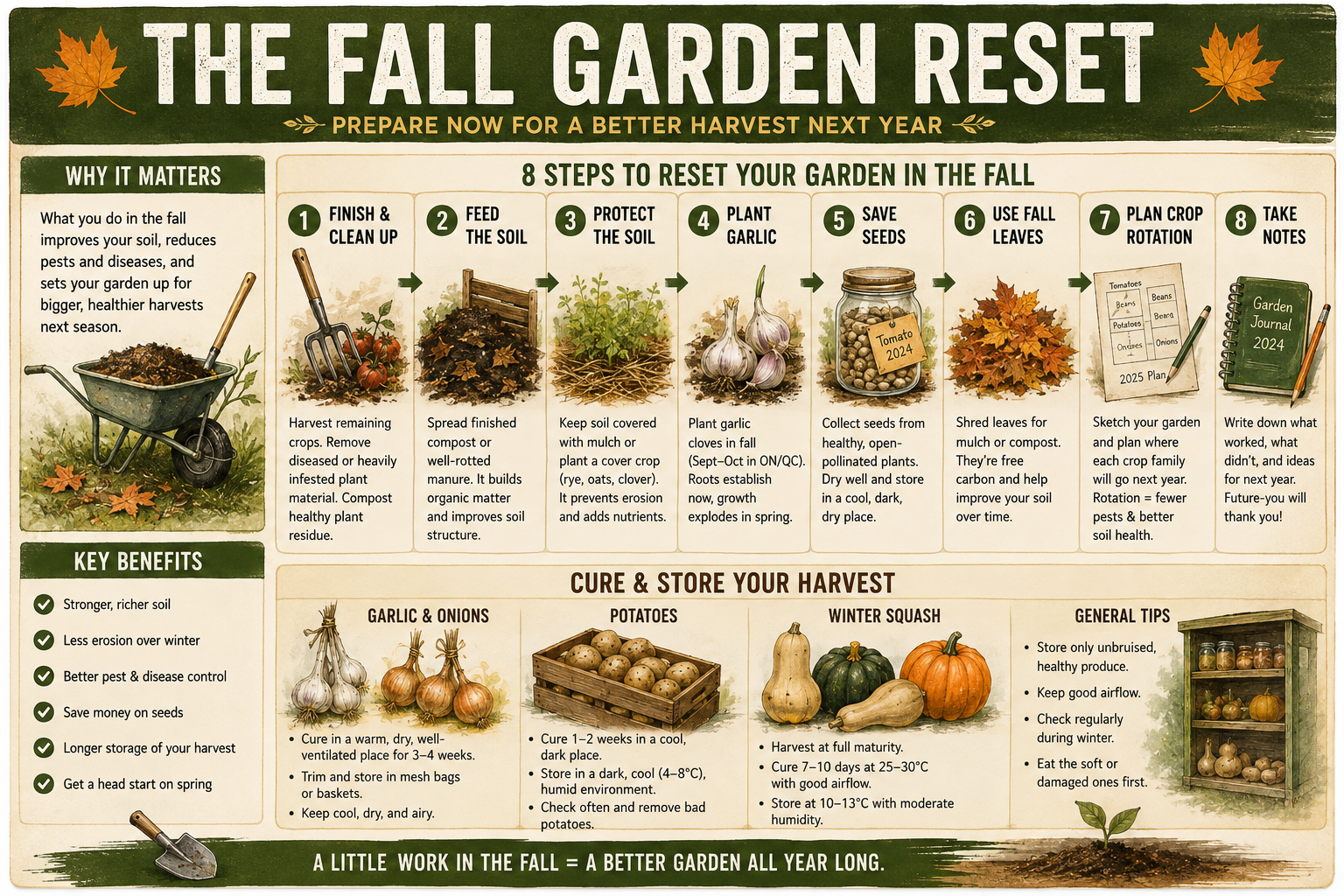
The fall reset can be reduced to a handful of jobs:
- Finish harvesting and inspect the garden.
- Remove diseased or badly pest-infested material.
- Leave or compost healthy organic material where appropriate.
- Add finished compost or other suitable organic amendments.
- Protect exposed soil with mulch or a cover crop.
- Plant garlic for next summer.
- Save seeds from suitable vegetables.
- Cure storage crops properly.
- Take notes while you still remember what worked and what failed.
None of these jobs is particularly complicated. The advantage comes from doing several small things at the right time rather than trying to repair everything next spring.
Start With an Autopsy of This Year’s Garden
Before ripping everything out, spend ten minutes looking at what actually happened. Which bed produced exceptionally well? Where did water collect after storms? Which crops stayed stunted? Did tomatoes repeatedly show disease symptoms? Were certain areas constantly dry while others remained wet? Your garden has been running a months-long experiment, and fall is when you finally get to read the results.
This is also a good time to make a crude garden map. You don’t need specialized software—draw the beds on paper and write down where your tomatoes, potatoes, beans, cucumbers, squash, onions and other major crops grew. Crop rotation becomes surprisingly difficult when you’re standing outside next May trying to remember whether potatoes were in the left bed or the right one eleven months earlier.
If a bed consistently performed poorly, resist the urge to blindly throw fertilizer at it. Consider a soil test, especially before applying phosphorus, potassium or lime. Ontario’s garlic guidance, for example, specifically recommends checking soil phosphorus and potassium rather than automatically applying them. More fertilizer is not synonymous with better soil; excessive nutrients can create problems just as deficiencies can.
Clean Up the Garden—But Don’t Sterilize It
Traditional fall garden advice sometimes sounds like you’re supposed to remove every leaf, stem and scrap of vegetation until the property resembles a freshly vacuumed living room. There are good reasons to clean up some material, but stripping everything isn’t automatically beneficial.
Plants that were heavily affected by disease deserve special attention. If tomato vines, squash leaves or other crops suffered serious disease problems, removing that infected material rather than leaving it directly in the growing bed can reduce the amount of contaminated residue waiting for next season. Obviously infested or diseased material also deserves more caution before being added to a casual cold compost pile, where temperatures may never become high enough to reliably destroy every pathogen or weed seed.
Healthy plant material is different. Roots left in the soil eventually decompose and contribute organic matter while leaving tiny channels through the ground. Clean leaves and chopped vegetation can become compost, mulch or material for future beds rather than being treated as garbage.
The principle is simple: remove problems, recycle resources.
Feed the Soil Instead of Just Feeding Plants
A productive garden isn’t merely dirt plus fertilizer. Healthy soil contains mineral particles, air, water, organic matter and an enormous biological community. Improving that system tends to create a garden that is more resilient than one dependent entirely on repeated fertilizer applications.
Finished compost is one of the easiest fall amendments for a home gardener. A modest layer spread over the surface can contribute organic matter while winter moisture, freeze-thaw cycles, worms and soil organisms gradually incorporate it. There is usually no need to bury compost deeply by aggressively tilling an established garden.
Ontario guidance notes that organic matter helps soil retain moisture and nutrients while improving structure and drainage. Organic additions such as compost and manure are among the dependable ways of maintaining or gradually increasing that organic matter, although building meaningful soil organic matter is a slow process rather than something accomplished with one wheelbarrow load.
This is where skepticism toward miracle soil products is healthy. You do not need seventeen bottled amendments because someone on social media claims your tomatoes require volcanic minerals harvested during a full moon. Start with soil testing where appropriate, quality compost, plant residues, mulch, sensible crop rotation and good drainage. Get the fundamentals right before spending money trying to optimize the final five percent.
Don’t Leave Good Soil Naked All Winter
Once a vegetable bed has been cleared, many gardeners leave the soil completely exposed until May. It certainly looks tidy, but a bare surface is vulnerable to erosion, crusting, nutrient movement and repeated pounding from fall rain and spring snowmelt.
One alternative is mulch. Shredded leaves, clean straw and other suitable organic materials create a protective blanket while slowly breaking down. The mulch also suppresses some weed germination and can help moderate temperature and moisture fluctuations.
The other option is a cover crop, sometimes called green manure. Instead of harvesting the crop for food, you grow it primarily to protect or improve the soil. Ontario guidance identifies winter cereals such as rye and wheat as fall-planted options that can provide winter and spring erosion protection, while other cover crops may winter-kill and leave residue behind.
Cover-crop choice deserves a little planning because every crop behaves differently. Winter rye is extremely hardy and can produce substantial spring growth, which is wonderful if you want biomass but less wonderful if you discover in May that you’ve accidentally created a tiny rye farm. Oats and some other crops may winter-kill in colder areas, which can make spring management easier.
For a small backyard garden, don’t overcomplicate it. Cover crops are tools, not commandments. If you’re comfortable managing them, they are useful; if not, a layer of suitable organic mulch is considerably better than abandoning soil simply because the sophisticated option sounds intimidating.
Autumn Leaves Are Free Garden Material
Every autumn, homeowners spend an extraordinary amount of effort gathering leaves so someone can take them away. Gardeners then spend money the following year buying bags of organic material to put back onto the same property.
There is an opportunity somewhere in there.
Healthy deciduous leaves can be shredded with a mower and used as mulch, added to compost as a carbon-rich “brown,” piled separately to make leaf mould, or spread over pathways where they gradually decompose. Shredding helps prevent large leaves from matting together into a water-resistant layer, although intact leaves can still be useful in appropriate areas.
Leaves are particularly valuable if you maintain a compost system because summer usually provides enormous quantities of nitrogen-rich green material while winter leaves gardeners scrambling for carbon. Bagging some dry shredded leaves and storing them beside the compost pile gives you a ready supply of browns throughout the following season.
Just don’t treat every leaf as automatically harmless. Material heavily contaminated by a serious plant disease or invasive pest deserves appropriate disposal rather than enthusiastic redistribution around the garden.
Plant Garlic Now and Harvest It Next Summer
Garlic may be the perfect example of why fall gardening matters. In Ontario, garlic is normally treated as a winter annual: you plant cloves in autumn, they establish roots before winter, experience the cold period they need, explode into growth the following spring and are harvested the next summer. Ontario’s vegetable-production guidance gives an autumn planting period beginning around September and extending through late October, although exact timing varies with location and weather.
Hardneck garlic is particularly common in Ontario because it handles cold winters well and produces the delicious curly flower stalks known as scapes. Softneck garlic generally stores longer but tends to be more associated with milder climates, although both types are grown in Ontario. For a first planting, buying healthy seed garlic adapted to your region is a much better bet than randomly planting whatever bulb happens to be sitting in the supermarket.
Keep your planting bulbs intact until relatively close to planting time. When you’re ready, separate them into individual cloves without unnecessarily damaging the basal plate or stripping away the protective wrapper. Large, healthy cloves are generally the ones worth planting; questionable, damaged or rotting cloves aren’t where I would gamble valuable garden space.
Ontario production guidance recommends planting cloves with the pointed end upward and notes that upside-down cloves can develop crooked shoots and misshapen bulbs. Current OMAFRA guidance lists roughly 2.5–5 cm of soil above the clove depending partly on soil type, with shallower planting in heavier soils and somewhat deeper planting providing additional winter protection. In-row spacing around 10 cm can work well, although backyard growers commonly give larger varieties additional room.
Once planted, garlic can be mulched for winter. Ontario notes that many Eastern Ontario growers use straw mulch to moderate soil temperatures and protect plants against temperature fluctuations, with roughly 10–15 cm used commercially in some situations. Just make sure whatever mulch you use isn’t bringing weed seeds or garlic pests along with it.
And then comes the strangely satisfying part: you basically walk away. While your garden appears dead and frozen in January, next year’s garlic crop is already in position.
What Else Can You Plant in Fall?
This is one area where gardening advice gets exaggerated. Fall isn’t automatically a magical second spring where everything can be planted just because temperatures are cooler. Garlic works because its biology is suited to overwintering, while many annual vegetables planted too late simply germinate, freeze and die.
The most useful “plantings” for next year’s vegetable garden are therefore often garlic and appropriate cover crops rather than a huge selection of ordinary vegetables. Depending on climate, property and timing, fall can also be an excellent season to establish certain hardy trees, shrubs and perennial plants while soil remains workable, but these should be selected based on local hardiness and given enough time to establish before the ground freezes.
If you’re experimenting with late-season spinach, radishes or other cold-tolerant vegetables, think of those as a fall harvest, not necessarily as preparation for next summer. They can extend this year’s food production beautifully, but they serve a different purpose from overwintering garlic or soil-building cover crops.
Save Seeds and Make Next Year’s Garden Partly Free
Seed saving might be the most literal form of self-reliance in the entire garden. Instead of purchasing every plant from scratch next spring, you preserve part of this year’s harvest and use it to begin the next one.
The easiest crops for beginners are generally beans, peas, tomatoes and peppers. University of Minnesota Extension recommends open-pollinated varieties for seed saving because they are much more likely to produce offspring resembling the parent plant. Seeds collected from F1 hybrids can absolutely germinate, but the next generation may split into different traits and produce something noticeably different from the vegetable you originally grew.
Beans and peas are beautifully simple. Allow selected pods to mature and dry on healthy plants, shell the seeds and let them finish drying before storage. Choose seeds from vigorous, healthy plants rather than automatically saving whatever miserable leftover pod happens to be hanging there in October.
Tomatoes require a little more work because the seeds are surrounded by a gelatinous coating. Many seed savers ferment tomato seeds briefly in a small amount of liquid, then rinse and dry them thoroughly. The University of Minnesota notes that wet seeds such as tomatoes and cucumbers require additional processing compared with dry-seeded crops such as beans.
Cross-pollinated crops can become considerably more complicated. Cucumbers, melons, squash and pumpkins may cross with compatible plants of the same species, meaning saved seed can produce unexpected offspring the following year. That can be great fun if you’re experimenting, but disappointing if you’re expecting an identical pumpkin.
Once seed is genuinely dry, label it with the crop, variety and year. Store it somewhere cool, dry and dark. Future-you will appreciate the label when a mysterious envelope of tiny brown objects appears next February.
Cure Your Harvest Before Trying to Store It
Harvesting an onion, potato or squash doesn’t necessarily mean it is immediately ready for months of storage. Several traditional storage crops benefit from curing, which allows surfaces to dry, skins to harden and minor injuries to heal.
University of Minnesota Extension identifies onions, garlic, pumpkins, winter squash, potatoes and sweet potatoes among crops that should be cured for storage. Proper curing can reduce storage losses by helping damaged tissues heal and allowing the outer layers of onions and garlic to dry properly.
This is one of those old-fashioned practices that makes dramatically more sense once you’ve tried storing uncured produce. A beautiful harvest can turn into a container of mould surprisingly quickly if vegetables are bruised, damp or packed away before their protective skins have developed.
Garlic and Onions
Garlic and onions need dryness and airflow. After harvest, allow them to cure in a dry, sheltered, well-ventilated location rather than immediately trimming everything and stuffing the bulbs into a box. University of Minnesota guidance says onion and garlic necks commonly require about three to four weeks to dry fully under curing conditions.
Once cured, brush away loose soil, trim where appropriate and inspect every bulb. Anything soft, damaged or suspicious should be eaten first rather than stored beside your best specimens. Long-term storage works best in cool, dry conditions with airflow, and mesh bags, baskets or ventilated containers beat sealed plastic.
Potatoes
Potatoes are different. After digging them carefully, avoid washing potatoes you intend to keep for months. Soil can be brushed away later, but introducing extra moisture immediately before storage is not helpful.
Curing gives small harvest injuries time to heal before the potatoes move into cooler storage. Afterwards, potatoes want a cool, dark environment with relatively high humidity; darkness matters because light encourages greening. Check the crop periodically and remove damaged or rotting tubers before one bad potato starts affecting its neighbours.
Winter Squash and Pumpkins
Winter squash earns its name. A mature butternut, acorn, Hubbard or similar squash can remain useful long after frost has killed the vine if it was harvested and handled properly.
Cut squash rather than ripping it from the vine, and preserve the stem where the variety calls for it because a broken stem can shorten storage life. University of Minnesota recommends curing winter squash and pumpkins in warm conditions with good airflow for roughly seven to ten days when conditions permit, after which storage around 10–13°C with moderate humidity is suitable for many winter squash.
Before storage, sort ruthlessly. Eat bruised, cracked or damaged squash first. The flawless specimens are the ones you gamble on for December, January and beyond.
Don’t Forget Crop Rotation
One of the easiest fall jobs takes less than five minutes: write down what grew where.
Growing the same crop family repeatedly in exactly the same location can encourage certain pests and diseases to accumulate while repeatedly drawing on similar nutrient patterns. Rotation isn’t a magic force field—small backyard gardens don’t always provide enough distance to completely break disease cycles—but it is still useful.
Garlic is a good example. Ontario recommends avoiding repeated rotation with other allium crops and highlights prevention as particularly important for problems such as stem and bulb nematode. Clean planting stock and sensible rotation are considerably easier than attempting to repair an established soil-borne infestation later.
Make a basic map. Next spring, move crop families where practical. You don’t need a spreadsheet worthy of an industrial farm; you just need something more reliable than your memory.
The Fall Garden Reset Checklist
Before winter finally locks up the garden, walk through this list:
- Harvest remaining warm-season crops before damaging frost.
- Inspect plants for disease and pest problems.
- Remove seriously diseased plant debris.
- Leave useful healthy roots and organic matter where appropriate.
- Add finished compost to beds that need organic matter.
- Soil-test questionable beds instead of blindly fertilizing them.
- Cover bare soil with mulch or an appropriate cover crop.
- Shred and save autumn leaves for mulch and compost.
- Plant healthy garlic cloves at the appropriate local time.
- Save seed from healthy open-pollinated plants.
- Cure onions, garlic, potatoes and winter squash before storage.
- Inspect stored produce regularly throughout winter.
- Record what grew in each bed for next year’s rotation.
- Write down what worked while you still remember it.
That checklist represents a couple of afternoons of work, not another entire gardening season. Yet many of those jobs continue paying you months later.
What I Wouldn’t Do
I wouldn’t completely till the garden simply because the calendar says autumn. Tillage has legitimate uses, but routinely pulverizing soil can disturb structure and biological activity while exposing more soil to erosion. If you have a specific compaction problem, amendment to incorporate or new bed to establish, that’s different; the point is to have a reason.
I also wouldn’t apply random fertilizer “for next year” without knowing what the soil needs. I wouldn’t save seeds indiscriminately from diseased plants. I wouldn’t store wet onions in plastic bins, leave potatoes in the light or assume damaged squash will somehow improve after three months on a shelf.
And I definitely wouldn’t throw away bags and bags of healthy leaves only to buy mulch and compost next year unless there is a good reason those leaves can’t be used on the property.
Self-reliance frequently isn’t about learning some exotic wilderness trick. Sometimes it is simply recognizing resources you already possess and wasting fewer of them.
Final Verdict: Next Year’s Garden Starts Before Winter
Spring gets most of the attention because that is when gardening feels exciting. Seed packets appear in stores, seedlings fill windowsills and every empty garden bed looks full of possibility. But a surprising amount of next year’s success can be created while this year’s garden is winding down.
Fall gives you something spring rarely does: time to fix problems before you desperately need the space. You can rebuild organic matter, protect exposed soil, save seed, establish garlic, recycle leaves, plan rotations and turn a pile of harvested vegetables into a winter food supply instead of watching half of it rot in storage.
You don’t have to accomplish every job perfectly. Even choosing three—planting garlic, protecting the soil and properly curing your harvest—puts you ahead of simply abandoning the garden until May.
The deeper lesson is that a productive garden isn’t really a collection of annual seasons. It is one continuous system. Summer feeds fall, fall prepares winter, winter protects what you’ve prepared, and spring begins with whatever foundation you left behind.
So when the last tomato comes off the vine, don’t think of it as the end.
Next year’s garden has already started.
Ontario — Garlic Production Guide
University of Minnesota — Preparing Your Vegetable Garden for Fall