
What Soil Classes Reveal About Farming, Food Security, and Homesteading
Canada Is Huge, But Good Farmland Is Not Everywhere
Canada looks endless on a map. Forests, lakes, mountains, tundra, islands, prairie, shield rock, river valleys, coastlines, and cold northern country all stretch across a landmass so large it almost feels impossible to understand as one place. But when you start asking a simple question — “Where can food actually be grown well?” — the map suddenly becomes more complicated.
Not all land is farmland. Not all farmland is equal. Some soil can grow common field crops with very few limitations, while other land is too steep, too wet, too dry, too stony, too cold, too shallow, or too fragile for ordinary farming. That is where Canada’s farmland ranking system becomes interesting. Agriculture and Agri-Food Canada, through the Canada Land Inventory, classifies land by agricultural capability, and those classes quietly reveal a lot about food, settlement, rural life, and what homesteaders should pay attention to before dreaming about land.
This article is not just about maps and government data. It is about understanding the country under your boots. Why do certain regions grow wheat, canola, soybeans, corn, potatoes, apples, dairy feed, greenhouse vegetables, or maple products? Why does Southern Ontario feel so agriculturally different from Northern Ontario? Why does the treeline exist? Could someone grow a garden in tundra country? And what does all of this mean for a regular person who wants to garden, homestead, buy rural land, or simply understand where Canadian food comes from?
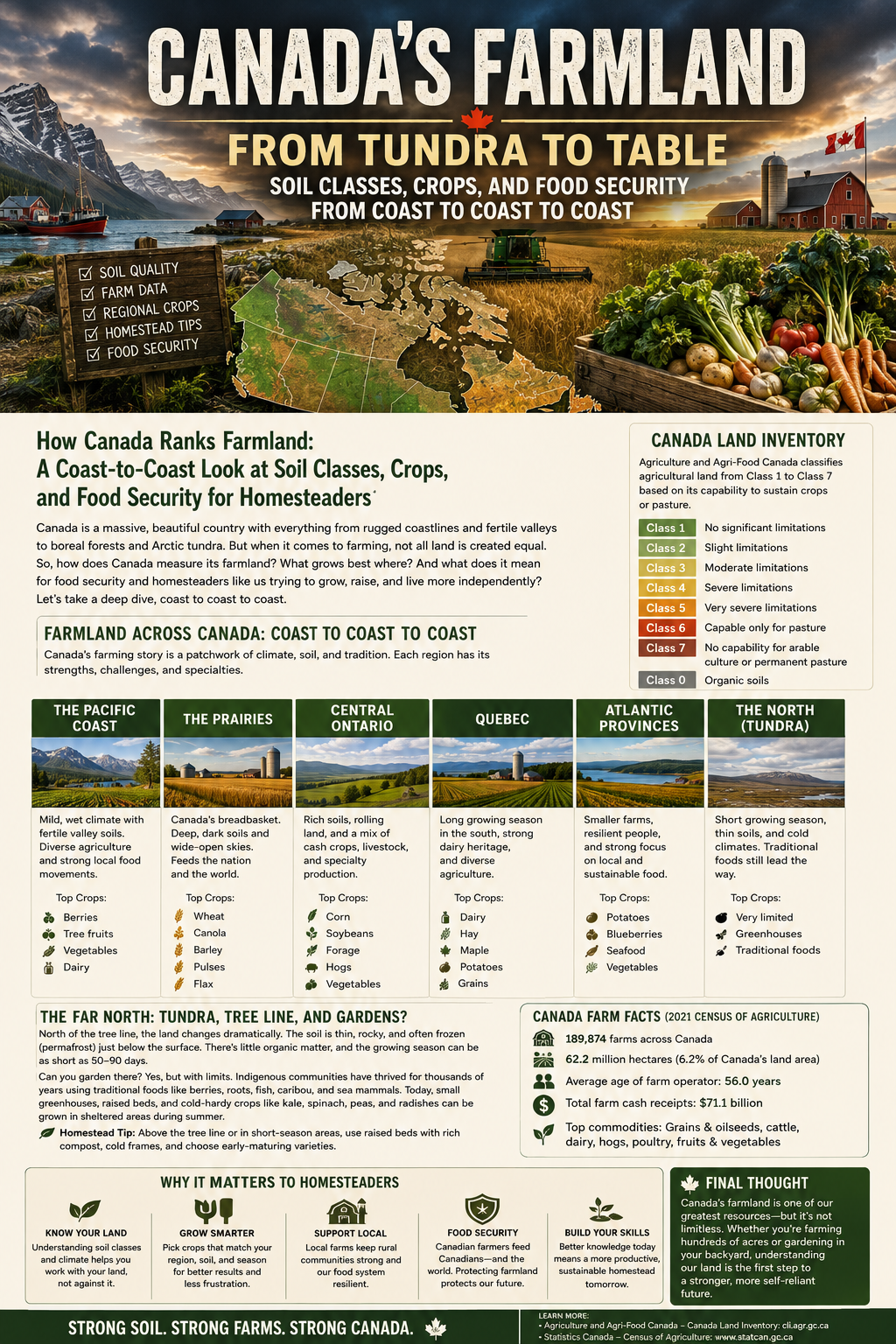
What Canada’s Farmland Ranking System Is
Canada’s main agricultural land capability system is the Canada Land Inventory, often shortened to CLI. For agriculture, it ranks land from Class 1 to Class 7. Class 1 is the best general-purpose agricultural land, with no significant limitations for common field crops. Class 7 is land with no capability for arable culture or permanent pasture. Between those extremes are lands with increasing limitations, such as poor drainage, stoniness, slope, erosion risk, low fertility, short growing season, excess moisture, or other restrictions.
That ranking matters because soil quality is not just “good” or “bad.” A piece of land can be excellent for pasture but poor for corn. It can be good for hay but difficult for vegetables. It can be rich but badly drained, flat but cold, fertile but erosion-prone, or beautiful but too shallow to support deep-rooted crops. The CLI system gives a broad regional view of what land can likely do, though it does not replace a proper local soil test, site walk, drainage assessment, or farm-specific advice.
For a homesteader, this is powerful. A cheap rural parcel might look tempting until you realize the soil is shallow, rocky, wet, acidic, shaded, or limited by climate. Meanwhile, a less dramatic-looking piece of land in a fertile agricultural belt may be far more useful. The land does not care about your dreams. It has its own conditions, and you either work with them or fight them.
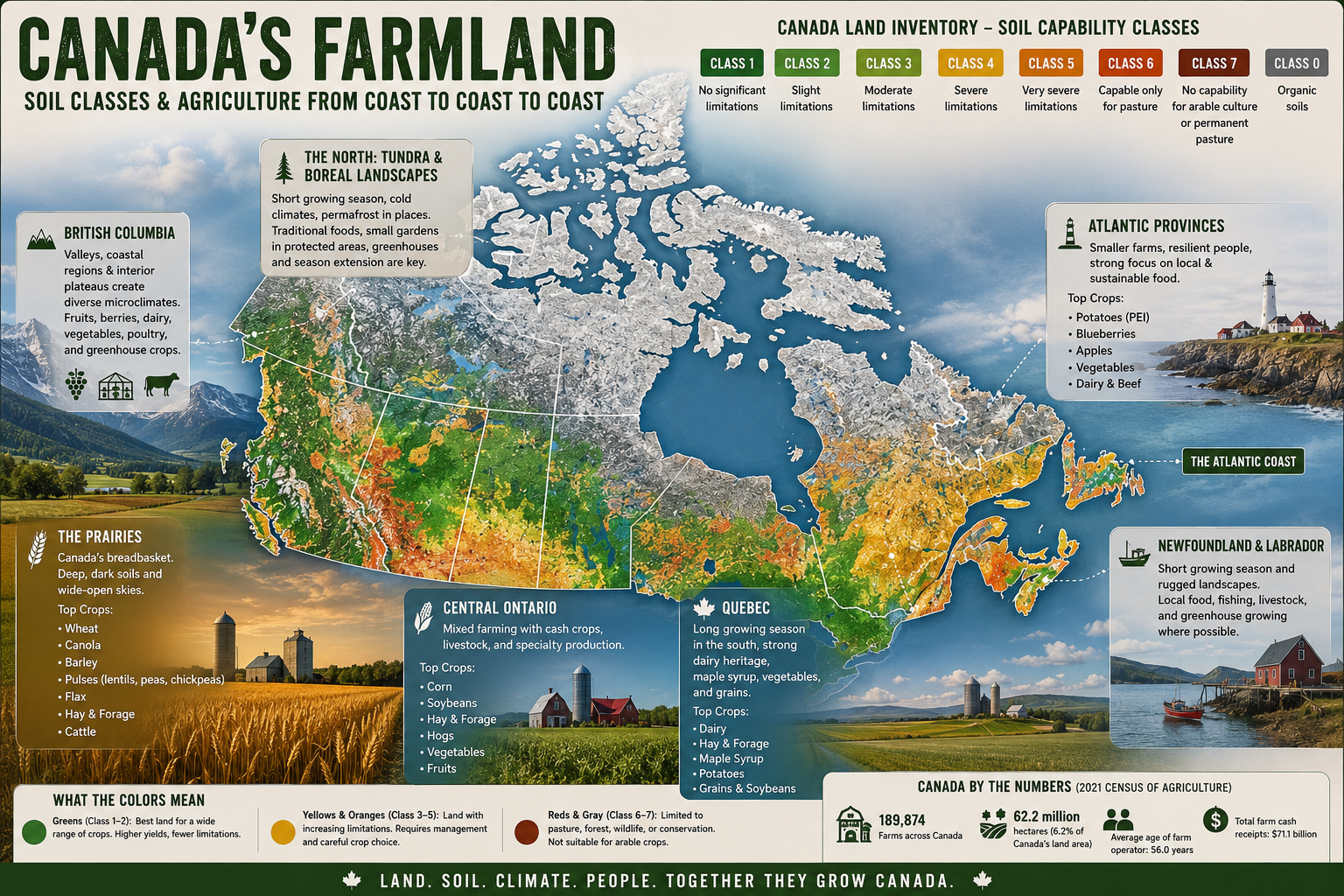
Why This Fascinates People
There is something fascinating, almost unsettling, about realizing that food production depends on a thin layer of soil and a narrow set of climate conditions. We talk about Canada as if it is unlimited, but the best farmland is not unlimited. Much of the country is forest, rock, wetland, mountain, northern cold land, or tundra. That land has enormous ecological value, but it is not all suitable for conventional farming.
This is where the investigative side comes in. Canada has a huge land area, but farms cover only a small share of it. The productive farm belt is concentrated in particular regions: the Prairies, Southern Ontario, parts of Quebec, Atlantic pockets, and British Columbia’s valleys and coastal zones. That should make people pause. Our grocery stores make food feel automatic, but the actual geography behind that food is specific and fragile.
The topic also fascinates homesteaders because it brings the dream back to reality. A person might imagine buying land anywhere and growing everything, but Canada does not work that way. A backyard in Eastern Ontario, a clay field near Ottawa, a rocky lot in the Shield, a mild valley in British Columbia, a windy prairie quarter, and a short-season northern property all require different strategies. The more you understand land capability, the less likely you are to waste time, money, and effort trying to force the wrong system into the wrong place.
Canadian Farmland From Coast to Coast to Coast
Atlantic Canada: Potatoes, Pasture, Berries, and Maritime Resilience
Atlantic Canada has a mixed farming identity. Prince Edward Island is famous for potatoes, and for good reason: potatoes suit certain cool, moist conditions and have become a major part of the region’s agricultural reputation. Nova Scotia has important fruit-growing areas, including apples and vineyards in suitable microclimates. New Brunswick has potatoes, blueberries, livestock, and mixed farms. Newfoundland and Labrador have a tougher agricultural climate overall, but local food production still exists in pockets where soil, shelter, and season allow it.
The Atlantic region is a good reminder that agriculture is not only about massive grain fields. Smaller farms, local markets, forage, livestock, berries, potatoes, apples, and mixed operations all matter. The climate can be humid, stormy, cool, and variable, so drainage and disease pressure can be serious considerations. A homesteader in this region would think carefully about wind protection, raised beds, soil building, season extension, and crops that tolerate cool, moist conditions.
Quebec: Dairy, Maple, Grains, Vegetables, and River Valley Agriculture
Quebec’s farming strength is deeply connected to the St. Lawrence corridor, dairy production, field crops, maple syrup, vegetables, and forage. The province has a strong agricultural identity because climate, culture, land patterns, and food traditions all overlap. Southern Quebec has some very productive land, while northern areas quickly become more forested, colder, and less suited to conventional farming.
Quebec is also a good example of how farming is not just soil; it is infrastructure. Dairy requires feed, barns, processors, supply chains, veterinarians, roads, markets, and knowledge. Maple syrup depends on sugar bush ecology and seasonal freeze-thaw cycles. Vegetable production needs markets, labour, timing, and often irrigation or drainage. The soil matters, but the surrounding system matters too.
Ontario: Corn, Soybeans, Greenhouses, Apples, Vegetables, and Local Food
Ontario is one of Canada’s agricultural powerhouses. Southern Ontario in particular has some of the best farmland in the country, and the province is a national leader in crops such as soybeans, corn for grain, and greenhouse products. Ontario also grows a wide range of fruits and vegetables, including apples, peaches, grapes, sweet corn, tomatoes, peppers, cucumbers, carrots, onions, potatoes, squash, leafy greens, berries, and greenhouse vegetables.
This is probably why many people remember those Ontario produce commercials. Ontario has the population, farmland, climate pockets, greenhouse sector, food processors, farm markets, and local food branding to make “grown in Ontario” feel like a real identity. The Foodland Ontario idea works because it connects grocery shoppers to a regional agricultural reality: a surprising amount of food can be grown close to home when climate, soil, markets, and infrastructure line up.
Eastern Ontario, including the Ottawa area, is not the same as the warmest parts of Southwestern Ontario or Niagara. The growing season is shorter, winters are harder, and soil can vary widely from clay to sand to loam to rocky patches. But it is still a very workable region for gardens, small livestock, hay, pasture, apples, hardy vegetables, berries, garlic, potatoes, brassicas, beans, tomatoes with proper timing, and season-extension setups. For a homesteader, Eastern Ontario rewards planning: start seedlings indoors, know your frost dates, mulch heavily, manage water, improve soil every year, and choose varieties that actually match the season.
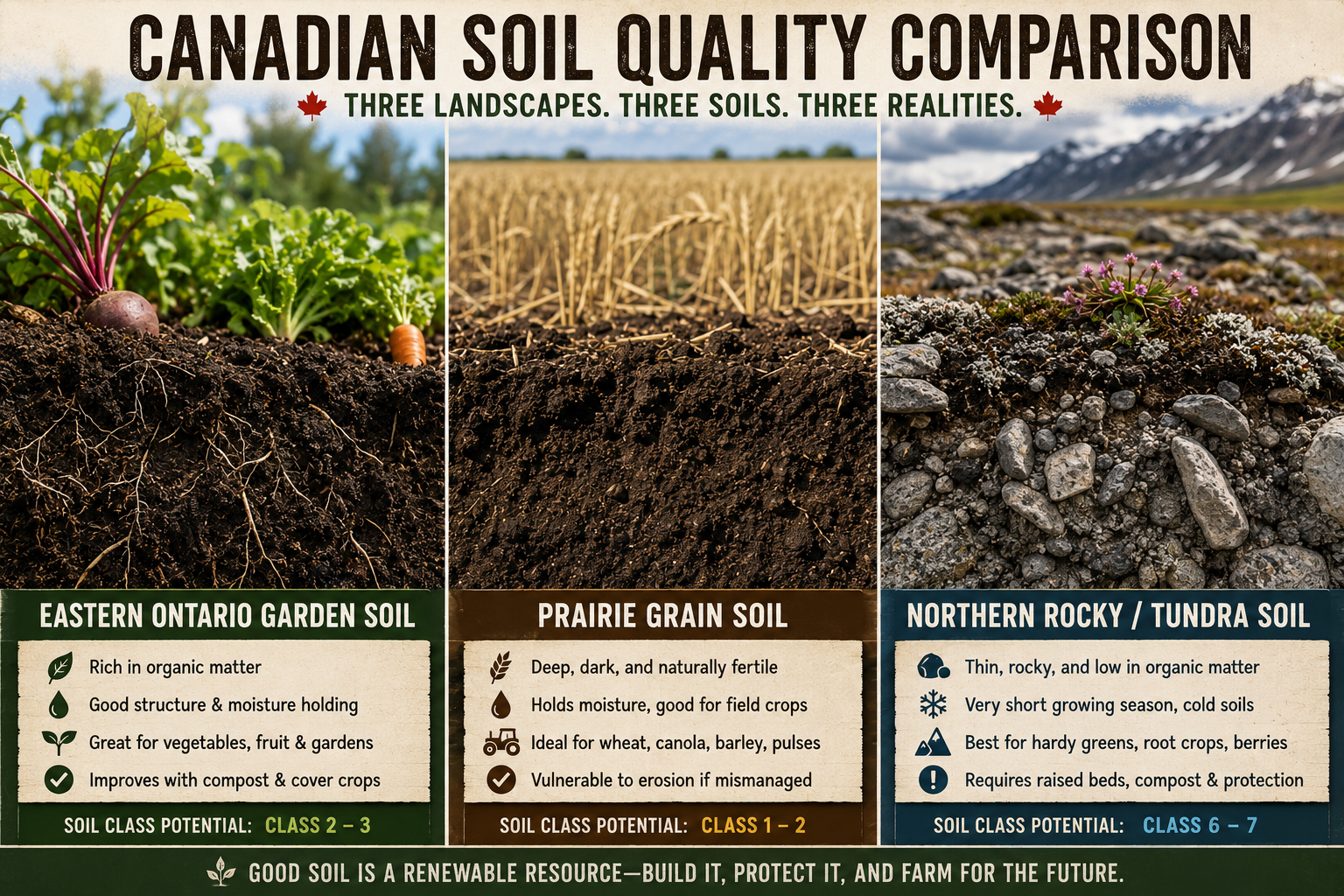
The Prairies: Canada’s Breadbasket, But Not Simple Land
Manitoba, Saskatchewan, and Alberta dominate many of Canada’s large field crops. The Prairies are strongly associated with wheat, canola, barley, oats, pulses, flax, hay, cattle, and massive open-field agriculture. When people imagine Canadian farming from a global perspective, they often picture prairie grain elevators, combines, straight roads, and enormous skies.
But the Prairies are not simple. Drought, wind, soil moisture, salinity, grassland ecology, input costs, fuel, machinery, and climate swings all matter. Good prairie soil can be incredibly productive, but it must be managed carefully. The region shows the difference between “lots of farmland” and “easy farming.” Large-scale agriculture is powerful, but it is also exposed to weather, markets, pests, and global commodity pressure.
For homesteaders, the Prairie lesson is water. Windbreaks, shelterbelts, drought planning, mulch, snow capture, hardy varieties, and soil organic matter can make the difference between struggling and thriving. The land can produce heavily, but only when moisture and timing cooperate.
British Columbia: Valleys, Fruit, Vegetables, Dairy, and Microclimates
British Columbia is agriculturally diverse because its geography is dramatic. Mountains, valleys, coastlines, islands, and interior dry zones create very different growing conditions. The Fraser Valley is important for dairy, poultry, berries, vegetables, and greenhouse crops. The Okanagan is famous for fruit, vineyards, and warm-season specialty production. Vancouver Island and coastal areas have milder conditions, though land availability and cost can be major constraints.
BC is a microclimate lesson. A few kilometres can change frost risk, wind exposure, rainfall, soil drainage, and heat accumulation. That matters for gardeners and homesteaders too. A sheltered south-facing slope, a valley bottom, a windy exposed site, and a shaded forest edge are not equivalent, even if they are in the same general region.
The North: Boreal Forest, Treeline, Tundra, and the Limits of Conventional Farming
The North is where the farmland conversation gets especially interesting. Canada’s northern territories and northern provincial regions contain vast areas of boreal forest, wetlands, rock, permafrost, tundra, and short growing seasons. This land is not empty or useless. It has ecological, cultural, wildlife, Indigenous, and climate importance. But it is not the same as Southern Ontario farmland or Saskatchewan cropland.
The treeline is one of those natural boundaries that makes you stop and think. At a certain point northward, trees become smaller, more scattered, and eventually stop forming normal forests. Cold temperatures, short growing seasons, wind exposure, frozen or poorly developed soils, permafrost, and moisture constraints all play a role. In tundra areas, plants do grow, but they are usually low-growing, hardy, and adapted to brief seasons: mosses, lichens, sedges, grasses, dwarf shrubs, and small flowering plants.
So can you garden in the tundra or above the treeline? Yes, but not in the ordinary “plant a big backyard vegetable garden and treat it like Southern Ontario” sense. Outdoor growing can be extremely limited and depends on raised beds, imported or built soil, wind protection, season extension, hardy crops, and careful timing. Greenhouses, cold frames, indoor starts, hydroponics, community growing spaces, and protected structures become much more important. In northern communities, growing food can be done, but it is a serious adaptation project, not a casual copy-paste of southern gardening advice.
Evidence Supporters Cite
Supporters of farmland classification point to a simple argument: land planning needs facts. If governments, farmers, planners, buyers, and communities do not understand soil capability, they can make bad decisions. Good farmland can be paved over, poor land can be oversold, drainage issues can be ignored, and people can assume any rural lot is automatically useful for food production.
The Canada Land Inventory gives a broad way to understand agricultural potential. It does not tell you everything, but it gives a starting point. Class 1 land is rare and valuable. Class 2 and 3 land can still be highly productive but may require management. Lower classes may be suited to pasture, forestry, wildlife, conservation, or limited uses rather than common field crops. This kind of classification helps people see land as a resource with strengths and limits.
The farm statistics also tell a bigger story. Canada has fewer farms than it did decades ago, farms have consolidated, the average age of operators is high, and the total farm area represents only a small portion of the country’s land base. That combination raises real questions about food security, land access, rural succession, and whether younger people can afford to enter farming.
For a homesteader, the evidence is practical. Soil class, drainage, frost dates, slope, water access, tree cover, and regional crop patterns matter. If the commercial farmers around you mostly grow hay, pasture, corn, soybeans, apples, dairy feed, or greenhouse crops, that tells you something. Local agriculture is often a clue to what the land naturally supports.
Counterarguments and the Skeptical View
The skeptical view is that soil capability maps can be misunderstood. A map is not a shovel. It cannot tell you exactly what is happening in one corner of your garden, one wet patch near your barn, or one sandy knoll behind your shed. Soil can change across short distances, and past land use matters. Compaction, erosion, drainage tile, fill, contamination, tree cover, and old construction debris can all change the real-world value of a site.
There is also a risk of thinking only “high-class farmland matters.” That is too narrow. Lower-capability land can still be valuable for forest, wildlife, grazing, maple bush, berries, recreation, conservation, water storage, Indigenous food systems, or low-impact homesteading. Not every acre needs to become corn or soybeans to be useful.
Climate change complicates the picture too. Longer growing seasons may create opportunities in some areas, but they also bring drought, heat stress, heavy rain, invasive pests, wildfire smoke, winter instability, and unpredictable extremes. Northern growing may become more possible in certain ways, but permafrost thaw, ecological disruption, infrastructure challenges, and soil limitations do not magically disappear.
The smarter conclusion is not “good soil map equals guaranteed success.” The smarter conclusion is “land capability is one layer of truth.” A serious gardener, farmer, or homesteader should combine the map with local observation, soil tests, drainage checks, climate data, neighbouring farm patterns, and plain old common sense.
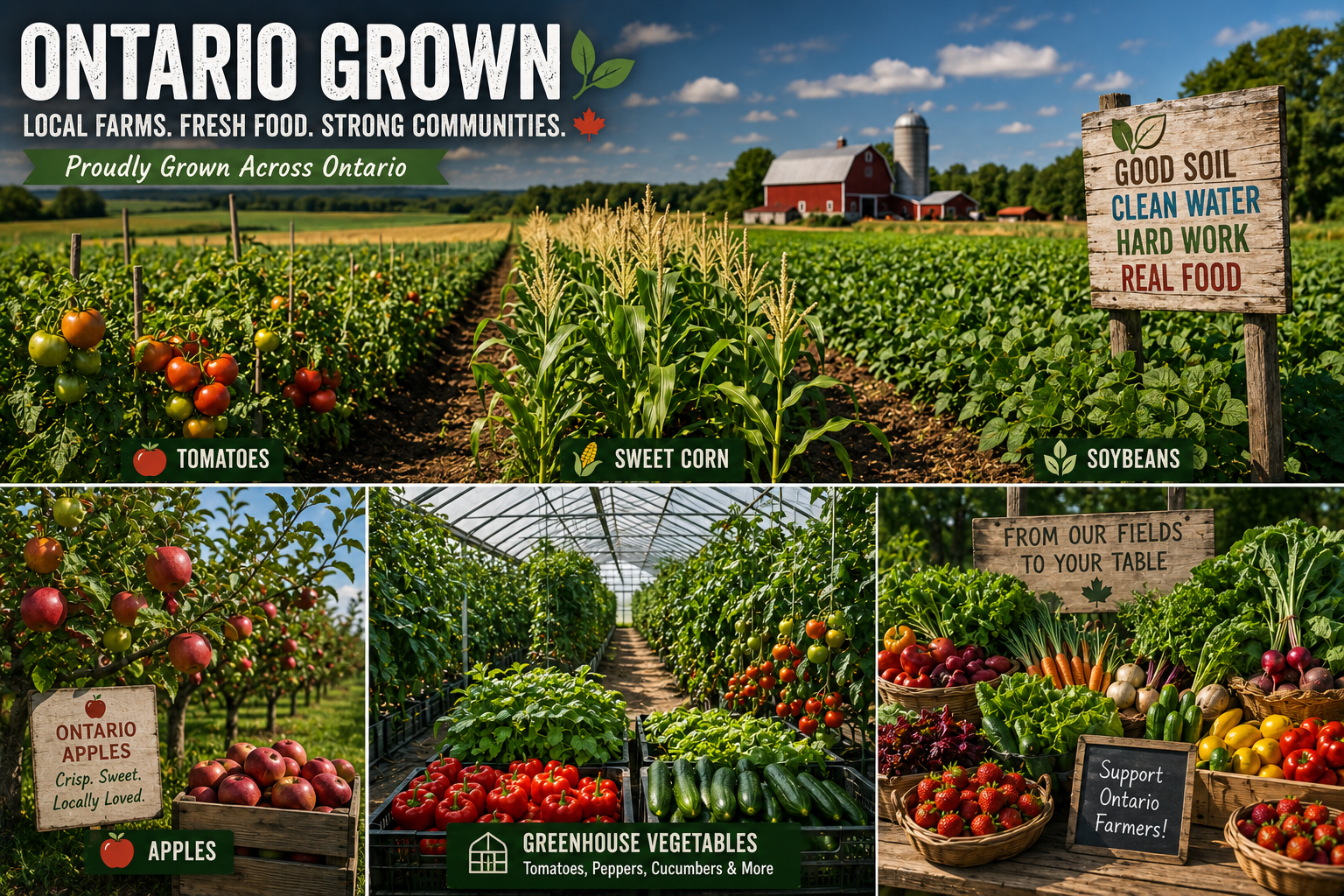
What Ontario Produce Teaches Homesteaders
Ontario is useful for homesteaders because it shows how much food variety can exist in one province. The warmest areas can support grapes, peaches, greenhouse vegetables, field tomatoes, corn, soybeans, and tender crops. Cooler areas can still produce apples, potatoes, brassicas, beans, squash, garlic, berries, hay, pasture, and hardy vegetables. Greenhouses extend what is possible, especially for tomatoes, cucumbers, peppers, seedlings, and longer-season crops.
If you are gardening in Eastern Ontario, the lesson is not to copy Southwestern Ontario exactly. You can grow a lot, but timing matters. Tomatoes, peppers, melons, and sweet potatoes need warmth and planning. Brassicas, potatoes, lettuce, peas, onions, garlic, carrots, beets, kale, beans, squash, cucumbers, herbs, and berries are more forgiving. Raised beds can help in wet or clay soil, mulch helps regulate moisture, and row covers can protect against frost and pests.
The big homestead takeaway is that local food is regional, not imaginary. If Ontario farmers and gardeners can produce such a wide range of crops, a backyard grower can learn from those patterns. You do not need to grow everything. You need to grow what fits your land, your season, your storage setup, and your household.
Practical Homestead Lessons from Canada’s Farmland Map
A national farmland map can feel abstract, but the lessons are very practical. First, soil is wealth. Not flashy wealth, not quick wealth, but deep practical wealth. If you have decent soil, protect it. Add organic matter, avoid erosion, prevent compaction, keep roots in the ground, mulch, compost, and stop treating soil like dirt.
Second, climate is not optional. A plant that thrives in Niagara may struggle near Ottawa, and a crop that works in a greenhouse may not work in an exposed field. Pay attention to frost dates, heat units, wind, sunlight, slope, and water. Your garden does not care what the seed packet photo looks like.
Third, water management matters as much as fertility. Too much water can drown roots and delay planting. Too little water can ruin a crop during flowering or fruiting. Raised beds, swales, mulch, drip irrigation, rain barrels, drainage, and organic matter all become tools for making the land more stable.
Fourth, regional crops are clues. If nearby farms grow mostly hay and pasture, ask why. If they grow apples, corn, soybeans, or vegetables, ask what conditions make that possible. Local farm patterns are not random. They are built from soil, climate, markets, machinery, history, and experience.
Why This Matters Today
This topic matters because food security is not just about grocery prices. It is about land, soil, farmers, water, infrastructure, seeds, energy, transportation, climate, and knowledge. Canada is fortunate to have productive agricultural regions, but that does not mean food production is automatic or guaranteed.
Good farmland near growing cities faces pressure from development. Farmers are aging. Land prices can make entry difficult. Weather is getting more erratic. Supply chains can be fragile. At the same time, more regular people are interested in gardening, small-scale food production, backyard resilience, and homesteading. That is a good thing, but only if it is grounded in reality.
Learning how Canada ranks farmland helps you see the country differently. It helps you understand why certain regions produce certain foods, why farmland protection matters, why soil should not be wasted, and why your own backyard garden is connected to a much bigger national story.
Final Verdict: Canada’s Farmland Is Powerful, But Not Unlimited
Canada has impressive agricultural capacity, but the best farmland is not spread evenly across the country. It is concentrated in specific regions where soil, climate, water, and infrastructure line up. The Canada Land Inventory soil classes help reveal that hidden structure. They show that land has capability, limits, and long-term value.
For homesteaders, the lesson is clear: know your land before you make plans for it. Learn your soil, frost dates, drainage, sun exposure, local crop patterns, and realistic growing season. If you are in Eastern Ontario, do not be discouraged by a shorter season than Southwestern Ontario. You can still grow a lot, especially with seedlings, mulch, compost, raised beds, hardy varieties, and simple season extension.
For readers looking at the bigger picture, the message is slightly more serious. Soil is not just scenery. Farmland is not just open space waiting to be developed. The land that feeds people deserves respect, protection, and better understanding.
Canada may stretch from coast to coast to coast, but the food-growing story is written in the thin, living layer beneath our feet.
If you are not born into a farm or have connections becoming a farmer has never been as hard as it is now. You’d think Canada having the second largest landmass in the world; farm land would be cheap but it is quite the opposite. IMO land should be parceled accordingly to make it affordable and government grants should be issued for anyone willing to buy remote land and turn it into a farm but alas this will probably never happen. Seems like you can’t do a single thing in this country sometimes. So much for the true north, strong and FREE…