
How to Make Money From Your Homestead: Practical Ways to Turn Your Property Into Income
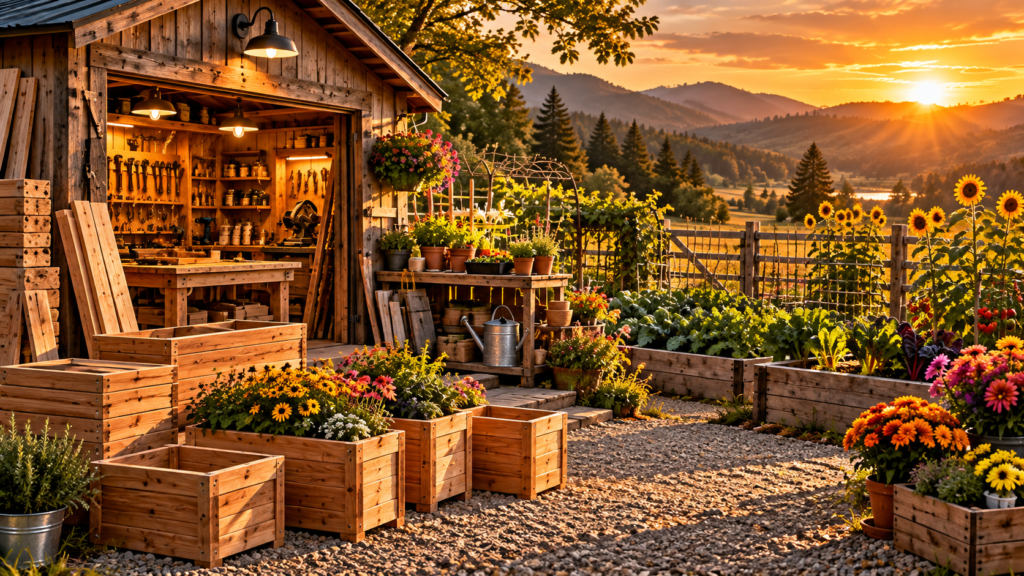
There is an appealing idea buried inside the modern homesteading movement: what if your property did more than simply cost you money? Instead of the shed, greenhouse, garden, garage, and spare corner of the basement being expenses, what if some of them actually produced income? For a surprising number of people, that is not fantasy—but the profitable version usually looks much less glamorous than the social-media version.
The internet is full of stories about people selling vegetables from a roadside stand, growing trays of microgreens under LED lights, making rustic furniture in a backyard workshop, or turning a few acres into half a dozen small income streams. Some of those ideas work extremely well. Others consume hundreds of hours, piles of lumber, and thousands of dollars before the owner discovers that nobody nearby actually wants to buy what they are producing.
That is the real question worth exploring. Not whether a homestead can make money—it clearly can—but how to identify the pieces of your property, skills, and equipment that have a realistic chance of earning more than they consume.
What Does “Monetizing a Homestead” Actually Mean?
A profitable homestead does not have to be a conventional farm. You do not need a tractor, livestock, or 100 acres of land to create something valuable. A suburban or semi-rural property with a detached garage, vegetable garden, and small greenhouse may actually offer more practical income opportunities than a large rural property with no nearby customers.
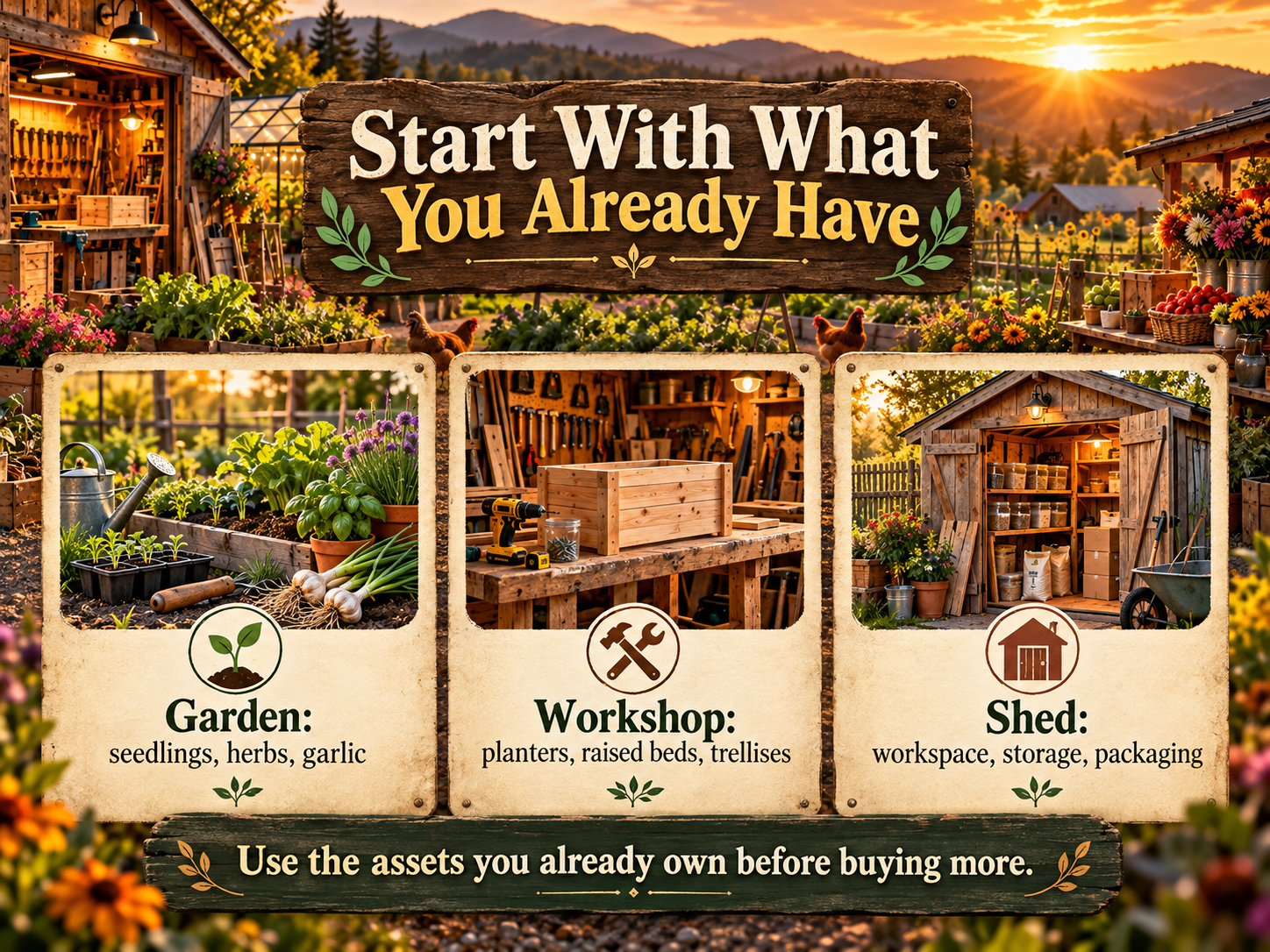
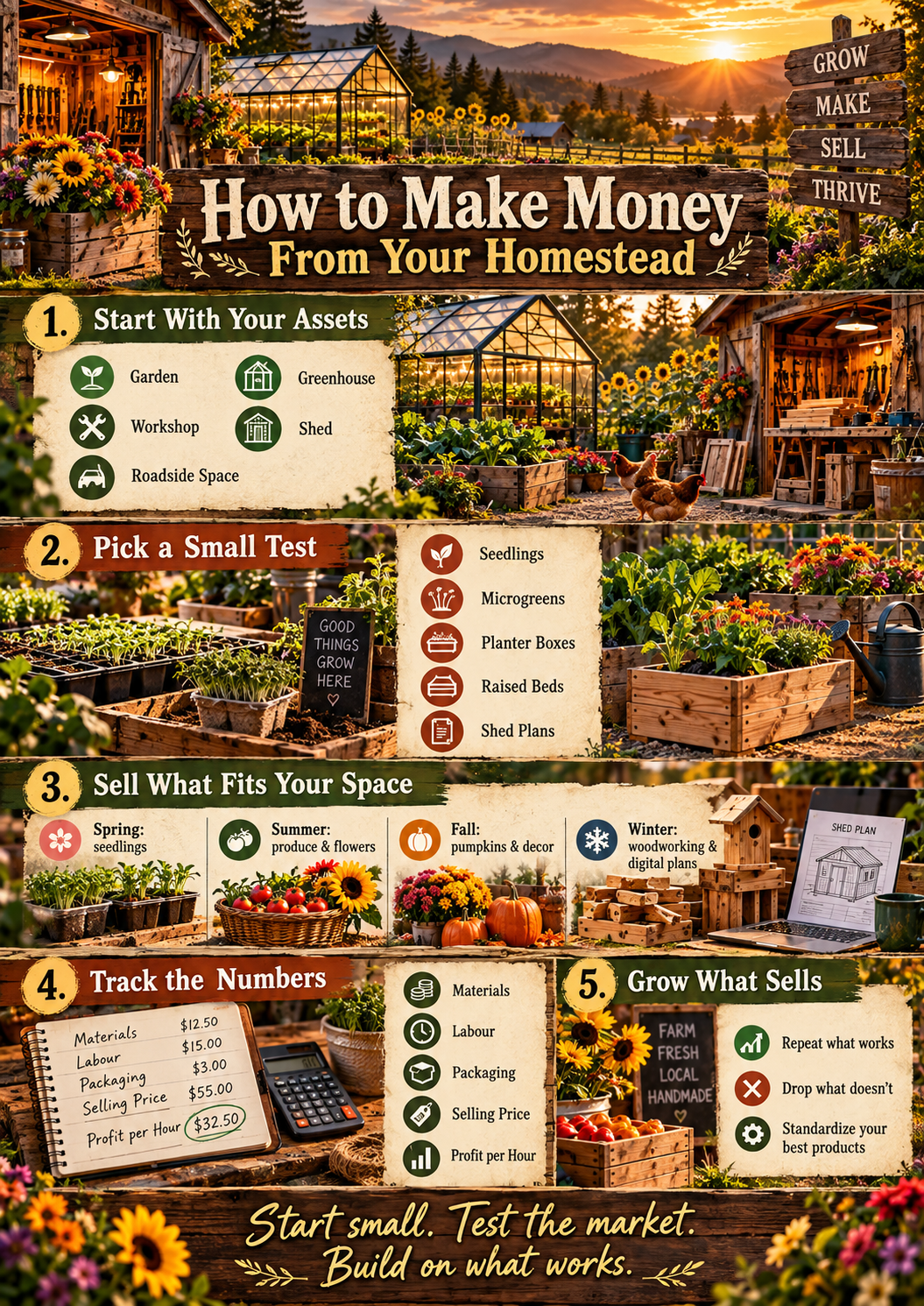
The simplest way to think about homestead income is to divide the property into productive assets. Your garden can grow something. Your workshop can manufacture something. Your shed can store materials or become production space. Your roadside frontage can help sell something, while your knowledge can eventually become digital products, plans, tutorials, or services.
That shift in thinking matters. Instead of asking, “What homestead business should I start?” ask, “What do I already own, know how to do, or have space to produce?” That question usually leads to cheaper experiments and much better decisions.
Why the Idea Is So Attractive
The appeal is easy to understand. Housing, land, tools, and outbuildings are expensive, yet most residential properties spend their lives producing nothing financially. A $3,000 shed normally stores lawn chairs and a snowblower; a greenhouse may grow tomatoes for a few months; a garage workshop may sit unused for most of the week.
Monetization changes that equation. If the same shed helps produce $300 worth of garden planters every month, or a small greenhouse produces hundreds of seedlings every spring, the property begins functioning more like a tiny productive system. It does not need to replace your employment income to matter.
There is also something psychologically satisfying about earning from tangible work. Growing a tray of greens, turning rough lumber into a planter, or selling pumpkins from a roadside stand feels different from another abstract online side hustle. You can see the raw material become a finished product, and customers can often see where it came from.
But that emotional appeal can also make people overlook the numbers.
Start With What You Already Have
One of the worst ways to begin is to watch a successful homesteader online and immediately buy the equipment required to copy them. A better approach is almost embarrassingly simple: inventory what you already possess.
Walk around your property and make a list. Do you have woodworking tools? Shelving? A sunny window? An unfinished shed? Garden beds? A trailer? A pressure washer? A greenhouse? Fruit trees? Room beside the driveway? A skill people already ask you about?
Then look for income ideas that require the smallest leap from your current situation. Someone who already owns a mitre saw, table saw, and drill should probably investigate wooden garden products before buying equipment for mushroom cultivation. Someone with an unused sunny greenhouse should investigate seedlings or specialty vegetables before deciding they need to build a woodworking business from scratch.
That is one of the recurring patterns in small business: the boring idea built around existing assets often beats the exciting idea that requires buying an entirely new set of assets.
Turn the Garden Into a Small Production Area
Vegetables are the obvious starting point, but selling ordinary vegetables is not automatically profitable. A gigantic zucchini may be impressive, yet zucchini is inexpensive and almost everyone with a garden eventually has too much of it. The economics become more interesting when you grow something customers value, something difficult to find locally, or something that can be produced intensively in a small area.
Seedlings are a good example. A tomato may sell for a few dollars later in the season, while a healthy tomato seedling can sell for several dollars when it is only a few weeks old. Herbs, unusual pepper varieties, perennial divisions, garlic, flower seedlings, and specialty garden plants can sometimes make better use of limited growing space than commodity vegetables.
A small homestead might experiment with vegetable and herb seedlings, garlic, cut flowers, fresh herbs, berries, unusual tomato varieties, hot peppers, pumpkins, decorative squash, perennial plant divisions, or locally adapted plants. The key word is experiment. Growing something successfully is only half of the equation; somebody still has to want to buy it.
That is where many would-be homestead businesses get tripped up. A gardener may be proud of producing 150 heads of lettuce, but pride does not create customers. The smarter approach is to start small, see what actually sells, and then expand the crops that earn their space.
Use a Greenhouse for More Than Tomatoes
A greenhouse is often treated as a season-extension device, but commercially it can be much more interesting than that. Instead of simply harvesting vegetables for your own kitchen, a modest greenhouse can become a propagation centre producing seedlings early in the year, specialty plants in spring, and heat-loving crops during summer.
The timing advantage is valuable. Customers rarely want tomato seedlings in August; they want them precisely when everyone is preparing gardens in spring. If your greenhouse allows you to produce healthy plants several weeks before outdoor conditions cooperate, you are creating value through timing rather than simply through quantity.
The same concept applies in autumn. Cold-tolerant greens, herbs, and late-season crops may extend production beyond the normal backyard growing calendar. A greenhouse that earns something during multiple seasons becomes much easier to justify than one that produces a heroic quantity of tomatoes for six weeks.
The trap is building the greenhouse before proving the market. Start with shelving, seed-starting equipment, or a modest structure if possible. If twenty trays sell quickly, build toward forty; do not build capacity for 400 trays and hope customers magically appear.
Grow Microgreens Indoors
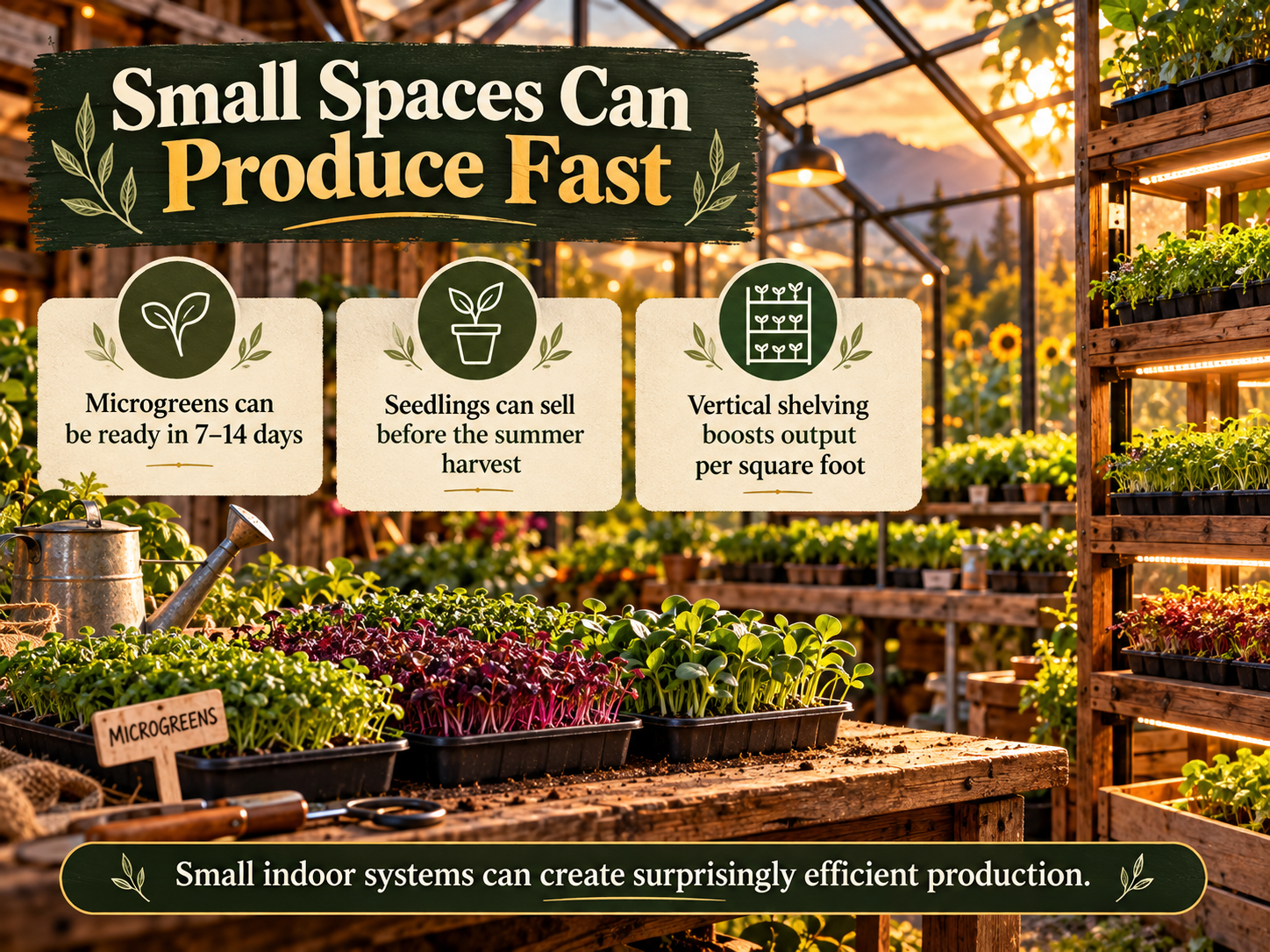
Microgreens are almost the opposite of traditional farming. They require very little land, grow quickly, and can be produced on shelving in a basement, spare room, insulated shed, or dedicated growing space. That makes them one of the more intriguing options for a small property where acreage is limited.
Their attraction is production speed. Instead of waiting months for a field crop, many varieties of microgreens are harvested on a much shorter cycle. Shelving also lets you stack production vertically, meaning a small footprint can hold several growing levels.
But this is another business where online income claims deserve skepticism. Growing microgreens is relatively easy; selling the same quantity every week is harder. Restaurants can change suppliers, household customers may buy irregularly, and unsold greens have a very short useful life.
The smarter model is to secure customers gradually. Start with a few trays, calculate the true cost of seed, growing medium, electricity, packaging, and spoilage, and only increase production when demand follows. The goal is not to grow the most microgreens possible; it is to grow roughly what you can sell.
Let the Workshop Earn Its Floor Space
For someone who already enjoys woodworking, a workshop may be one of the most flexible income-producing areas on the entire property. Unlike vegetables, wooden products do not spoil on Sunday evening because they failed to sell on Saturday. You can build inventory gradually, refine designs, and move successful products online.
The mistake is attempting elaborate furniture too early. A dining table may sell for a large amount, but it also requires substantial material, finishing, transportation, and customer coordination. Smaller repeatable products are often better for establishing whether there is a market.
Raised garden beds are a perfect example. They are relatively straightforward to build, useful to gardeners, easy to photograph, and can be offered in a few standardized sizes. The same workshop can also produce window boxes, planter stands, trellises, birdhouses, simple benches, firewood racks, garden tool organizers, outdoor shelves, and seasonal decorations.
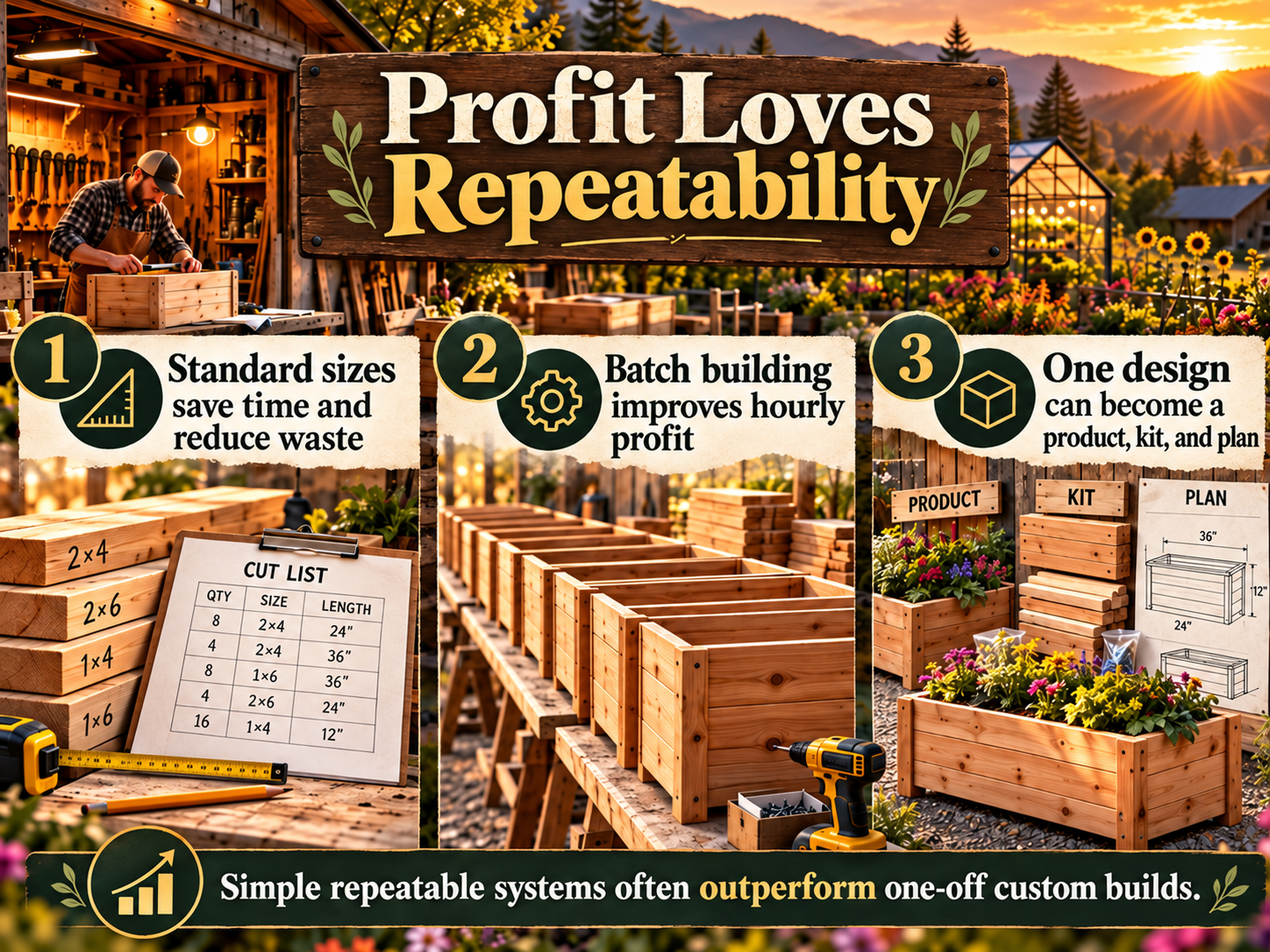
The best designs are repeatable. If you can cut the lumber for four planters at once, drill from a jig, use the same hardware, and assemble them in batches, your hourly return can improve dramatically. That is where woodworking begins to move from hobby territory toward a real small business.
There is another advantage here: your homestead becomes your showroom. A planter beside your own shed, a trellis supporting your beans, or a raised bed beside the driveway demonstrates the product better than a stock photograph ever could.
The Humble Shed Has More Business Potential Than It Gets Credit For
A shed is usually thought of as storage, but a well-designed shed can support several income streams. It can be a compact workshop, seed-starting room, inventory room, photography space, packaging station, or sheltered workspace. If it is insulated and permitted for its intended use, it can extend productive work far beyond the summer months.
Then there is the shed itself as a product.
If you are comfortable with carpentry, you could build small garden sheds for customers, develop standardized storage shed designs, create partially prefabricated kits, or sell detailed shed plans digitally. A single basic design can potentially become several different products.
Imagine building a simple 6-by-8-foot garden shed. The first version is for your own property. You photograph the build, refine the measurements, record the lumber list, and figure out where you wasted material. The second one is faster because you already know the process.
Eventually, that one project could become a locally built shed, a prefabricated wall-panel kit, a downloadable building plan, a materials list, a tutorial, and even a series of related woodworking products. That is much more interesting than simply building one shed and moving on.
There are plenty of adjacent products as well. Woodsheds, garbage-bin shelters, mini greenhouses, potting benches, chicken-coop structures, garden-tool sheds, bike shelters, and equipment storage buildings all use similar skills.
A woodworker does not necessarily need to become “a shed company.” Sheds can simply anchor an entire family of outdoor products.
There is one important distinction, though. Using a shed for storage or workshop space is very different from turning it into a rental unit, guesthouse, or sleeping accommodation. Building codes, zoning, setbacks, utilities, and occupancy rules can change quickly once a structure is being used for people rather than tools.
Sell From the Roadside—But Test the Simplest Version First
A roadside stand is probably the most recognizable homestead business. There is something almost timeless about vegetables, pumpkins, flowers, or handmade goods displayed near the end of a driveway with a simple price sign. In the right location, the customer’s trip to the store is replaced by your product being directly in front of them.
Traffic matters enormously. So do visibility, safe parking, local rules, theft risk, and the type of product. A beautiful stand on a dead-end road may sell almost nothing, while a basic table along a heavily travelled route can perform remarkably well.
The best way to test the idea is probably not to spend two weekends constructing an elaborate farm stand. Put out a folding table, attractive wooden crates, and a limited selection of products. See whether anybody stops.
If they do, improve it.
A roadside setup could sell produce, seedlings, flowers, pumpkins, handmade planters, small wooden garden decorations, birdhouses, firewood products, seasonal décor, or other locally permitted goods. A woodworking shop and a garden can complement each other nicely here because the stand does not have to depend entirely on perishable produce.
There is also an interesting trust factor with roadside sales. When people can see the garden, greenhouse, or workshop behind the product, it feels genuinely local. That story can be part of what they are buying.
Make One Product Feed Another
This is where homestead businesses can become far more efficient.
Suppose you grow tomato seedlings in spring. You could simply sell tomato seedlings. Or you could build wooden planter boxes in the workshop and sell a planter containing several seedlings, a trellis, and a simple planting guide.
Now one customer is buying from two parts of the homestead instead of one.
The same idea applies to sheds. A customer buying a small garden shed might also want shelving, a potting bench, a tool rack, or raised beds. Someone buying a greenhouse bench may also be interested in seedlings.
The most interesting homestead businesses often become little ecosystems. Products begin supporting other products instead of existing as completely separate side hustles.
Sell the Same Skill Digitally
This is where a traditional homestead can quietly become something much larger. Suppose you build a particularly good 6-by-8-foot storage shed. The physical shed can only be sold to someone within a reasonable driving distance, but the plan can theoretically be sold anywhere.
The same applies to raised beds, chicken coops, greenhouse benches, garden layouts, seed-starting systems, potting benches, and workshop projects. Once you have solved a problem carefully for yourself, documenting the dimensions, materials, and process creates another product from essentially the same work.
Digital products can include downloadable woodworking plans, cut lists, planting calendars, printable garden journals, small ebooks, garden templates, and step-by-step project guides. Articles and videos can support those products by showing that the design has actually been built and used.
This does not mean passive income magically appears. Good plans take substantial work, and online competition is intense. But the economics are different from physical production.
The twentieth PDF does not require another stack of lumber.
Use Seasonal Income Instead of Fighting Seasonality
One of the strongest homestead models may not be a single year-round business at all. It may be several small businesses that naturally take turns.
Spring is ideal for seedlings, planters, raised beds, and garden structures. Summer can favour vegetables, flowers, herbs, and roadside sales. Autumn brings pumpkins, decorative produce, firewood products, storage projects, and outdoor woodworking, while winter can shift workshop capacity toward indoor builds, Christmas items, planning, and digital products.
That rhythm has an underrated advantage: it prevents one tiny operation from needing to support the household every month of the year. A greenhouse can be productive when the garden is barely waking up, and the workshop can become more important once the growing season ends.
A diversified homestead therefore resembles a portfolio more than a conventional business. The goal is not necessarily to have ten enterprises operating simultaneously. It is to have several compatible ways of earning that use the same property, tools, and skills at different times.
The Numbers Matter More Than the Aesthetic
This is where skepticism becomes useful.
Homestead businesses photograph beautifully. A handcrafted cedar planter full of herbs beside a weathered shed looks like a profitable lifestyle in a single image. A greenhouse glowing at dusk looks productive even if it costs more to heat than it earns.
The spreadsheet may tell a different story.
Suppose a planter sells for $90. If lumber and hardware cost $42, finishing materials cost $6, selling fees and transportation average another $7, and it takes two hours to build, the attractive $90 sale is no longer a $90 profit. That does not make it a bad product—but it tells you whether you have a hobby, a business, or a business that needs a better production method.
For every product, it is worth tracking material cost, packaging, electricity, equipment wear, selling fees, transportation, spoilage, labour time, selling price, and actual profit. Eventually, one number becomes especially important: profit per hour.
A $300 project that takes twelve hours may be less useful than a $45 product that can be made in twenty minutes.
That calculation can be uncomfortable, but it prevents a lot of wasted effort.
Build Around Repeatability
This may be the least exciting and most important principle in the entire article. Profit generally improves when the same process can be repeated.
If every raised bed has different measurements, every customer chooses different lumber, and every project requires three messages about customization, you have created a bespoke carpentry service. That may be profitable, but it is difficult to scale.
If you offer a 4-by-4 bed, a 4-by-8 bed, and one premium version, you can buy materials intelligently, create jigs, batch your cuts, and accurately estimate labour. The same principle applies to microgreen trays, plant varieties, shed kits, and roadside products.
Standardization is not the enemy of craftsmanship. It is often the thing that lets craftsmanship become a viable business.
Where the Homestead Dream Can Go Wrong
The largest danger is capital spending.
A person decides to sell plants, so they build a $15,000 greenhouse. Then they discover that local customers only buy $1,500 worth of plants. Someone decides to make furniture, fills a workshop with expensive machinery, and eventually realizes that customers will not pay enough to justify the labour.
Another danger is assuming your own enthusiasm equals market demand. You may love elaborate wooden birdhouses, rare vegetables, or handcrafted garden sculptures. Customers are allowed to disagree.
There is also the temptation to create five tiny businesses at once. Homestead diversification is useful after something works; before that point, diversification can simply mean failing to focus.
The better approach is almost ruthlessly small. Build five planters. Grow ten trays. Start fifty seedlings. List one shed design. See what happens.
Then make the next decision using evidence.
Do Not Ignore the Legal Side
A handmade roadside business can feel informal, but earning money generally creates real business obligations. Depending on what you sell, you may need to consider municipal zoning, business licences, building permits, food rules, labelling requirements, insurance, and tax recordkeeping.
Food deserves particular caution because selling fresh produce is different from preparing or processing food products. Likewise, constructing a storage shed is different from creating a building intended for accommodation. The exact rules depend on what you are doing and where you live.
That does not mean regulation makes a small homestead business impossible. It means the smartest time to discover a rule is before you build the structure, order the packaging, or spend thousands of dollars.
A few hours of research can be much cheaper than discovering afterward that your great idea is not permitted in the form you imagined.
A Practical Way to Start This Weekend
If this article has you looking differently at the backyard, resist the urge to start constructing things immediately. Spend an hour doing an inventory first.
Pick one part of your property: the garden, greenhouse, workshop, shed, basement, garage, or roadside frontage. Then write down three things that space could realistically produce without requiring a major investment.
Choose the easiest one to test.
Maybe you build three cedar planters and list them locally. Maybe you start ten trays of seedlings. Maybe you make a simple roadside table and test pumpkins or garden décor. Maybe you design a small woodshed, build one for yourself, and document the entire process.
Your first objective is not to build an empire. It is to obtain evidence that a stranger is willing to pay money for the thing you created.
Once someone does, repeat it.
Then improve it.
Final Verdict: Can a Homestead Really Make Money?
Absolutely—but the profitable version is usually more disciplined than the romantic version.
The greatest advantage of a homestead is not acreage. It is the ability to combine assets. The same workshop that builds a raised bed can build a roadside display. The same greenhouse that starts your vegetables can produce seedlings for customers. The same shed project can generate a physical structure, photographs, an article, a video, and eventually a downloadable building plan.
That is where the model becomes powerful. You are not searching for one miraculous crop or one perfect side hustle. You are gradually turning underused space, practical skills, and things you were already interested in into assets that produce something people value.
The best first homestead business may therefore be surprisingly ordinary. It might be ten tomato seedlings on a table by the driveway. It might be three cedar planters. It might be a rack of microgreens.
It might even be a small shed.
What matters is not whether the idea looks impressive. What matters is whether someone buys the first one—and whether you still want to make the second.