
Watering a Garden During Heat and Drought
A summer garden can look healthy one morning and exhausted by late afternoon. Leaves droop, the soil surface turns dusty, lettuce becomes bitter, and developing vegetables suddenly demand more water than they did a few weeks earlier. When a heat wave overlaps with drought, even experienced gardeners can struggle to decide how often to water and how much is enough.
The instinctive response is often to water everything every day. That may be appropriate for a small container during extreme heat, but it can be excessive for an established plant growing in moisture-retentive soil. A calendar cannot tell you what is happening below the surface, which is where roots obtain nearly all their water.
Fertilizer introduces another complication. Water-soluble plant food can support actively growing vegetables and hedges, but it cannot replace water or rescue roots from heat stress. If it is applied too strongly or to severely dry soil, the fertilizer salts can make an already stressed plant’s situation worse.
Wildfire smoke adds yet another layer. Smoke can change light levels, deposit particles on leaves, and make outdoor gardening unsafe for people even when the plants appear unaffected. The best summer strategy therefore combines soil testing, deep irrigation, mulch, cautious fertilization, and common sense about air quality.
Quick Answer: How Should You Water During a Heat Wave?
There is no reliable rule that every garden should be watered daily. Begin with the soil, recent rainfall, plant type, and weather:
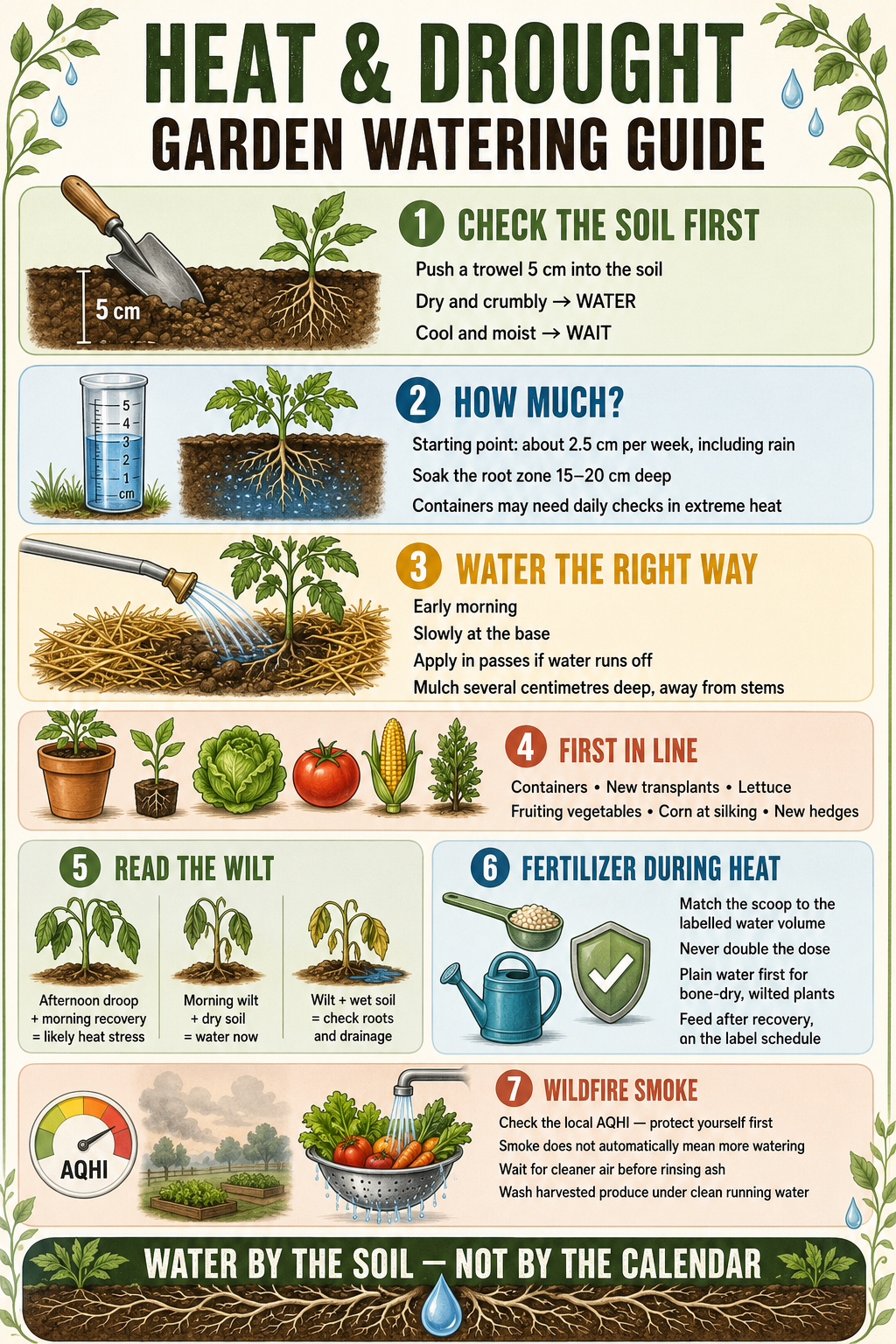
- Check the soil approximately 5 centimetres below the surface.
- Water when the root zone is becoming dry, not merely because the surface looks dusty.
- Apply water slowly enough to soak deeply without running away.
- Water early in the morning when possible.
- Prioritize containers, seedlings, recent transplants, and fruiting vegetables.
- Use mulch to reduce evaporation and moderate soil temperature.
- During severe heat, containers and raised beds may require daily attention.
- Do not automatically fertilize a wilted or severely drought-stressed plant.
- When wildfire smoke makes outdoor air unsafe, protect yourself first.
A typical vegetable garden often needs roughly 2.5 centimetres of total water per week from rain and irrigation, but that figure is only a starting point. Heat, wind, sandy soil, raised beds, large plants, and active fruit production can increase demand. Heavy clay, organic-rich soil, mulch, cooler weather, and reduced sunlight may decrease it.
What Heat Does to a Vegetable Plant
Plants draw water from the soil and release some of it through tiny pores called stomata. This process, known as transpiration, helps move water and nutrients through the plant while cooling its leaves. During hot, dry, or windy weather, water can leave the foliage faster than roots can replace it.
A plant may respond by closing its stomata. This reduces water loss, but it also limits the carbon dioxide entering the leaves and slows photosynthesis. Growth may stall even when the plant remains alive.
Temporary afternoon wilting does not always mean the soil is dangerously dry. Large-leaved plants such as squash may droop during the hottest part of the day and recover as the temperature falls. If the plant looks normal the following morning and the soil remains moist below the surface, adding more water may not be necessary.
Wilting that continues overnight or appears early in the morning deserves attention. Check the root zone rather than diagnosing the problem from the leaves alone. Waterlogged roots, root disease, stem damage, and intense heat can also cause wilting, so blindly adding water can sometimes make the problem worse.
How Often Should You Water a Vegetable Garden?
The most useful watering tool may be a hand trowel. Dig a small inspection hole away from the main stem and feel the soil about 5 centimetres down. If it feels cool and moist, wait; if it is dry and crumbly at that depth, irrigation is probably needed.
Sandy soil drains quickly and may require watering two or more times per week during hot weather. Loam enriched with organic matter holds water longer, while heavy clay can remain wet beneath a dry-looking crust. Clay should be watered slowly because it absorbs water less readily and is prone to runoff.
Raised beds frequently dry faster than surrounding ground because more of their soil is exposed to warm air. Containers can dry even faster, particularly small dark-coloured pots in full sun. During an extreme heat wave, some containers may require water every morning and another check later in the day.
Established in-ground vegetables usually benefit from deeper, less frequent watering rather than a daily surface sprinkle. During exceptionally hot weather—especially when both daytime and nighttime temperatures remain high—some gardens may need water daily or every other day. That is not a permanent schedule; it is a temporary response that should still be confirmed by checking the soil.
A simple rain gauge helps prevent unnecessary irrigation after a storm. Do not assume that a short thunderstorm soaked the root zone. A brief downpour may produce impressive puddles while delivering little useful moisture into dry or compacted soil.
Which Vegetables Need Water Most Urgently?
All vegetables require water, but some growth stages are particularly sensitive. When water is limited, prioritize crops that are establishing roots, flowering, or developing the part you intend to eat.
| Crop | Water-sensitive stage | Possible result of irregular moisture |
|---|---|---|
| Tomatoes | Flowering and fruit development | Cracking, flower drop, blossom-end rot, smaller fruit |
| Peppers and eggplant | Flowering and fruit set | Flower drop, thin or undersized fruit |
| Cucumbers and zucchini | Flowering and rapid fruit growth | Misshapen fruit, bitterness, reduced production |
| Sweet corn | Tasseling, silking, and ear formation | Poor pollination and incomplete kernel development |
| Potatoes | Tuber initiation and enlargement | Knobby, cracked, or undersized tubers |
| Onions | Bulb expansion | Small or poorly developed bulbs |
| Lettuce | Throughout leafy growth | Tough, bitter leaves and faster bolting |
| Beans | Flowering and pod development | Blossom drop and reduced pod production |
Tomatoes are particularly sensitive to alternating drought and heavy watering. A very dry plant followed by a sudden soaking can absorb water rapidly, contributing to cracked fruit. Consistent moisture is generally more valuable than attempting to correct several dry days with one enormous flood.
Potatoes need reliable moisture while tubers are developing, but irrigation should be reduced as the foliage naturally yellows and dies. Saturated soil late in the season can encourage tuber decay and complicate storage. Onions follow a similar pattern: they need moisture during active growth, but less water as their tops fall and the bulbs prepare for harvest.
What Deep Watering Actually Means
Deep watering does not mean leaving a hose running until the garden becomes a swamp. It means delivering enough water, slowly enough, to moisten the main root zone rather than wetting only the top centimetre of soil. For many vegetables, a practical target is moist soil extending approximately 15 to 20 centimetres below the surface.
Apply water at the base of the plant over the surrounding root area. Roots extend outward, so repeatedly pouring water against the stem is less effective than moistening a wider zone beneath the canopy. Trees and established hedges require an even broader watering area because many active roots are located away from the trunk.
After irrigating, wait long enough for the water to move through the soil and inspect it with a trowel. If only the surface is damp, water longer or more slowly next time. If the soil is saturated and sticky far below the roots, reduce the duration or increase the time between sessions.
When water runs across the surface, apply it in several shorter passes. Allow the first pass to soak in before beginning the next. A shallow basin around a plant can help retain water on sloped or crusted ground, provided it does not keep the stem submerged.
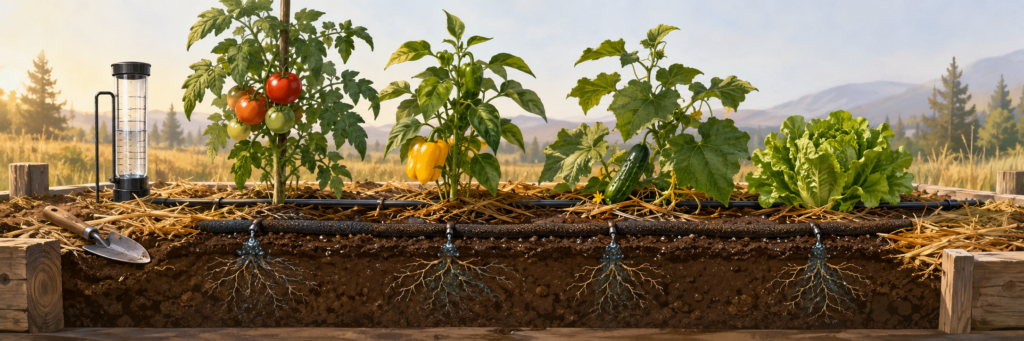
A watering can works well for targeted beds, but it can become labour-intensive when plants are large. A hose-end watering wand provides gentle flow, while drip irrigation and soaker hoses apply water slowly near the soil. Overhead sprinklers can cover a large area, but more water may be lost to wind and evaporation, and frequent wet foliage can encourage certain plant diseases.
The Best Time of Day to Water
Early morning is normally the best time to irrigate. Temperatures are cooler, wind is often lighter, and water has time to enter the soil before afternoon demand peaks. Foliage that becomes wet can also dry as the day warms.
Evening watering is acceptable when water is directed at the soil. Avoid repeatedly soaking leaves overnight, especially when plants are crowded or fungal diseases are already present. Drip lines, soaker hoses, and careful hand watering reduce that concern.
Midday is less efficient because evaporation is greater, but a dangerously dry plant should not be left suffering simply because the clock says it is the wrong time. Water the soil if the plant genuinely needs it. The “never water at midday” rule should not override an immediate need for moisture.
Mulch and Temporary Shade
A layer of organic mulch can substantially reduce evaporation while keeping the soil surface cooler. Straw, shredded leaves, untreated grass clippings, or other suitable organic materials can be spread several centimetres deep around vegetables. Leave a small gap around stems to avoid trapping constant moisture directly against plant tissue.
Mulch also limits weed growth, which matters during drought because weeds compete with vegetables for water. Check beneath the mulch before irrigating; the surface may appear dry while the protected soil remains moist. Mulch reduces watering frequency, but it does not eliminate the need to inspect the root zone.
Temporary shade cloth can help lettuce, recent transplants, and heat-sensitive crops survive extreme afternoon sun. Suspend it above the plants so air can move rather than draping material directly onto leaves. Too much permanent shade can reduce flowering and fruit production, so shade should solve a specific heat problem rather than become a substitute for adequate sunlight.
Using Water-Soluble Plant Food During Hot Weather
Water and fertilizer perform different jobs. Water maintains cell pressure, transports nutrients, supports photosynthesis, and cools the plant. Fertilizer supplies mineral nutrients, but those nutrients can only be used effectively when the root system is functioning and adequately hydrated.
Mixing water-soluble plant food in a watering can and filling it with a hose is a legitimate application method. The critical detail is concentration. “One scoop” is correct only if it is the scoop specified by that particular product and the watering can holds the volume stated on the label.
First determine the watering can’s actual capacity. A large can might hold 6, 8, or 10 litres, and using one scoop in each would create different concentrations. Use a level measurement, match it to the labelled water volume, and confirm whether the scoop has separate measurements on each end.
Adding the measured powder before filling can help the water movement dissolve it, but inspect the bottom for undissolved crystals. Stir if necessary and apply the solution evenly around the root zone. Do not place concentrated powder directly against stems or roots unless the product explicitly instructs that application.
If the package recommends feeding every 7 to 14 days, treat that as a labelled interval—not a reason to feed more frequently during a heat wave. More fertilizer does not make plants more drought-resistant. Excess nutrients can create salt buildup, injure roots, encourage excessive soft growth, and contaminate runoff.
Avoid feeding a severely wilted plant in bone-dry soil. Irrigate with plain water first and allow the plant to recover. Once the root zone is evenly moist and the plant is actively growing again, resume the normal labelled fertilization schedule.
Do not combine every watering with fertilizer unless the specific product is designed for that method. During extreme heat, a plant may need water more frequently while its nutrient requirement remains unchanged. Separating emergency irrigation from routine feeding prevents accidental overfertilization.
Should You Use the Same Fertilizer on Hedges?
Many all-purpose water-soluble fertilizers are labelled for shrubs, but that does not mean every hedge needs frequent feeding. A hedge growing normally in reasonably fertile soil may respond more to correct watering, mulch, sunlight, and pruning than to additional nitrogen.
Fertilizer can stimulate shoot growth, but faster growth is not automatically better privacy. Excessive nitrogen may produce long, soft shoots rather than dense branching, increase water demand, and create growth that is more vulnerable to pests or winter injury. Late-season feeding is particularly worth reconsidering in cold climates if it pushes tender new growth shortly before autumn.
When irrigating a hedge, distribute water through the root zone along both sides of the row rather than pouring it only at the trunks. Newly planted hedges need closer monitoring because their roots have not spread into the surrounding soil. Established hedges generally benefit from slower, deeper irrigation followed by time for the soil to partially dry.
If growth is poor despite adequate water, inspect soil drainage, light, root competition, pests, and pruning history before assuming that more fertilizer is the answer. A soil test can reveal whether nutrients or pH are actually limiting growth.
How Wildfire Smoke Affects Garden Plants
Wildfire smoke does not affect a garden in one simple way. Dense smoke can reduce the total sunlight reaching leaves, while scattered or diffuse light may penetrate deeper into a plant canopy. Smoke may also lower daytime temperature temporarily, reducing water loss compared with a clear, intensely sunny day.
At the same time, smoke contains fine particles and gases. Ozone and other pollutants can damage plant tissue at sufficient concentrations, while ash deposited heavily on leaves may interfere with light capture or normal gas exchange. The actual effect depends on the fire, pollutant concentration, distance, weather, crop, and duration of exposure.
A few smoky days will not necessarily ruin a healthy vegetable garden. Heat, drought, and inconsistent watering are often more immediate problems than the smoke itself. Do not increase irrigation simply because the sky looks smoky; check the soil and plant condition as usual.
Human safety comes first. When the local Air Quality Health Index or public-health guidance indicates unhealthy conditions, avoid prolonged outdoor gardening. Automatic timers, drip irrigation, or a brief essential watering session can keep plants alive without turning garden maintenance into unnecessary smoke exposure.
Visible ash requires caution because its composition may be unknown. Ash from vegetation is different from residue produced when buildings, vehicles, plastics, treated wood, or other manufactured materials burn. Do not deliberately work dry ash into garden soil as fertilizer.
Wait until air quality improves before cleaning plants or outdoor surfaces. Avoid dry sweeping or using a leaf blower, which can send particles back into the air. A gentle rinse can remove light deposits from sturdy plants, but that rinse should not be confused with the slow, deep watering needed by roots.
Wash harvested produce thoroughly under clean running water. Remove damaged outer leaves and avoid eating produce that cannot be cleaned adequately or may have been contaminated by nearby structural-fire debris. When contamination is substantial or its source is uncertain, follow local public-health or environmental guidance.
A Practical Heat-Wave Watering Plan
Before extreme heat arrives, water the garden deeply if the soil needs it, replenish mulch, repair leaking hoses, and confirm that drip emitters are working. Harvest ripe vegetables so the plant is not maintaining fruit that is already ready to eat.
During the heat wave, check containers and shallow-rooted crops every morning. Inspect in-ground soil rather than relying entirely on wilted leaves. Prioritize new plantings, fruiting vegetables, corn at silking, and valuable trees or shrubs.
Pause transplanting, heavy pruning, and unnecessary fertilization while plants are severely stressed. After temperatures moderate, inspect for damage, return gradually to the normal watering schedule, and resume feeding only when plants are hydrated and actively growing.
Summer garden care is not about pouring on the greatest possible amount of water or fertilizer. It is about maintaining steady conditions in an unstable season. Check beneath the surface, soak the root zone, protect the soil with mulch, and let the plant’s growth stage determine what receives priority.
Wildfire smoke may complicate the situation, but it does not change the basic hierarchy: protect yourself, inspect the soil, water according to need, and avoid forcing growth from a plant that is already under stress. A thoughtful watering routine will do more for a summer garden than any emergency scoop of fertilizer.
- University of Minnesota Extension: Watering the Vegetable Garden — Learn how soil type, mulch, rainfall, and root-zone moisture determine when a vegetable garden needs water.
- Oregon State University Extension: Garden Produce and Wildfires — Find safety guidance for working around wildfire smoke and handling garden produce exposed to smoke or ash.
wow I never knew it mattered so much what time of day you water plants. Makes sense though, early morning watering is best, midday is no good because of evaporation and evening is okay but increases chance of disease due to the moisture not having the sun to evaporate.